Al-Sadi Abdullah M, Al-Oweisi Fatma A, Edwards Simon G, Al-Nadabi Hamed, Al-Fahdi Ahmed M
Department of Crop Sciences, College of Agricultural and Marine Sciences, Sultan Qaboos University, Muscat, Oman.
Royal Court Affairs, Seeb, Oman.
BMC Microbiol. 2015 Jul 28;15:147. doi: 10.1186/s12866-015-0483-8.
Trichoderma is one of the most common fungi in soil. However, little information is available concerning the diversity of Trichoderma in soil with no previous history of cultivation. This study was conducted to investigate the most common species and the level of genetic relatedness of Trichoderma species from uncultivated soil in relation to cultivated soil and potting media.
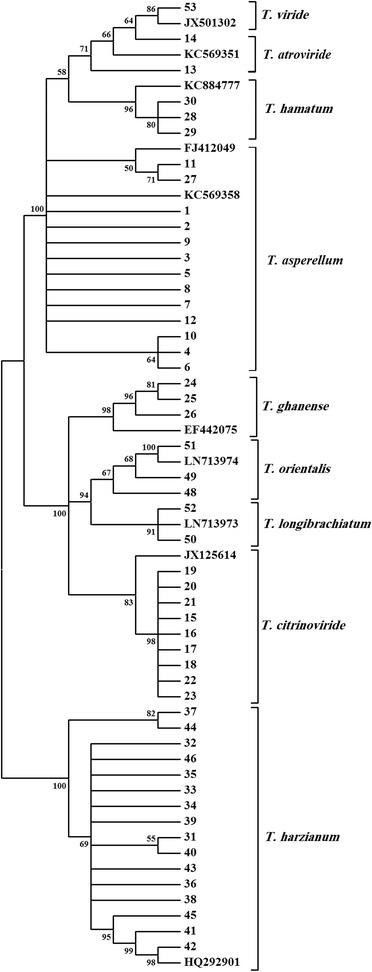
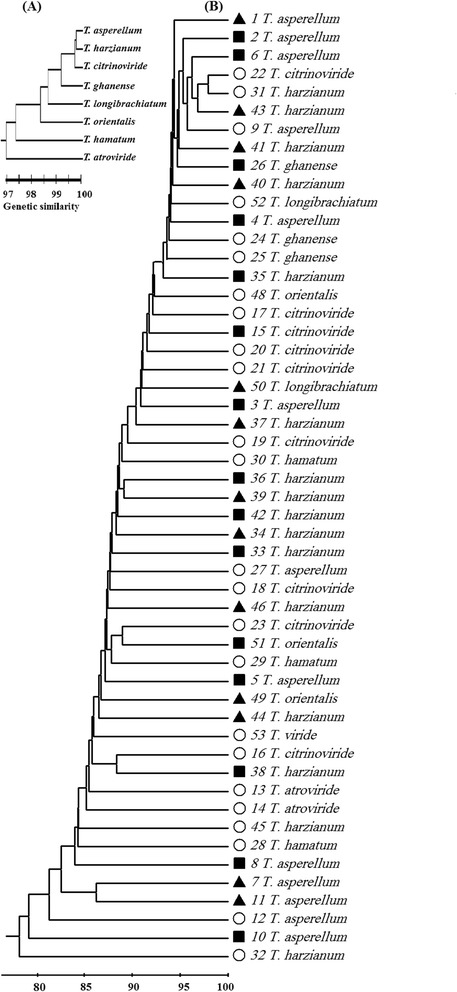
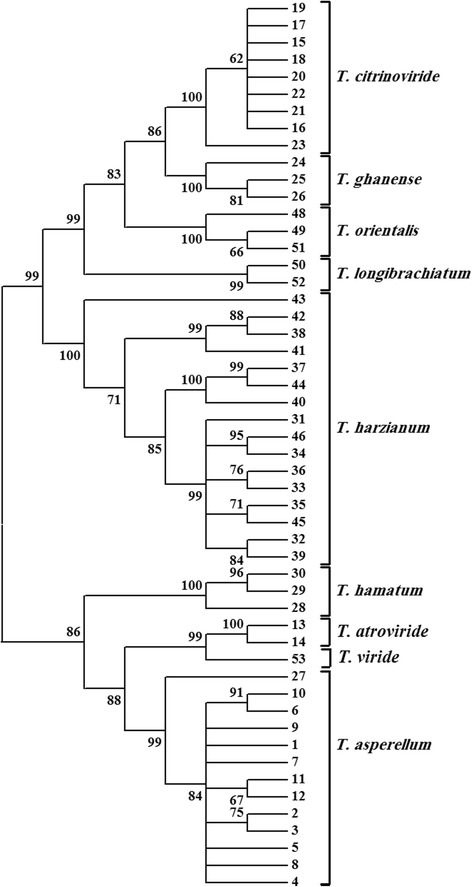
A total of 24, 15 and 13 Trichoderma isolates were recovered from 84 potting media samples, 45 cultivated soil samples and 65 uncultivated soil samples, respectively. Analysis based on the internal transcribed spacer region of the ribosomal RNA (rRNA) and the translation elongation factor gene (EF1) indicated the presence of 9 Trichoderma species: T. harzianum (16 isolates), T. asperellum (13), T. citrinoviride (9), T. orientalis (3), T. ghanense (3), T. hamatum (3), T. longibrachiatum (2), T. atroviride (2), and T. viride (1). All species were found to occur in potting media samples, while five Trichoderma species were recovered from the cultivated soils and four from the uncultivated soils. AFLP analysis of the 52 Trichoderma isolates produced 52 genotypes and 993 polymorphic loci. Low to moderate levels of genetic diversity were found within populations of Trichoderma species (H = 0.0780 to 0.2208). Analysis of Molecular Variance indicated the presence of very low levels of genetic differentiation (Fst = 0.0002 to 0.0139) among populations of the same Trichoderma species obtained from the potting media, cultivated soil and uncultivated soil.
The study provides evidence for occurrence of Trichoderma isolates in soil with no previous history of cultivation. The lack of genetic differentiation among Trichoderma populations from potting media, cultivated soil and uncultivated soil suggests that some factors could have been responsible for moving Trichoderma propagules among the three substrates. The study reports for the first time the presence of 4 Trichoderma species in Oman: T. asperellum, T. ghanense, T. longibrachiatum and T. orientalis.
木霉是土壤中最常见的真菌之一。然而,关于从未耕种过的土壤中木霉的多样性,目前所知甚少。本研究旨在调查从未耕种过的土壤中木霉的常见种类及其与耕种土壤和盆栽基质中木霉种类的遗传相关性水平。
分别从84份盆栽基质样品、45份耕种土壤样品和65份未耕种土壤样品中分离出24株、15株和13株木霉。基于核糖体RNA(rRNA)的内部转录间隔区和翻译延伸因子基因(EF1)的分析表明,存在9种木霉:哈茨木霉(16株)、棘孢木霉(13株)、黄绿木霉(9株)、东方木霉(3株)、加纳木霉(3株)、钩状木霉(3株)、长枝木霉(2株)、深绿木霉(2株)和绿色木霉(1株)。所有种类均在盆栽基质样品中被发现,而在耕种土壤中分离出5种木霉,在未耕种土壤中分离出4种木霉。对52株木霉分离株进行AFLP分析,产生了52种基因型和993个多态性位点。在木霉种群中发现了低到中等水平的遗传多样性(H = 0.0780至0.2208)。分子方差分析表明,从盆栽基质、耕种土壤和未耕种土壤中获得的同一木霉种群之间存在极低水平的遗传分化(Fst = 0.0002至0.0139)。
该研究为从未耕种过的土壤中存在木霉分离株提供了证据。盆栽基质、耕种土壤和未耕种土壤中的木霉种群缺乏遗传分化,这表明某些因素可能导致木霉繁殖体在这三种基质之间移动。该研究首次报道了阿曼存在4种木霉:棘孢木霉、加纳木霉、长枝木霉和东方木霉。