Lindberg Patricia, Koller Michael, Steinger Brunhilde, Lorenz Wilfried, Wyatt Jeremy C, Inwald Elisabeth C, Klinkhammer-Schalke Monika
Tumor Center Regensburg e.V., An-Institute of the University of Regensburg, Regensburg, Germany.
Center for Clinical Trials, University Hospital Regensburg, Regensburg, Germany.
BMC Cancer. 2015 Jul 29;15:554. doi: 10.1186/s12885-015-1573-6.
Little is known about the subjective experience of breast cancer survivors after primary treatment. However, these experiences are important because they shape their communication about their illness in everyday life, usage and acceptance of healthcare, and expectations of new generations of patients. The present study investigated this topic by combining qualitative and quantitative methods.
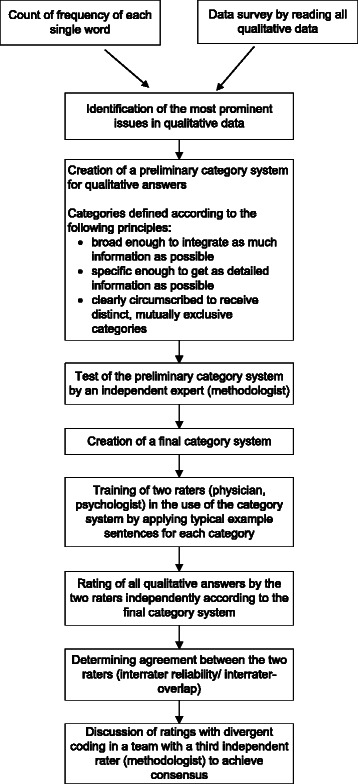
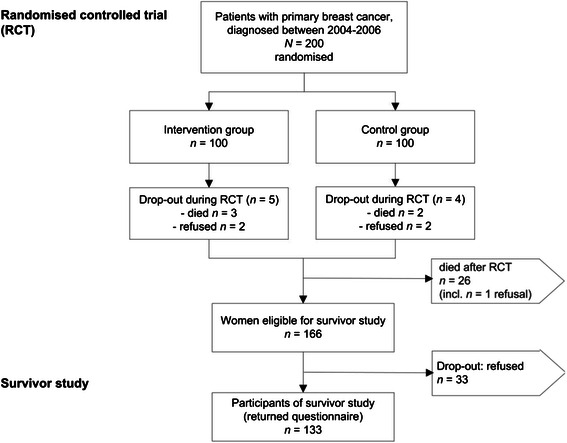
Breast cancer survivors in Bavaria, Germany were mailed a questionnaire up to seven years after enrolment into a randomised controlled clinical trial and start of their therapy. This enquired about their worst experiences during the breast cancer episode, positive aspects of the illness and any advice they would give to newly diagnosed patients. A category system for themes was systematically created and answers were categorised by two independent raters. Frequencies of key categories were then quantitatively analysed using descriptive statistics. In addition, local treating physicians gave their opinion on the response categories chosen by their patients.
133 (80%) of 166 eligible patients who survived up to seven years returned the questionnaire. The most prominent worst experience reported by survivors was psychological distress (i.e. anxiety, uncertainty; prevalence 38%) followed by chemotherapy (25%), and cancer diagnosis (18%). Positive aspects of the illness were reported by 48% with the most frequent including change in life priorities (50%) and social support (22%). The most frequent advice survivors gave was fighting spirit (i.e. think positive, never give up; prevalence 42%). Overall, physicians' estimates of the frequency of these responses corresponded well with survivors' answers.
Although physicians' understanding of breast cancer patients was good, psychological distress and chemotherapy-related side effects were remembered as particularly burdensome by a substantial part of survivors. On the one hand, patients' quality of life needs to be assessed repeatedly during medical follow-up to identify such specific complaints also including specific recommendations to the physician for targeted psychosocial and medical support. On the other hand the advices and positive aspects of the disease, reported by the survivors, can be used to promote positive ways of coping with the illness.
对于乳腺癌幸存者在接受初始治疗后的主观体验,我们了解甚少。然而,这些体验很重要,因为它们塑造了幸存者在日常生活中关于自身疾病的交流方式、对医疗保健的使用和接受情况以及对新一代患者的期望。本研究通过结合定性和定量方法对这一主题进行了调查。
在德国巴伐利亚州,乳腺癌幸存者在入选一项随机对照临床试验并开始治疗后的七年内向其邮寄了一份问卷。问卷询问了她们在乳腺癌患病期间最糟糕的经历、疾病的积极方面以及她们会给新确诊患者的任何建议。系统地创建了一个主题分类系统,并由两名独立评分者对答案进行分类。然后使用描述性统计对关键类别的频率进行定量分析。此外,当地的主治医生对其患者选择的回答类别发表了意见。
166名存活长达七年的 eligible 患者中有133名(80%)返回了问卷。幸存者报告的最突出的糟糕经历是心理困扰(即焦虑、不确定性;患病率38%),其次是化疗(25%)和癌症诊断(18%)。48%的患者报告了疾病的积极方面,最常见的包括生活优先级的改变(50%)和社会支持(22%)。幸存者给出的最常见建议是斗志(即积极思考,永不放弃;患病率42%)。总体而言,医生对这些回答频率的估计与幸存者的答案相当吻合。
尽管医生对乳腺癌患者的了解较好,但相当一部分幸存者认为心理困扰和化疗相关的副作用特别沉重。一方面,在医学随访期间需要反复评估患者的生活质量,以识别此类具体抱怨,还包括向医生提出针对性心理社会和医疗支持的具体建议。另一方面,幸存者报告的疾病建议和积极方面可用于促进应对疾病的积极方式。