Koo Ja-Won, Quintanilla-Dieck Lourdes, Jiang Meiyan, Liu Jianping, Urdang Zachary D, Allensworth Jordan J, Cross Campbell P, Li Hongzhe, Steyger Peter S
Oregon Hearing Research Center, Department of Otolaryngology, Oregon Health & Science University, 3181 Southwest Sam Jackson Park Road, Portland, OR 97239, USA. Department of Otorhinolaryngology, Seoul National University College of Medicine, Seoul National University Bundang Hospital, 173-82 Kumiro, Bundang-gu, Seongnam 463-707, Republic of Korea.
Oregon Hearing Research Center, Department of Otolaryngology, Oregon Health & Science University, 3181 Southwest Sam Jackson Park Road, Portland, OR 97239, USA.
Sci Transl Med. 2015 Jul 29;7(298):298ra118. doi: 10.1126/scitranslmed.aac5546.
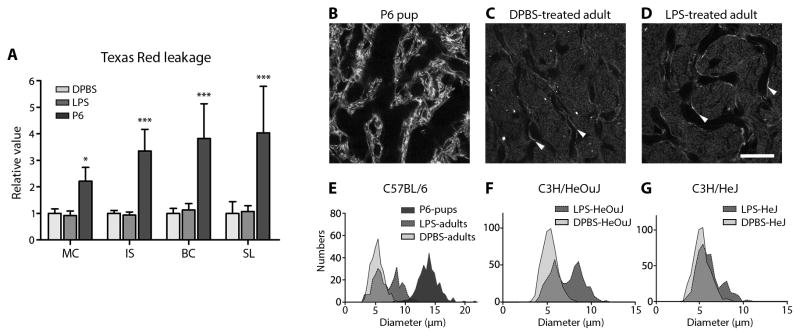
The ototoxic aminoglycoside antibiotics are essential to treat severe bacterial infections, particularly in neonatal intensive care units. Using a bacterial lipopolysaccharide (LPS) experimental model of sepsis, we tested whether LPS-mediated inflammation potentiates cochlear uptake of aminoglycosides and permanent hearing loss in mice. Using confocal microscopy and enzyme-linked immunosorbent assays, we found that low-dose LPS (endotoxemia) greatly increased cochlear concentrations of aminoglycosides and resulted in vasodilation of cochlear capillaries without inducing paracellular flux across the blood-labyrinth barrier (BLB) or elevating serum concentrations of the drug. Additionally, endotoxemia increased expression of both serum and cochlear inflammatory markers. These LPS-induced changes, classically mediated by Toll-like receptor 4 (TLR4), were attenuated in TLR4-hyporesponsive mice. Multiday dosing with aminoglycosides during chronic endotoxemia induced greater hearing threshold shifts and sensory cell loss compared to mice without endotoxemia. Thus, endotoxemia-mediated inflammation enhanced aminoglycoside trafficking across the BLB and potentiated aminoglycoside-induced ototoxicity. These data indicate that patients with severe infections are at greater risk of aminoglycoside-induced hearing loss than previously recognized.
耳毒性氨基糖苷类抗生素对于治疗严重细菌感染至关重要,尤其是在新生儿重症监护病房。我们使用脓毒症的细菌脂多糖(LPS)实验模型,测试了LPS介导的炎症是否会增强小鼠耳蜗对氨基糖苷类药物的摄取以及导致永久性听力损失。通过共聚焦显微镜和酶联免疫吸附测定,我们发现低剂量LPS(内毒素血症)极大地增加了耳蜗中氨基糖苷类药物的浓度,并导致耳蜗毛细血管扩张,而不会诱导药物通过血迷路屏障(BLB)的细胞旁通量增加或提高血清药物浓度。此外,内毒素血症增加了血清和耳蜗炎症标志物的表达。这些由Toll样受体4(TLR4)经典介导的LPS诱导的变化,在TLR4低反应性小鼠中减弱。与没有内毒素血症的小鼠相比,慢性内毒素血症期间多日给予氨基糖苷类药物会导致更大的听力阈值变化和感觉细胞损失。因此,内毒素血症介导的炎症增强了氨基糖苷类药物跨BLB的转运,并增强了氨基糖苷类药物诱导的耳毒性。这些数据表明,严重感染患者发生氨基糖苷类药物所致听力损失的风险比之前认识到的更高。