Ito Rika, Fukui Tomoyasu, Hayashi Toshiyuki, Osamura Anna, Ohara Makoto, Hara Noriko, Higuchi Akiko, Yamamoto Takeshi, Hirano Tsutomu
Division of Diabetes, Metabolism, and Endocrinology, Department of Medicine, Showa University School of Medicine, 1-5-8 Hatanodai, Shinagawa-ku, Tokyo, 142-8666, Japan,
Drugs R D. 2015 Sep;15(3):245-51. doi: 10.1007/s40268-015-0096-6.
It remains unknown whether dipeptidyl peptidase-4 (DPP-4) inhibitors improve early-phase insulin secretion in Japanese patients with type 2 diabetes (T2D), a disease characterized by impaired insulin secretion. We investigated the changes in insulin secretion before and after treatment with the DPP-4 inhibitor teneligliptin in patients with T2D with a low insulinogenic index (IGI) determined by the oral glucose tolerance test (OGTT).
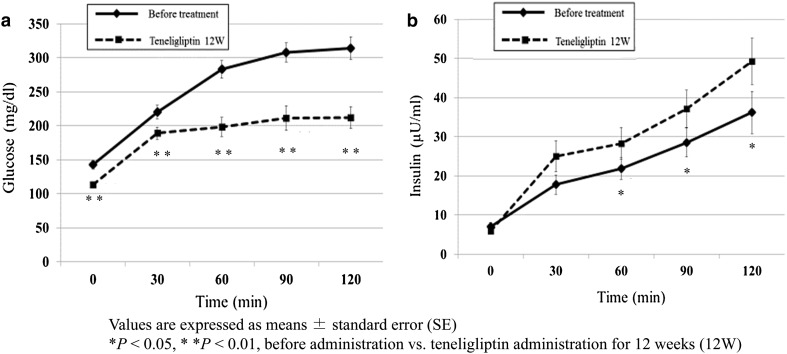
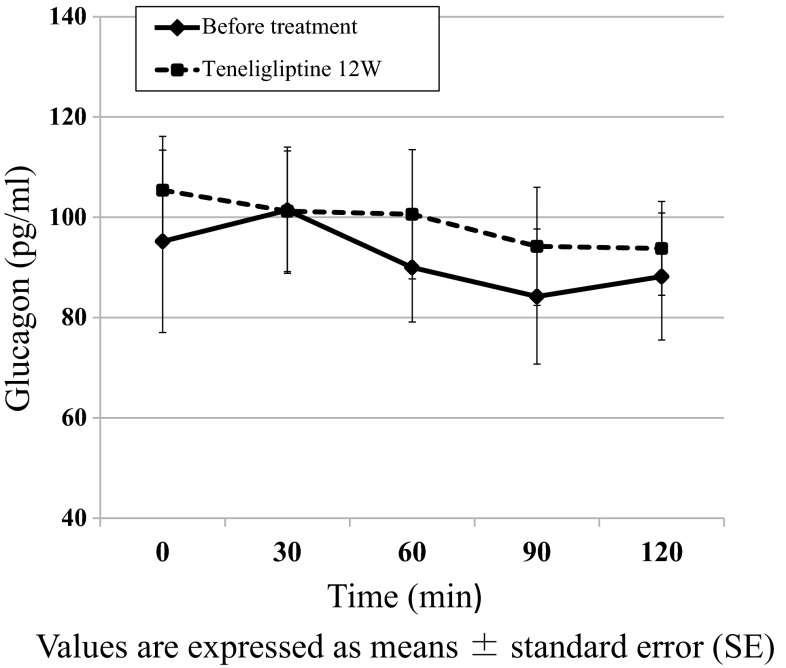
An open-label, prospective clinical study was conducted. Thirteen drug-naïve patients (mean age 55.5 ± 3.9 years) with T2D underwent OGTT before and after teneligliptin 20 mg/day monotherapy. Plasma levels of glucose (PG), insulin, and C-peptide were measured at 0, 30, 60, 90, and 120 min after glucose loading in the OGTT. Homeostasis model assessment (HOMA)-β, IGI, and the total or incremental area under the curve (AUC) for PG and insulin were measured. AUC120min for the secretory units of islets in transplantation (SUIT) index was also measured.
HbA1c significantly decreased from 8.3 ± 0.4% at baseline to 6.3 ± 0.2% after 12 weeks of teneligliptin treatment (p < 0.05). Incremental AUC120min PG also significantly decreased, and β-cell function assessed by IGI30min, AUC120min insulin, and the AUC120min SUIT index significantly increased (0.16 ± 0.05 vs. 0.28 ± 0.06, 2692 ± 333 µU·2h/mL vs. 3537 ± 361 µU·2h/mL, and 4261 ± 442 vs. 8290 ± 1147, respectively; all p < 0.05). HOMA-β was unchanged. The reduction in incremental AUC120min PG was significantly associated with the augmentation of IGI30min and the AUC120min SUIT index. No severe adverse events were observed.
Twelve weeks of teneligliptin treatment improved IGI30min, AUC120min, and the SUIT index in drug-naïve Japanese patients with T2D.
二肽基肽酶-4(DPP-4)抑制剂是否能改善日本2型糖尿病(T2D)患者的早期胰岛素分泌仍不清楚,2型糖尿病的特征是胰岛素分泌受损。我们研究了口服葡萄糖耐量试验(OGTT)测定的胰岛素生成指数(IGI)较低的T2D患者在使用DPP-4抑制剂替格列汀治疗前后胰岛素分泌的变化。
进行了一项开放标签的前瞻性临床研究。13例初治T2D患者(平均年龄55.5±3.9岁)在接受20mg/天替格列汀单药治疗前后进行了OGTT。在OGTT葡萄糖负荷后0、30、60、90和120分钟测量血浆葡萄糖(PG)、胰岛素和C肽水平。测量稳态模型评估(HOMA)-β、IGI以及PG和胰岛素的曲线下总面积或增量面积(AUC)。还测量了移植胰岛分泌单位(SUIT)指数的AUC120min。
替格列汀治疗12周后,糖化血红蛋白(HbA1c)从基线时的8.3±0.4%显著降至6.3±0.2%(p<0.05)。增量AUC120min PG也显著降低,通过IGI30min、AUC120min胰岛素和AUC120min SUIT指数评估的β细胞功能显著增加(分别为0.16±0.05对0.28±0.06、2692±333μU·2h/mL对3537±361μU·2h/mL、4261±442对8290±1147;均p<0.05)。HOMA-β无变化。增量AUC120min PG的降低与IGI30min和AUC120min SUIT指数的增加显著相关。未观察到严重不良事件。
12周的替格列汀治疗改善了初治日本T2D患者的IGI30min、AUC120min和SUIT指数。