Agarwal Piyush, Jindal Chhavi, Sapakal Vinayak
Department of Medical Services, Glenmark Pharmaceuticals Limited, Mumbai, Maharashtra, India.
Indian J Endocrinol Metab. 2018 Jan-Feb;22(1):41-46. doi: 10.4103/ijem.IJEM_97_16.
This study evaluated the efficacy and safety of teneligliptin in patients with inadequately controlled type 2 diabetes mellitus (T2DM).
This was a randomized, doubleblind, placebocontrolled, parallelgroup, multicenter, Phase III study.
Patients with T2DM and inadequate glycemic control (glycosylated hemoglobin [HbA1c]: >7.0-≤8.5%) were enrolled. Patients were randomly assigned (ratio: 2:1) to receive teneligliptin 20 mg (Glenmark) or placebo. The primary efficacy variable was change from baseline in HbA1c at week 16. Additional analyses included the proportion of patients who achieved target of HbA1c ≤7.0%, changes in fasting plasma glucose (FPG), and postprandial glucose (PPG).
Mean change in HbA1c was analyzed using an analysis of covariance model, least square (LS) means, 95% confidence intervals (CIs), and values were calculated.
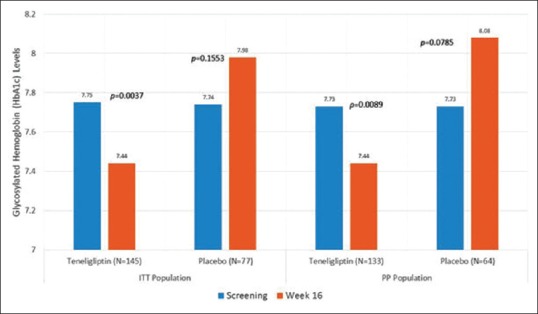
Overall, 237 patients were included. Patients of the teneligliptin group showed reduced HbA1c levels (LS mean difference = -0.304% for intent-to-treat [ITT]; -0.291% for per-protocol (PP) populations) after 16 weeks of treatment, and a statistically significant difference was observed between the ITT (LS mean difference = 0.555; 95% CI: 0.176-0.934; = 0.0043) and PP populations (LS mean difference = 0.642; 95% CI: 0.233-1.052; = 0.0023). Target HbA1c level was achieved by a greater proportion of teneligliptin group patients (ITT, 43.4%; PP, 43.6%) than placebo group patients (ITT, 27.3%; PP, 26.6%). Reduction in FPG levels was observed in ITT (LS mean difference: 8.829; 95% CI: -4.357-22.016; = 0.1883) and PP populations (LS mean difference: 11.710 mg/dL; 95% CI: -2.893-26.312; = 0.1154). Reduction in PPG levels was higher in teneligliptin group than placebo group in both ITT (LS mean difference = 25.849 mg/dL; 95% CI: 7.143-44.556; = 0.0070) and PP populations (LS mean difference = 25.683 mg/dL; 95% CI: 5.830-45.536; = 0.0115). Overall, 44 patients (18.6%) experienced at least one adverse event. Three or more hypoglycemic events were experienced by 2.5% patients of teneligliptin group and none in placebo group.
Treatment with once-daily teneligliptin led to statistically significant and clinically meaningful reductions in HbA1c and PPG, and was well tolerated in Indian patients with T2DM.
本研究评估了替奈利肽对2型糖尿病(T2DM)控制不佳患者的疗效和安全性。
这是一项随机、双盲、安慰剂对照、平行组、多中心的III期研究。
纳入T2DM且血糖控制不佳(糖化血红蛋白[HbA1c]:>7.0%至≤8.5%)的患者。患者被随机分配(比例为2:1)接受替奈利肽20mg(Glenmark)或安慰剂治疗。主要疗效变量为第16周时HbA1c相对于基线的变化。额外分析包括达到HbA1c≤7.0%目标的患者比例、空腹血糖(FPG)和餐后血糖(PPG)的变化。
使用协方差分析模型、最小二乘(LS)均值分析HbA1c的平均变化,计算95%置信区间(CI)和P值。
总共纳入了237名患者。替奈利肽组患者在治疗16周后HbA1c水平降低(意向性分析[ITT]的LS平均差值=-0.304%;符合方案集[PP]人群的LS平均差值=-0.291%),ITT人群(LS平均差值=0.555;95%CI:0.176 - 0.934;P = 0.0043)和PP人群(LS平均差值=0.642;95%CI:0.233 - 1.052;P = 0.0023)之间观察到具有统计学意义的差异。达到目标HbA1c水平的替奈利肽组患者比例(ITT为%,PP为43.6%)高于安慰剂组患者(ITT为27.3%,PP为26.6%)。在ITT人群(LS平均差值:8.829;95%CI:-4.357 - 22.016;P = 0.1883)和PP人群(LS平均差值:11.710mg/dL;95%CI:-2.893 - 26.312;P = 0.1154)中观察到FPG水平降低。在ITT人群(LS平均差值=25.849mg/dL;95%CI:7.143 - 44.556;P = 0.0070)和PP人群(LS平均差值=25.683mg/dL;95%CI:5.830 - 45.536;P = 0.0115)中,替奈利肽组的PPG水平降低幅度均高于安慰剂组。总体而言,44名患者(18.6%)经历了至少一次不良事件。替奈利肽组2.5%的患者经历了3次或更多次低血糖事件,而安慰剂组无此情况。
每日一次使用替奈利肽治疗可使HbA1c和PPG在统计学上显著降低且具有临床意义,并且在印度T2DM患者中耐受性良好。