Kim Backki, Kim Dong-Gwan, Lee Gileung, Seo Jeonghwan, Choi Ik-Young, Choi Beom-Soon, Yang Tae-Jin, Kim Kwang Soo, Lee Joohyun, Chin Joong Hyoun, Koh Hee-Jong
Department of Plant Science, Research Institute for Agriculture and Life Sciences, and Plant Genomics and Breeding Institute, Seoul National University, Seoul, 151-921, South Korea,
Rice (N Y). 2014 Dec;7(1):22. doi: 10.1186/s12284-014-0022-5. Epub 2014 Sep 14.
Tongil (IR667-98-1-2) rice, developed in 1972, is a high-yield rice variety derived from a three-way cross between indica and japonica varieties. Tongil contributed to the self-sufficiency of staple food production in Korea during a period known as the 'Korean Green Revolution'. We analyzed the nucleotide-level genome structure of Tongil rice and compared it to those of the parental varieties.
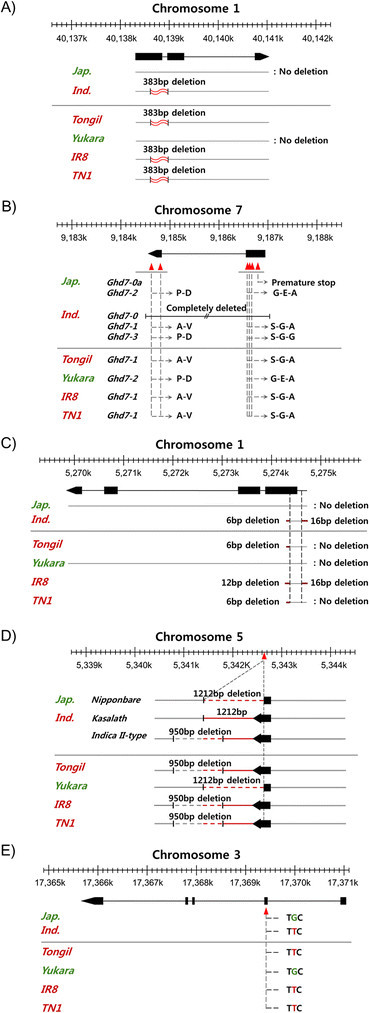
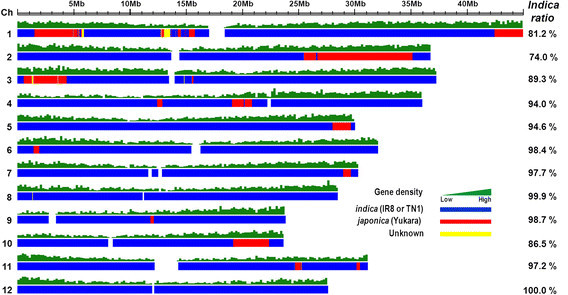
A total of 17.3 billion Illumina Hiseq reads, 47× genome coverage, were generated for Tongil rice. Three parental accessions of Tongil rice, two indica types and one japonica type, were also sequenced at approximately 30x genome coverage. A total of 2,149,991 SNPs were detected between Tongil and Nipponbare varieties. The average SNP frequency of Tongil was 5.77 per kb. Genome composition was determined based on SNP data by comparing Tongil with three parental genome sequences using the sliding window approach. Analyses revealed that 91.8% of the Tongil genome originated from the indica parents and 7.9% from the japonica parent. Copy numbers of SSR motifs, ORF gene distribution throughout the whole genome, gene ontology (GO) annotation, and some yield-related QTLs or gene locations were also comparatively analyzed between Tongil and parental varieties using sequence-based tools. Each genetic factor was transferred from the parents into Tongil rice in amounts that were in proportion to the whole genome composition.
Tongil was derived from a three-way cross among two indica and one japonica varieties. Defining the genome structure of Tongil rice demonstrates that the Tongil genome is derived primarily from the indica genome with a small proportion of japonica genome introgression. Comparative gene distribution, SSR, GO, and yield-related gene analysis support the finding that the Tongil genome is primarily made up of the indica genome.
统一(IR667 - 98 - 1 - 2)水稻于1972年育成,是一种通过籼稻和粳稻品种三交培育出的高产水稻品种。在被称为“韩国绿色革命”的时期,统一水稻为韩国主食生产的自给自足做出了贡献。我们分析了统一水稻的核苷酸水平基因组结构,并将其与亲本品种的基因组结构进行了比较。
为统一水稻生成了总计173亿条Illumina Hiseq reads,基因组覆盖率达47倍。统一水稻的三个亲本材料,两个籼稻类型和一个粳稻类型,也进行了测序,基因组覆盖率约为30倍。在统一水稻和日本晴品种之间共检测到2149991个单核苷酸多态性(SNP)。统一水稻的平均SNP频率为每千碱基5.77个。通过使用滑动窗口方法将统一水稻与三个亲本基因组序列进行比较,基于SNP数据确定了基因组组成。分析表明,统一水稻基因组的91.8%源自籼稻亲本,7.9%源自粳稻亲本。还使用基于序列的工具对统一水稻和亲本品种之间的简单序列重复(SSR)基序的拷贝数、全基因组的开放阅读框(ORF)基因分布、基因本体(GO)注释以及一些与产量相关的数量性状位点(QTL)或基因位置进行了比较分析。每个遗传因子从亲本转移到统一水稻中的量与整个基因组组成成比例。
统一水稻源自两个籼稻品种和一个粳稻品种的三交。确定统一水稻的基因组结构表明,统一水稻基因组主要源自籼稻基因组,有一小部分粳稻基因组渗入。比较基因分布、SSR、GO和与产量相关的基因分析支持了统一水稻基因组主要由籼稻基因组组成这一发现。