Kishor D S, Seo Jeonghwan, Chin Joong Hyoun, Koh Hee-Jong
Department of Plant Science, Plant Genomics and Breeding Institute, and Research Institute of Agriculture and Life Science, Seoul National University, Seoul, South Korea.
Department of Integrative Bio-industrial Engineering, Sejong University, Seoul, South Korea.
Front Genet. 2020 Feb 21;11:86. doi: 10.3389/fgene.2020.00086. eCollection 2020.
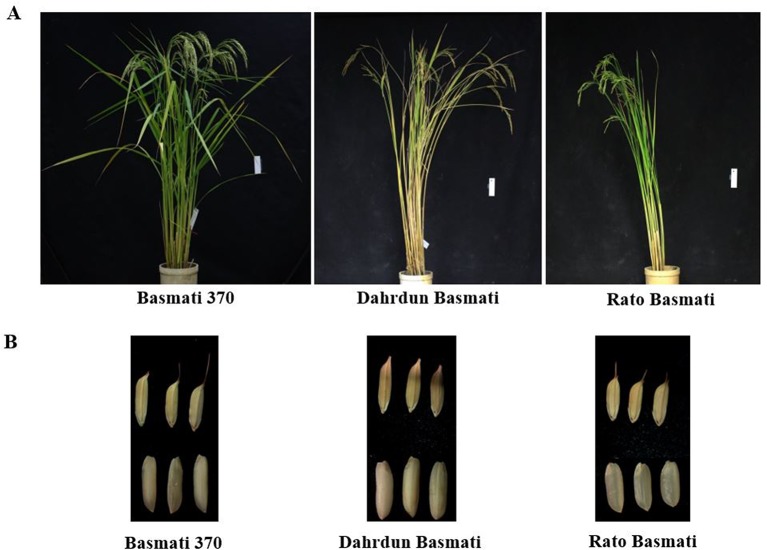
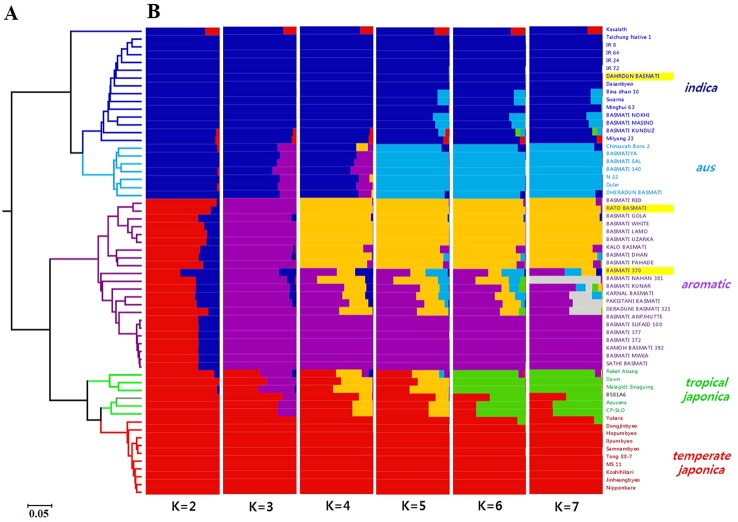
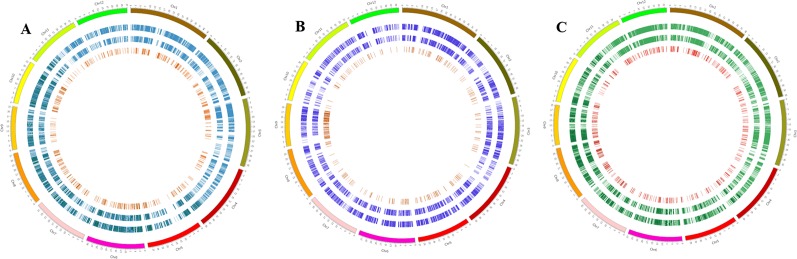
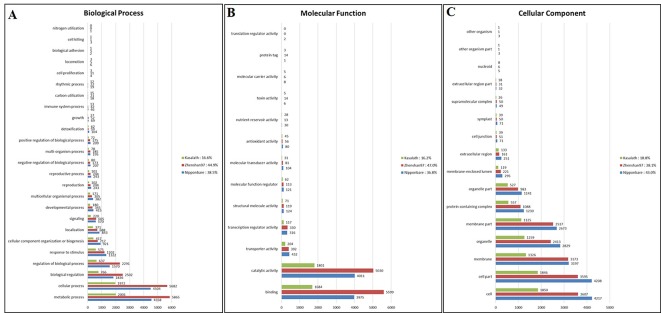
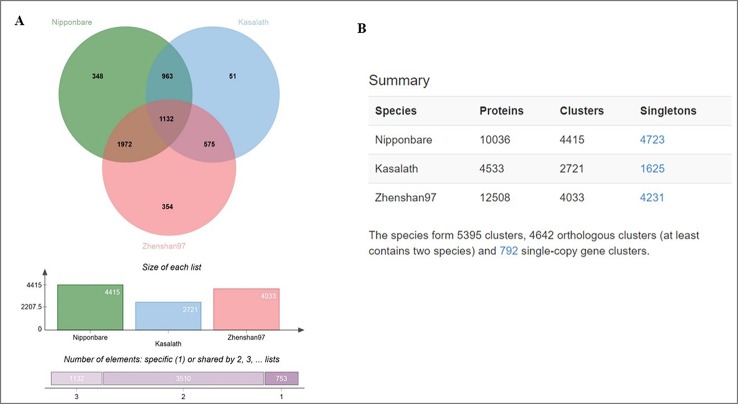
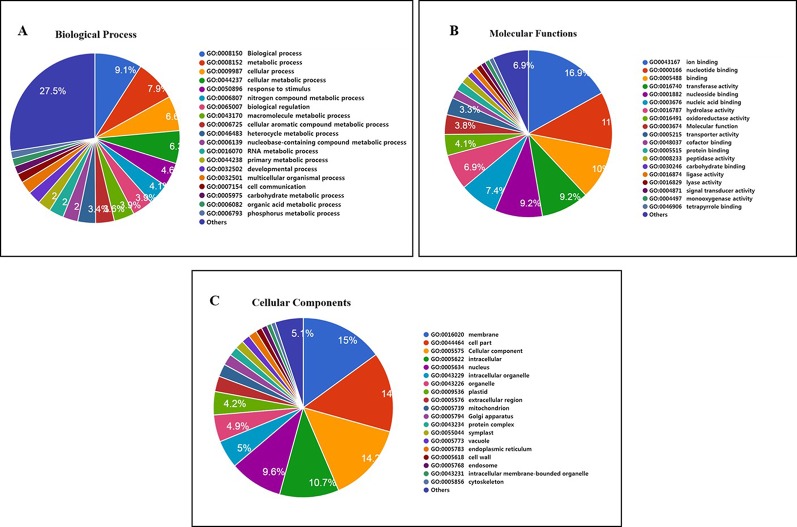
Basmati is considered a unique varietal group of rice ( L.) because of its aroma and superior grain quality. Previous genetic analyses of rice showed that most of the Basmati varieties are classified into the group. Despite various efforts, genomic relationship of Basmati rice with other varietal groups and genomic variation in Basmati rice are yet to be understood. In the present study, we resequenced the whole genome of three traditional Basmati varieties at a coverage of more than 25X using Illumina HiSeq2500 and mapped the obtained sequences to the reference genome sequences of Nipponbare ( rice), Kasalath ( rice), and Zhenshan 97 ( rice). Comparison of these sequences revealed common single nucleotide polymorphisms (SNPs) in the genic regions of three Basmati varieties. Analysis of these SNPs revealed that Basmati varieties showed fewer sequence variations compared with the group than with the and groups. Gene ontology (GO) enrichment analysis indicated that SNPs were present in genes with various biological, molecular, and cellular functions. Additionally, functional annotation of the Basmati mutated gene cluster shared by Nipponbare, Kasalath, and Zhenshan 97 was found to be associated with the metabolic process involved in the cellular aromatic compound, suggesting that aroma is an important specific genomic feature of Basmati varieties. Furthermore, 30 traditional Basmati varieties were classified into three different groups, (22 varieties), (four varieties), and (four varieties), based on genome-wide SNPs. All 22 Basmati varieties harbored the fragrant-inducing allele. We also performed comparative analysis of 13 key agronomic and grain quality traits of Basmati rice and other rice varieties. Three traits including length-to-width ratio of grain (L/W ratio), panicle length (PL), and amylose content (AC) showed significant ( < 0.05 and < 0.01) differences between the and / groups. Comparative analysis of genome structure, based on genome sequence variation and GO analysis, revealed that the Basmati genome was derived mostly from the and groups. Overall, whole-genome sequence data and genetic diversity information obtained in this study will serve as an important resource for molecular breeding and genetic analysis of Basmati varieties.
由于其香气和优良的谷物品质,巴斯马蒂大米被认为是一个独特的水稻品种群。先前对水稻的遗传分析表明,大多数巴斯马蒂品种被归类为 组。尽管做出了各种努力,但巴斯马蒂大米与其他品种群的基因组关系以及巴斯马蒂大米的基因组变异仍有待了解。在本研究中,我们使用Illumina HiSeq2500对三个传统巴斯马蒂品种的全基因组进行了重测序,覆盖度超过25倍,并将获得的序列映射到日本晴(水稻)、卡萨拉斯(水稻)和珍汕97(水稻)的参考基因组序列上。这些序列的比较揭示了三个巴斯马蒂品种基因区域中的常见单核苷酸多态性(SNP)。对这些SNP的分析表明,与 组相比,巴斯马蒂品种与 组和 组相比显示出更少的序列变异。基因本体(GO)富集分析表明,SNP存在于具有各种生物学、分子和细胞功能的基因中。此外,发现日本晴、卡萨拉斯和珍汕97共有的巴斯马蒂突变基因簇的功能注释与细胞芳香化合物的代谢过程有关,这表明香气是巴斯马蒂品种的一个重要的特定基因组特征。此外,根据全基因组SNP,30个传统巴斯马蒂品种被分为三个不同的组, (22个品种)、 (4个品种)和 (4个品种)。所有22个 巴斯马蒂品种都含有诱导香味的 等位基因。我们还对巴斯马蒂大米和其他水稻品种的13个关键农艺和谷物品质性状进行了比较分析。包括谷粒长宽比(L/W比)、穗长(PL)和直链淀粉含量(AC)在内的三个性状在 组和 / 组之间表现出显著( < 0.05和 < 0.01)差异。基于基因组序列变异和GO分析的基因组结构比较分析表明,巴斯马蒂基因组主要来自 组和 组。总体而言,本研究中获得的全基因组序列数据和遗传多样性信息将作为巴斯马蒂品种分子育种和遗传分析的重要资源。