Kwan Saskia, Boudes Elodie, Benseler Anouk, Gilbert Guillaume, Saint-Martin Christine, Shevell Michael, Wintermark Pia
Division of Newborn Medicine, Department of Pediatrics, Montreal Children's Hospital, McGill University, Montreal, QC, Canada H3H 1P3.
MR Clinical Science, Philips Healthcare, Montreal, QC, Canada H2S 2J3.
Neural Plast. 2015;2015:653727. doi: 10.1155/2015/653727. Epub 2015 Jul 2.
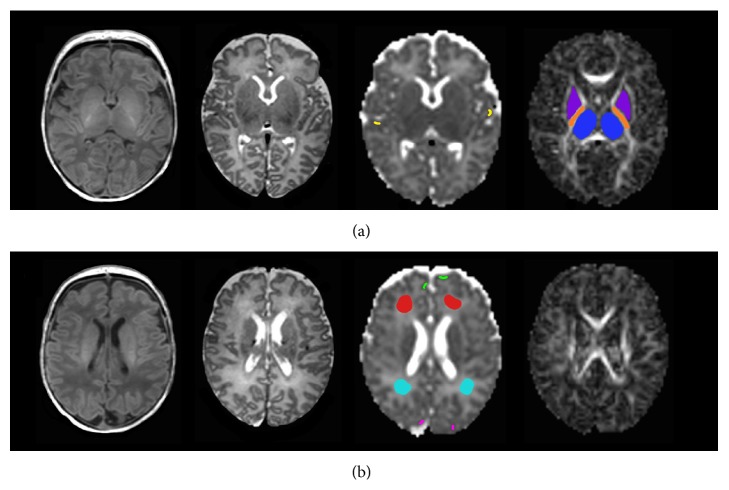
The objective of this study was to assess the evolution of diffusion-weighted imaging (DWI) and diffusion-tensor imaging (DTI) over the first month of life in asphyxiated newborns treated with hypothermia and to compare it with that of healthy newborns. Asphyxiated newborns treated with hypothermia were enrolled prospectively; and the presence and extent of brain injury were scored on each MRI. Apparent diffusion coefficient (ADC) and fractional anisotropy (FA) values were measured in the basal ganglia, in the white matter and in the cortical grey matter. Sixty-one asphyxiated newborns treated with hypothermia had a total of 126 ADC and FA maps. Asphyxiated newborns developing brain injury eventually had significantly decreased ADC values on days 2-3 of life and decreased FA values around day 10 and 1 month of life compared with those not developing brain injury. Despite hypothermia treatment, asphyxiated newborns may develop brain injury that still can be detected with advanced neuroimaging techniques such as DWI and DTI as early as days 2-3 of life. A study of ADC and FA values over time may aid in the understanding of how brain injury develops in these newborns despite hypothermia treatment.
本研究的目的是评估接受低温治疗的窒息新生儿出生后第一个月内弥散加权成像(DWI)和弥散张量成像(DTI)的变化情况,并将其与健康新生儿进行比较。前瞻性纳入接受低温治疗的窒息新生儿;每次MRI均对脑损伤的存在情况和程度进行评分。在基底节、白质和皮质灰质中测量表观扩散系数(ADC)和分数各向异性(FA)值。61例接受低温治疗的窒息新生儿共有126张ADC和FA图。与未发生脑损伤的窒息新生儿相比,最终发生脑损伤的窒息新生儿在出生后第2 - 3天ADC值显著降低,在出生后第10天左右和1个月时FA值降低。尽管进行了低温治疗,但窒息新生儿仍可能发生脑损伤,这种损伤最早在出生后第2 - 3天就可以通过DWI和DTI等先进的神经成像技术检测到。对ADC和FA值随时间变化的研究可能有助于理解尽管进行了低温治疗,这些新生儿的脑损伤是如何发展的。