Borup Gitte, Mikkelsen Kim Lyngby, Tønnesen Philip, Christrup Lona Louring
Department of Drug Design and Pharmacology, University of Copenhagen, Universitetsparken 2, 2100, Copenhagen, Denmark.
The Danish Patient Compensation Association, Copenhagen, Denmark.
Harm Reduct J. 2015 Jan 19;12:2. doi: 10.1186/1477-7517-12-2.
Long-term use of nicotine replacement therapy (NRT) has been approved in several countries for smokers who are unable or unwilling to quit smoking. However, information on basic characteristics, degree of nicotine dependence, health status and contentment with long-term use of NRT is scarce. The aim of this study was to collect information on the characteristics of long-term NRT users, having used NRT for at least 12 months, reasons for, and contentment with, their continued use of NRT including reasons for wishing to quit or sustain use and an estimation of their degree of nicotine dependence.
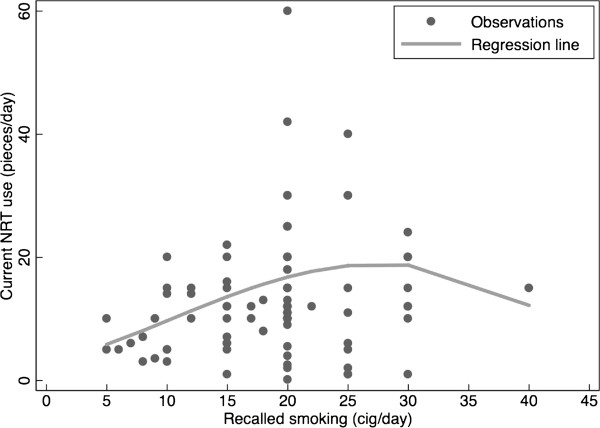
Through advertisements in three national Danish newspapers, long-term NRT users were recruited to answer a short questionnaire about basic characteristics, health status and satisfaction with using NRT. A modified version of the Heaviness of Smoking Index (HSI) questionnaire was applied to estimate nicotine dependence. Linear regression was used to test association between time to first NRT and daily dosage of NRT.
A total of 92 respondents were included in the data analysis. A majority of 88% wished to quit NRT for the following reasons: costs of NRT, being tired of feeling addicted and fear of adverse health effects. Scoring on the modified HSI scale was 22.0% low, 68.0% moderate and 9.3% high dependent. Of the respondents, 67.0% used NRT within the first 30 min after waking. A validation check found a significant linear association between the two items in the modified HSI.
A significant majority of users wished to quit NRT because of the cost of products, being tired of feeling addicted and fear of adverse health consequences. The majority of these users were moderate to high nicotine dependent. The strong association found between time to first NRT and NRT dosages used per day gives reason to believe the validity of the modified HSI. Further studies are required for confirmation. Better counselling of long-term users on the benefits of using NRT compared to smoking should be provided, for those who are chronically dependent, as well as support to stop long-term use of NRT if wanted.
在一些国家,长期使用尼古丁替代疗法(NRT)已被批准用于那些无法或不愿戒烟的吸烟者。然而,关于长期使用NRT者的基本特征、尼古丁依赖程度、健康状况及满意度的信息却很匮乏。本研究的目的是收集有关长期使用NRT至少12个月的使用者的特征、继续使用NRT的原因及满意度的信息,包括希望戒烟或维持使用的原因以及对其尼古丁依赖程度的评估。
通过在丹麦三家全国性报纸上刊登广告,招募长期使用NRT的使用者,以回答一份关于基本特征、健康状况及使用NRT满意度的简短问卷。应用改良版的吸烟强度指数(HSI)问卷来评估尼古丁依赖程度。采用线性回归分析首次使用NRT的时间与NRT每日剂量之间的关联。
共有92名受访者纳入数据分析。88%的大多数人希望停止使用NRT,原因如下:NRT的费用、厌倦成瘾的感觉以及担心对健康产生不良影响。改良版HSI量表得分低依赖者占22.0%,中度依赖者占68.0%,高度依赖者占9.3%。在受访者中,67.0%在醒来后的前30分钟内使用NRT。一项验证检查发现改良版HSI中的两个项目之间存在显著的线性关联。
绝大多数使用者希望停止使用NRT,原因是产品成本、厌倦成瘾的感觉以及担心对健康产生不良后果。这些使用者中的大多数对尼古丁有中度至高度依赖。首次使用NRT的时间与每日使用的NRT剂量之间存在的强关联,使人们有理由相信改良版HSI的有效性。需要进一步研究加以证实。对于长期依赖者,应更好地向其提供关于使用NRT相较于吸烟的益处的咨询,以及如果有意愿,提供支持以停止长期使用NRT。