van Erp Paul B G, Jackson Ryan N, Carter Joshua, Golden Sarah M, Bailey Scott, Wiedenheft Blake
Department of Microbiology and Immunology, Montana State University, Bozeman, MT 59717, USA.
Department of Biochemistry and Molecular Biology, Johns Hopkins School of Public Health, Baltimore, MD 21205, USA.
Nucleic Acids Res. 2015 Sep 30;43(17):8381-91. doi: 10.1093/nar/gkv793. Epub 2015 Aug 3.
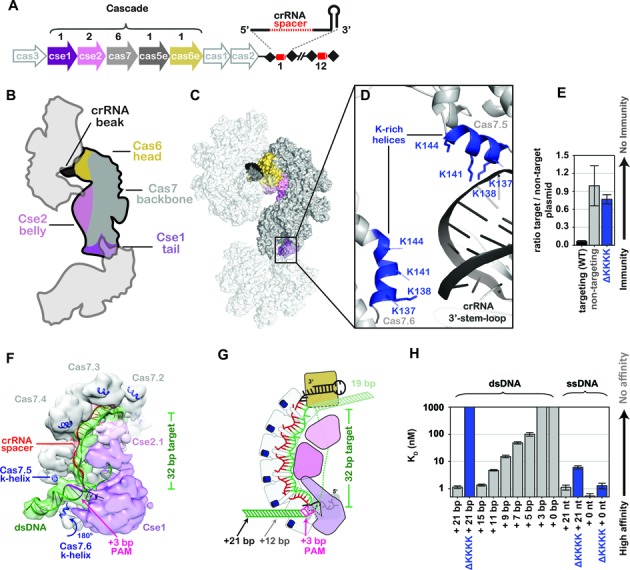
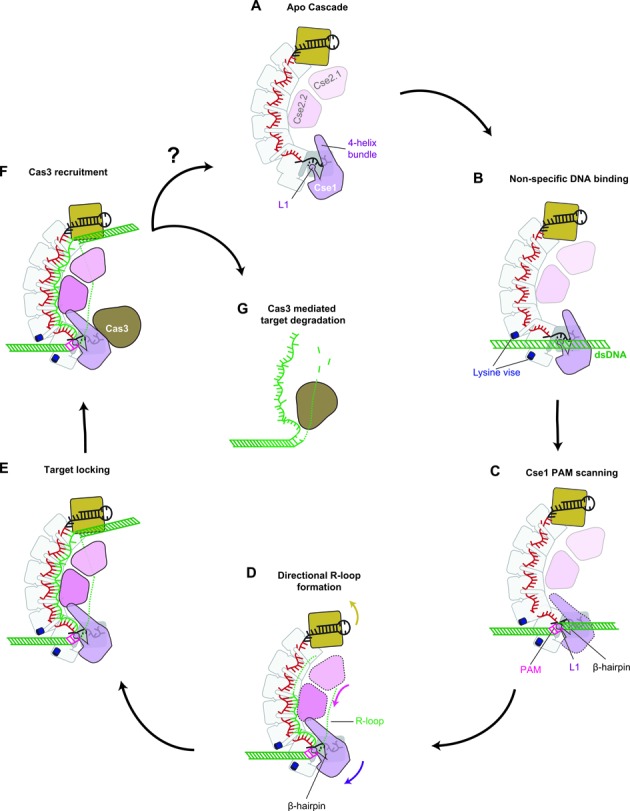
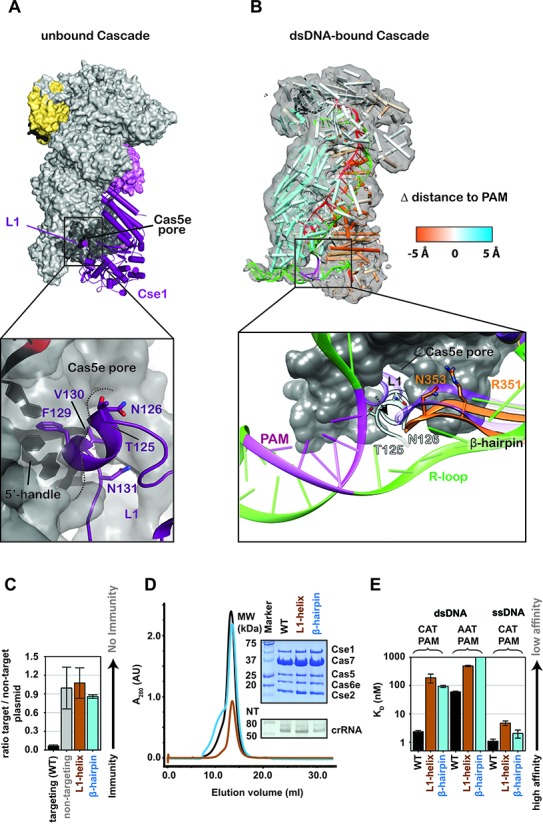
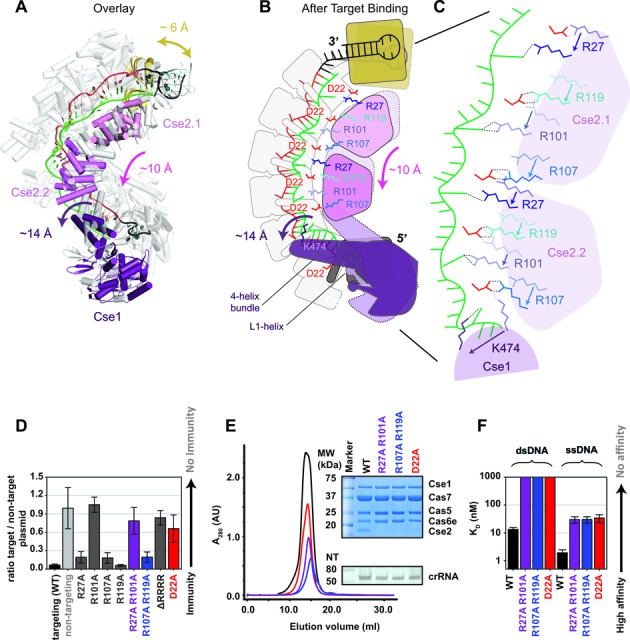
In bacteria and archaea, short fragments of foreign DNA are integrated into Clustered Regularly Interspaced Short Palindromic Repeat (CRISPR) loci, providing a molecular memory of previous encounters with foreign genetic elements. In Escherichia coli, short CRISPR-derived RNAs are incorporated into a multi-subunit surveillance complex called Cascade (CRISPR-associated complex for antiviral defense). Recent structures of Cascade capture snapshots of this seahorse-shaped RNA-guided surveillance complex before and after binding to a DNA target. Here we determine a 3.2 Å x-ray crystal structure of Cascade in a new crystal form that provides insight into the mechanism of double-stranded DNA binding. Molecular dynamic simulations performed using available structures reveal functional roles for residues in the tail, backbone and belly subunits of Cascade that are critical for binding double-stranded DNA. Structural comparisons are used to make functional predictions and these predictions are tested in vivo and in vitro. Collectively, the results in this study reveal underlying mechanisms involved in target-induced conformational changes and highlight residues important in DNA binding and protospacer adjacent motif recognition.
在细菌和古生菌中,外源DNA的短片段被整合到成簇规律间隔短回文重复序列(CRISPR)位点中,形成对先前接触过的外源遗传元件的分子记忆。在大肠杆菌中,源自CRISPR的短RNA被整合到一个称为Cascade(用于抗病毒防御的CRISPR相关复合物)的多亚基监测复合物中。Cascade最近的结构捕捉到了这种海马状RNA引导监测复合物与DNA靶标结合前后的瞬间。在这里,我们确定了一种新晶体形式的Cascade的3.2埃X射线晶体结构,该结构为双链DNA结合机制提供了见解。利用现有结构进行的分子动力学模拟揭示了Cascade的尾部、主干和腹部亚基中对结合双链DNA至关重要的残基的功能作用。通过结构比较进行功能预测,并在体内和体外对这些预测进行测试。本研究的结果共同揭示了靶标诱导构象变化所涉及的潜在机制,并突出了在DNA结合和原间隔相邻基序识别中重要的残基。