Sionov Edward, Mayer-Barber Katrin D, Chang Yun C, Kauffman Keith D, Eckhaus Michael A, Salazar Andres M, Barber Daniel L, Kwon-Chung Kyung J
Molecular Microbiology Section, Laboratory of Clinical Infectious Diseases, National Institute of Allergy and Infectious Diseases (NIAID), National Institutes of Health (NIH), Bethesda, Maryland, United States of America.
Immunobiology Section, Laboratory of Parasitic Diseases, National Institute of Allergy and Infectious Diseases (NIAID), National Institutes of Health (NIH), Bethesda, Maryland, United States of America.
PLoS Pathog. 2015 Aug 7;11(8):e1005040. doi: 10.1371/journal.ppat.1005040. eCollection 2015 Aug.
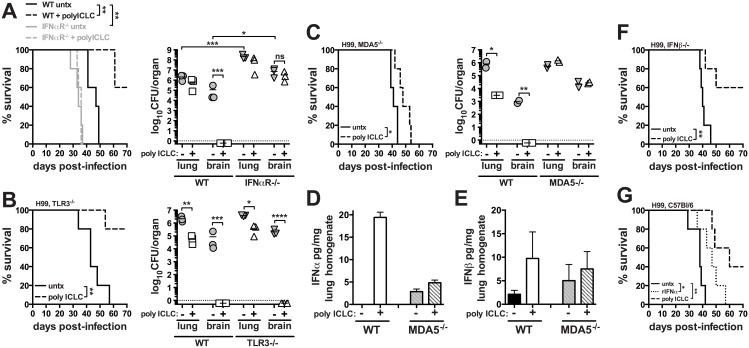
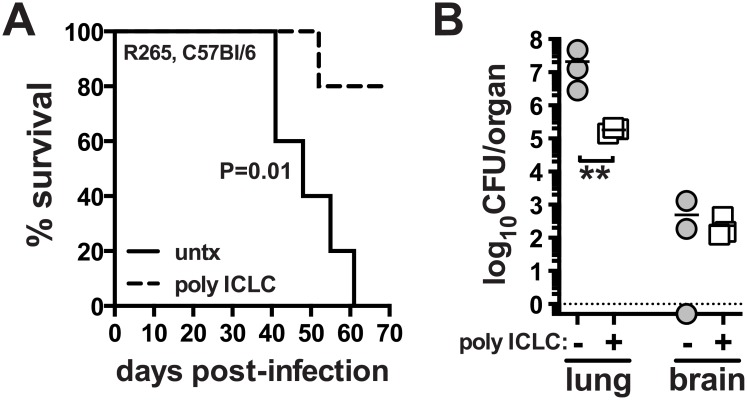
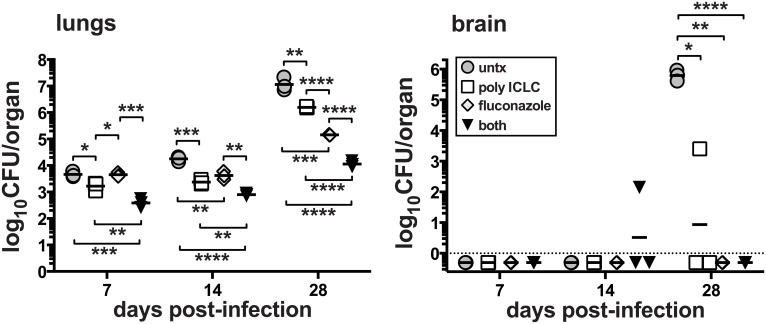
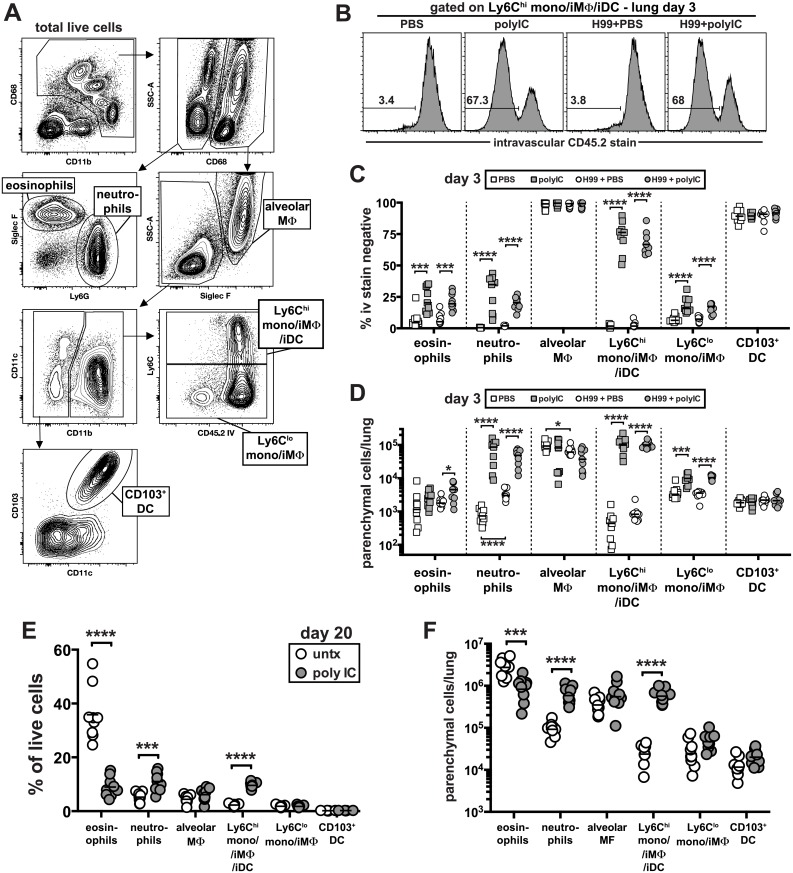
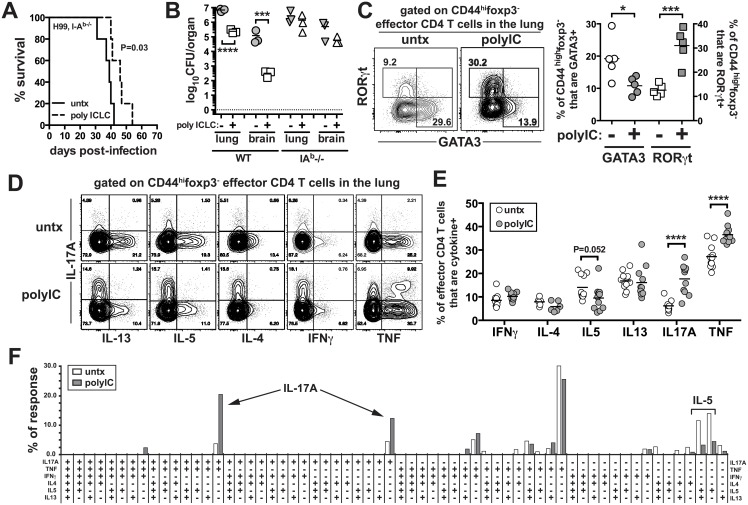
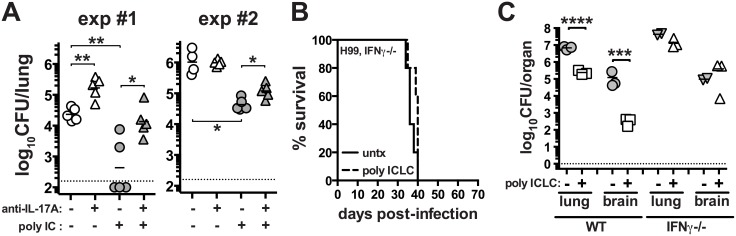
Cryptococcus neoformans is the most common cause of fungal meningoencephalitis in AIDS patients. Depletion of CD4 cells, such as occurs during advanced AIDS, is known to be a critical risk factor for developing cryptococcosis. However, the role of HIV-induced innate inflammation in susceptibility to cryptococcosis has not been evaluated. Thus, we sought to determine the role of Type I IFN induction in host defense against cryptococci by treatment of C. neoformans (H99) infected mice with poly-ICLC (pICLC), a dsRNA virus mimic. Unexpectedly, pICLC treatment greatly extended survival of infected mice and reduced fungal burdens in the brain. Protection from cryptococcosis by pICLC-induced Type I IFN was mediated by MDA5 rather than TLR3. PICLC treatment induced a large, rapid and sustained influx of neutrophils and Ly6Chigh monocytes into the lung while suppressing the development of eosinophilia. The pICLC-mediated protection against H99 was CD4 T cell dependent and analysis of CD4 T cell polyfunctionality showed a reduction in IL-5 producing CD4 T cells, marginal increases in Th1 cells and dramatic increases in RORγt+ Th17 cells in pICLC treated mice. Moreover, the protective effect of pICLC against H99 was diminished in IFNγ KO mice and by IL-17A neutralization with blocking mAbs. Furthermore, pICLC treatment also significantly extended survival of C. gattii infected mice with reduced fungal loads in the lungs. These data demonstrate that induction of type I IFN dramatically improves host resistance against the etiologic agents of cryptococcosis by beneficial alterations in both innate and adaptive immune responses.
新型隐球菌是艾滋病患者真菌性脑膜脑炎最常见的病因。CD4细胞耗竭,如在晚期艾滋病期间发生的那样,已知是发生隐球菌病的关键危险因素。然而,HIV诱导的先天性炎症在隐球菌病易感性中的作用尚未得到评估。因此,我们试图通过用聚肌胞苷酸(pICLC,一种双链RNA病毒模拟物)治疗新型隐球菌(H99)感染的小鼠,来确定I型干扰素诱导在宿主抗隐球菌防御中的作用。出乎意料的是,pICLC治疗大大延长了感染小鼠的存活时间,并降低了脑中的真菌负荷。pICLC诱导的I型干扰素对隐球菌病的保护作用是由黑色素瘤分化相关基因5(MDA5)介导的,而非Toll样受体3(TLR3)。pICLC治疗诱导大量、快速且持续的中性粒细胞和Ly6C高表达单核细胞流入肺部,同时抑制嗜酸性粒细胞增多的发展。pICLC介导的对H99的保护作用依赖于CD4 T细胞,对CD4 T细胞多功能性的分析显示,在pICLC治疗的小鼠中,产生白细胞介素-5(IL-5)的CD4 T细胞减少,辅助性T细胞1(Th1)细胞略有增加,而维甲酸相关孤儿受体γt(RORγt)+辅助性T细胞17(Th17)细胞显著增加。此外,在干扰素γ基因敲除(IFNγ KO)小鼠中以及通过用阻断性单克隆抗体中和白细胞介素-17A(IL-17A),pICLC对H99的保护作用减弱。此外,pICLC治疗还显著延长了感染加氏隐球菌小鼠的存活时间,并降低了肺部的真菌载量。这些数据表明,I型干扰素的诱导通过先天性和适应性免疫反应的有益改变,显著提高了宿主对隐球菌病病原体的抵抗力。