Cui Jian, Muller Matthew D, Blaha Cheryl, Kunselman Allen R, Sinoway Lawrence I
Penn State Hershey Heart and Vascular Institute, Pennsylvania State University College of Medicine Milton S. Hershey Medical Center, Hershey, Pennsylvania.
Division of Biostatistics and Bioinformatics, Department of Public Health Sciences, Pennsylvania State University College of Medicine Milton S. Hershey Medical Center, Hershey, Pennsylvania.
Physiol Rep. 2015 Aug;3(8). doi: 10.14814/phy2.12492.
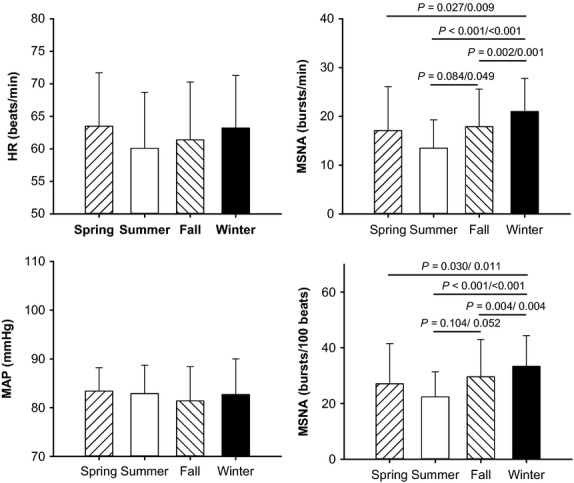
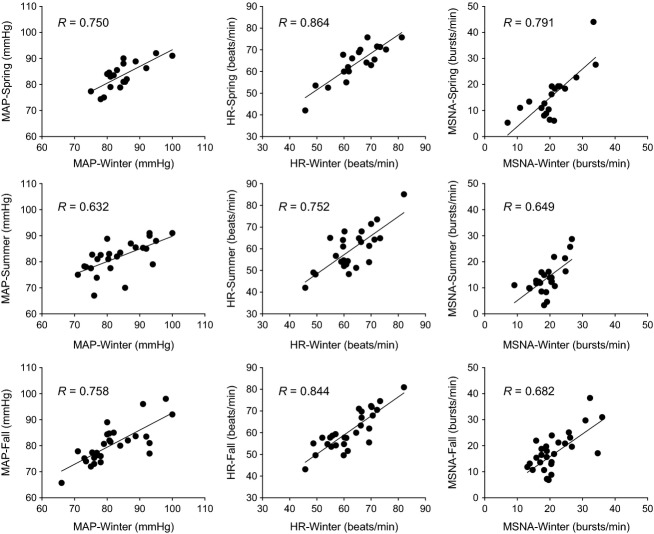
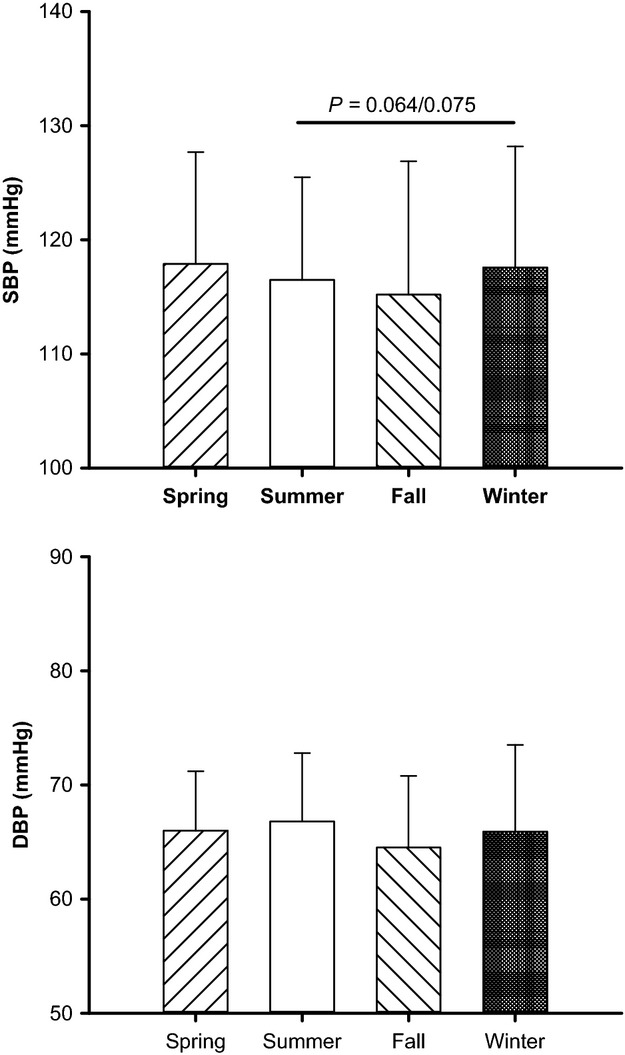
Epidemiologic data suggest there are seasonal variations in the incidence of severe cardiac events with peak levels being evident in the winter. Whether autonomic indices including muscle sympathetic nerve activity (MSNA) vary with season remains unclear. In this report, we tested the hypothesis that resting MSNA varies with the seasons of the year with peak levels evident in the winter. We analyzed the supine resting MSNA in 60 healthy subjects. Each subject was studied during two, three, or four seasons (total 237 visits). MSNA burst rate in the winter (21.0 ± 6.8 burst/min, mean ± SD) was significantly greater than in the summer (13.5 ± 5.8 burst/min, P < 0.001), the spring (17.1 ± 9.0 burst/min, P = 0.03), and the fall (17.9 ± 7.7 burst/min, P = 0.002). There was no significant difference in MSNA for other seasonal comparisons. The results suggest that resting sympathetic nerve activity varies along the seasons, with peak levels evident in the winter. We speculate that the seasonal changes in sympathetic activity may be a contribution to the previously observed seasonal variations in cardiovascular morbidity and mortality.
流行病学数据表明,严重心脏事件的发生率存在季节性变化,冬季达到峰值。包括肌肉交感神经活动(MSNA)在内的自主神经指标是否随季节变化尚不清楚。在本报告中,我们检验了静息MSNA随一年中的季节变化且冬季达到峰值的假设。我们分析了60名健康受试者的仰卧位静息MSNA。每位受试者在两个、三个或四个季节接受研究(共237次访视)。冬季的MSNA爆发率(21.0±6.8次/分钟,均值±标准差)显著高于夏季(13.5±5.8次/分钟,P<0.001)、春季(17.1±9.0次/分钟,P=0.03)和秋季(17.9±7.7次/分钟,P=0.002)。其他季节比较的MSNA无显著差异。结果表明,静息交感神经活动随季节变化,冬季达到峰值。我们推测,交感神经活动的季节性变化可能是先前观察到的心血管发病率和死亡率季节性变化的一个原因。