Fessler Evelyn, Borovski Tijana, Medema Jan Paul
Laboratory for Experimental Oncology and Radiobiology (LEXOR), Center for Experimental Molecular Medicine (CEMM), Academic Medical Center (AMC), University of Amsterdam, Amsterdam, Meibergdreef 9, 1105 AZ, Amsterdam, The Netherlands.
Present address: Department of Surgery, University Medical Center (UMC) Utrecht, Utrecht, The Netherlands.
Mol Cancer. 2015 Aug 19;14:157. doi: 10.1186/s12943-015-0420-3.
Glioblastoma multiforme (GBM) is a rapidly growing malignant brain tumor, which has been reported to be organized in a hierarchical fashion with cancer stem cells (CSCs) at the apex. Recent studies demonstrate that this hierarchy does not follow a one-way route but can be reverted with more differentiated cells giving rise to cells possessing CSC features. We investigated the role of tumor microvascular endothelial cells (tMVECs) in reverting differentiated glioblastoma cells to CSC-like cells.
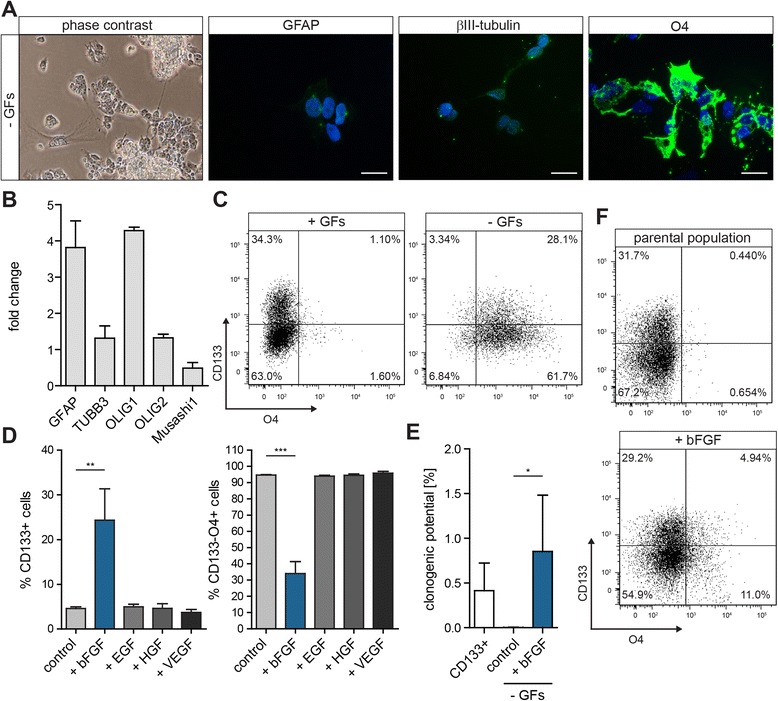
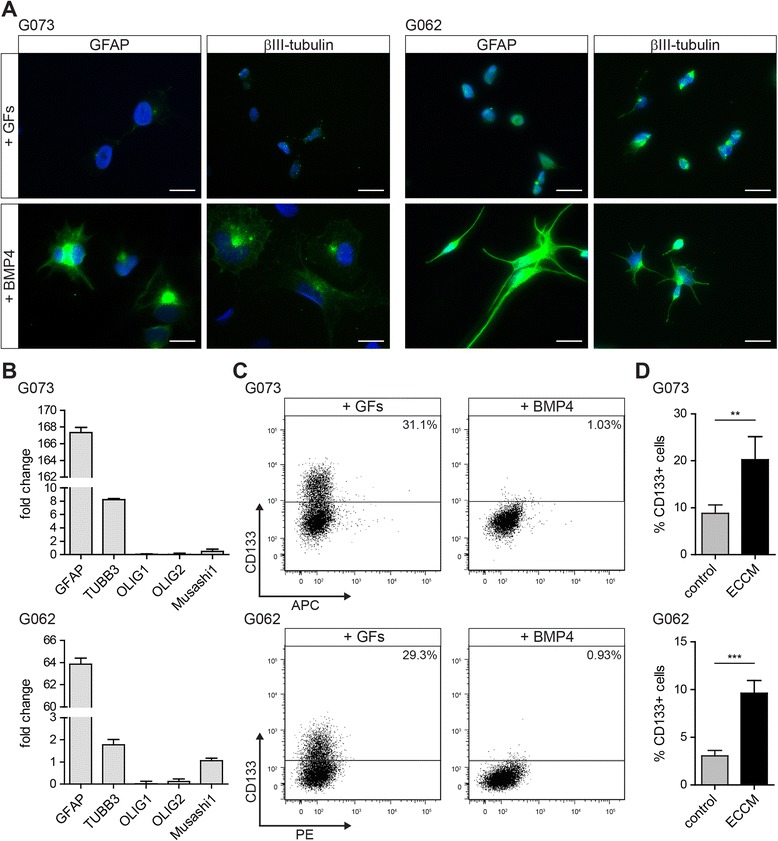
We made use of primary GBM lines and tMVECs. To ensure differentiation, CSC-enriched cultures were forced into differentiation using several stimuli and cultures consisting solely of differentiated cells were obtained by sorting on the oligodendrocyte marker O4. Reversion to the CSC state was assessed phenotypically by CSC marker expression and functionally by evaluating clonogenic and multilineage differentiation potential.
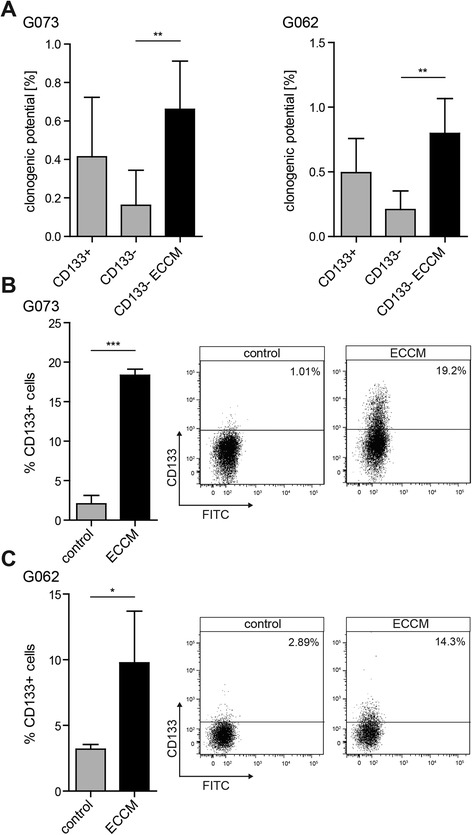
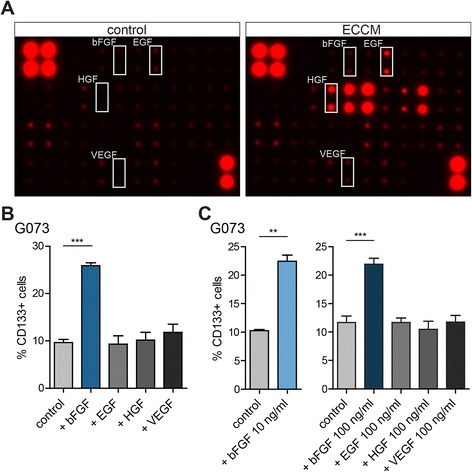
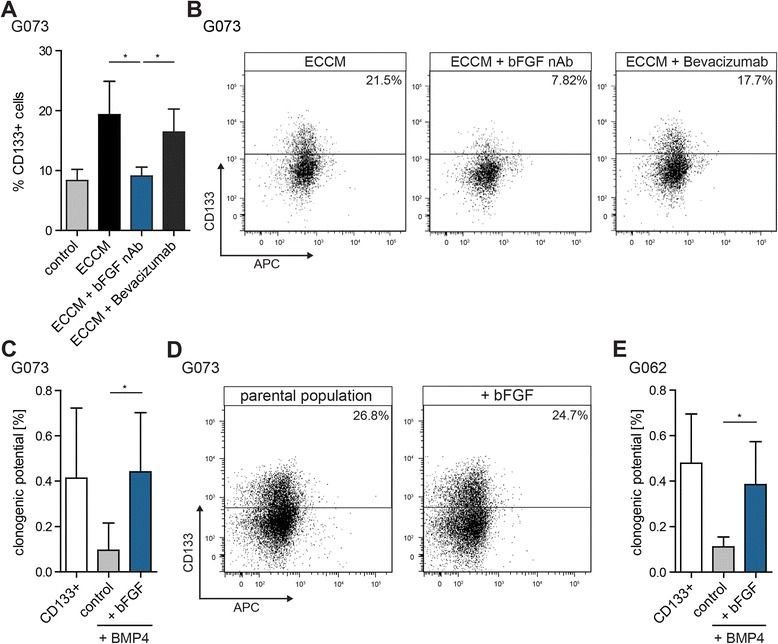
Conditioned medium of tMVECs was able to replenish the CSC pool by phenotypically and functionally reverting differentiated GBM cells to the CSC state. Basic fibroblast growth factor (bFGF), secreted by tMVECs, recapitulated the effects of the conditioned medium in inducing re-expression of CSC markers and increasing neurosphere formation ability of differentiated GBM cells.
Our findings demonstrate that the CSC-based hierarchy displays a high level of plasticity showing that differentiated GBM cells can acquire CSC features when placed in the right environment. These results point to the need to intersect the elaborate network of tMVECs and GBM CSCs for efficient elimination of GBM CSCs.
多形性胶质母细胞瘤(GBM)是一种快速生长的恶性脑肿瘤,据报道其以分层方式组织,癌症干细胞(CSCs)位于顶端。最近的研究表明,这种分层并非遵循单向路径,而是可以被逆转,即更多分化细胞可产生具有CSC特征的细胞。我们研究了肿瘤微血管内皮细胞(tMVECs)在将分化的胶质母细胞瘤细胞逆转为CSC样细胞中的作用。
我们使用了原发性GBM细胞系和tMVECs。为确保分化,利用多种刺激促使富含CSC的培养物分化,并通过对少突胶质细胞标志物O4进行分选获得仅由分化细胞组成的培养物。通过CSC标志物表达从表型上评估向CSC状态的逆转,并通过评估克隆形成和多谱系分化潜能从功能上进行评估。
tMVECs的条件培养基能够通过将分化的GBM细胞从表型和功能上逆转为CSC状态来补充CSC库。tMVECs分泌的碱性成纤维细胞生长因子(bFGF)概括了条件培养基在诱导CSC标志物重新表达和增加分化的GBM细胞神经球形成能力方面的作用。
我们的研究结果表明,基于CSC的分层显示出高度的可塑性,表明分化的GBM细胞在置于合适环境时可获得CSC特征。这些结果表明,为有效消除GBM CSCs,需要深入研究tMVECs和GBM CSCs的复杂网络。