Ovadia M, Kalok D, Tamir I, Mitra S, Sacépé B, Shahar D
Department of Condensed Matter Physics, The Weizmann Institute of Science, Rehovot 76100, Israel.
Univ. Grenoble Alpes, Institut NEEL, F-38042 Grenoble, France.
Sci Rep. 2015 Aug 27;5:13503. doi: 10.1038/srep13503.
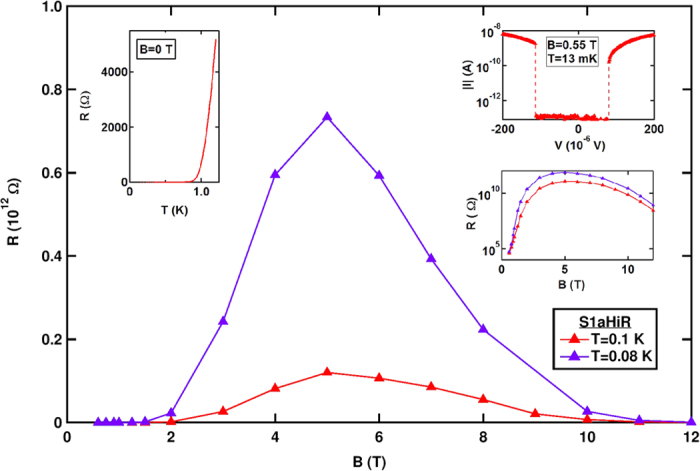
In superconductors the zero-resistance current-flow is protected from dissipation at finite temperatures (T) by virtue of the short-circuit condition maintained by the electrons that remain in the condensed state. The recently suggested finite-T insulator and the "superinsulating" phase are different because any residual mechanism of conduction will eventually become dominant as the finite-T insulator sets-in. If the residual conduction is small it may be possible to observe the transition to these intriguing states. We show that the conductivity of the high magnetic-field insulator terminating superconductivity in amorphous indium-oxide exhibits an abrupt drop, and seem to approach a zero conductance at T < 0.04 K. We discuss our results in the light of theories that lead to a finite-T insulator.
在超导体中,零电阻电流的流动在有限温度(T)下受到保护,不会因处于凝聚态的电子所维持的短路条件而耗散。最近提出的有限温度绝缘体和“超绝缘”相有所不同,因为随着有限温度绝缘体的出现,任何剩余的传导机制最终都会占据主导地位。如果剩余传导很小,那么有可能观察到向这些有趣状态的转变。我们表明,在非晶氧化铟中终止超导性的高磁场绝缘体的电导率会突然下降,并且在T < 0.04 K时似乎趋近于零电导。我们根据导致有限温度绝缘体的理论来讨论我们的结果。