Randriamaherijaona Sanjiarizaha, Briët Olivier J T, Boyer Sébastien, Bouraima Aziz, N'Guessan Raphael, Rogier Christophe, Corbel Vincent
Institut Pasteur de Madagascar, Antananarivo, Madagascar.
Department of Epidemiology and Public Health, Swiss Tropical and Public Health Institute, Basel, Switzerland.
Malar J. 2015 Aug 28;14:332. doi: 10.1186/s12936-015-0836-7.
Resistance of malaria vectors to pyrethroids threatens the effectiveness of long-lasting insecticidal nets (LLINs) as a tool for malaria control. Recent experimental hut and observational studies in Benin show that pyrethroid resistance reduces the insecticidal effect and personal protection of LLINs especially when they become torn. The World Health Organization has proposed a threshold for when nets are "too torn" at 1,000 cm(2) for rectangular holes and 790 cm(2) for round holes. This study examines whether there is a threshold above which LLINs no longer reduce malaria transmission.
Intact and artificially-holed LLINs under three months old and untreated nets were tested by releasing mosquitoes from a susceptible Anopheles gambiae colony, a pyrethroid-resistant An. gambiae population and a resistant Culex quinquefasciatus population in closed experimental huts in Southern Benin, West Africa. The efficacy of LLINs and untreated nets was evaluated in terms of protection against blood feeding, insecticidal effect and potential effect on malaria transmission.
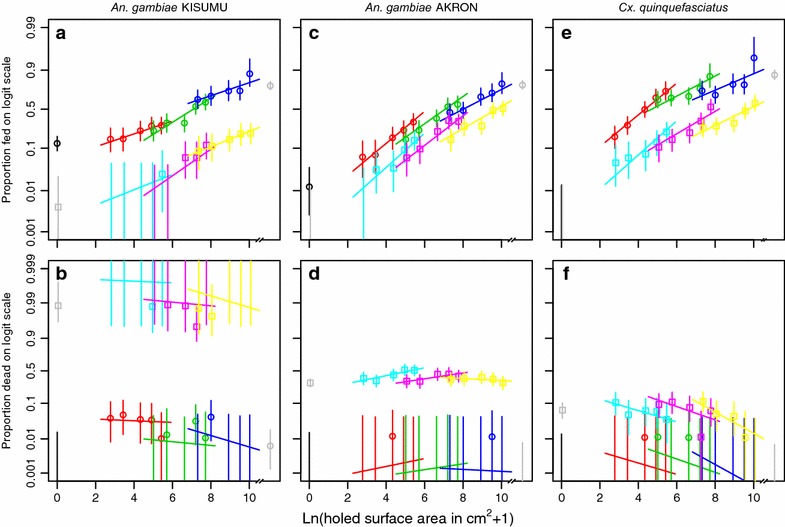
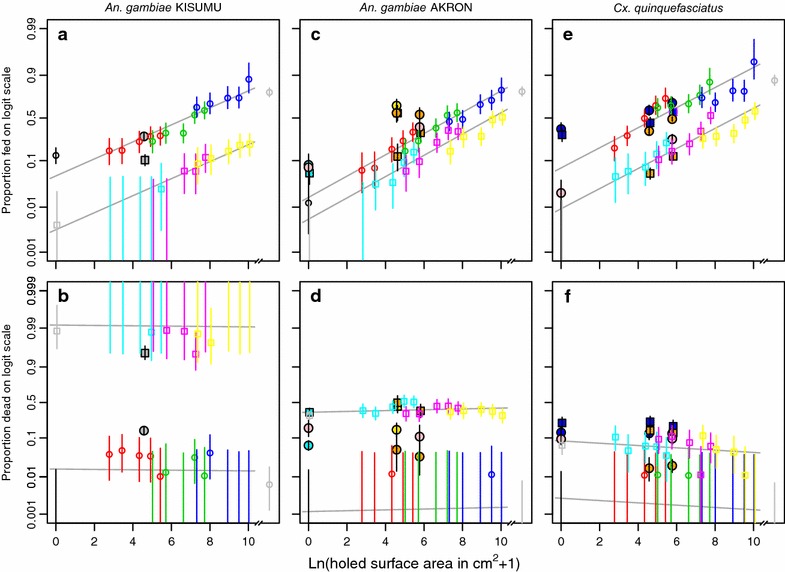
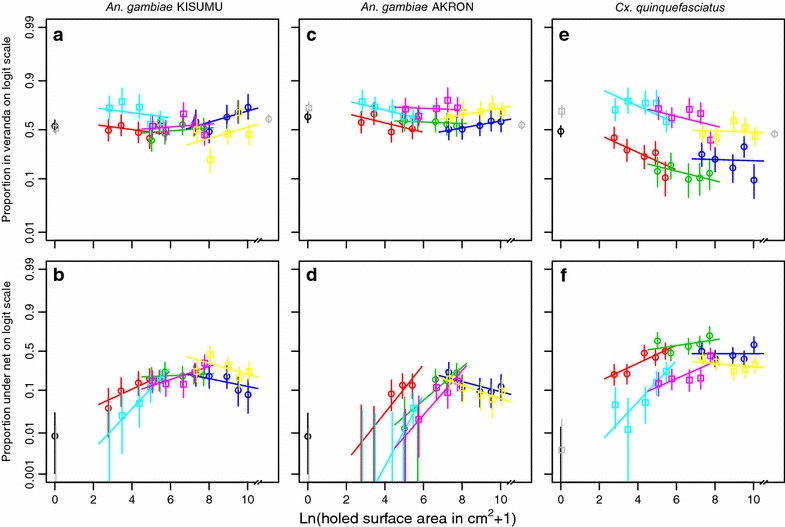
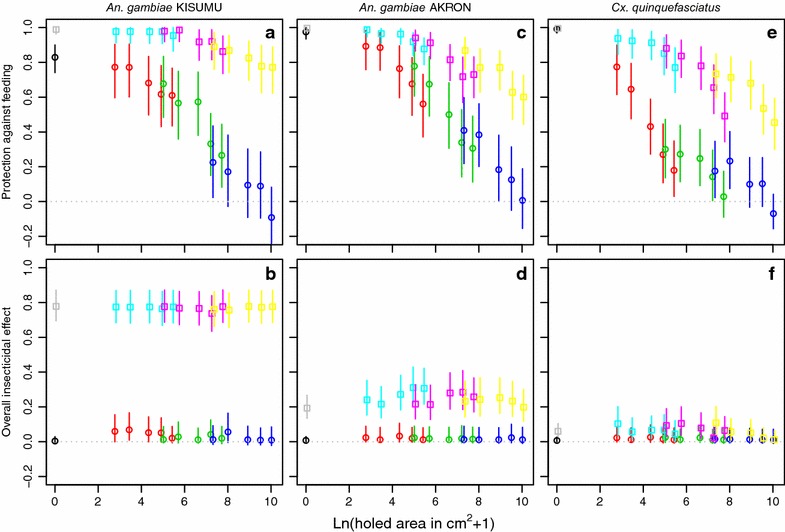
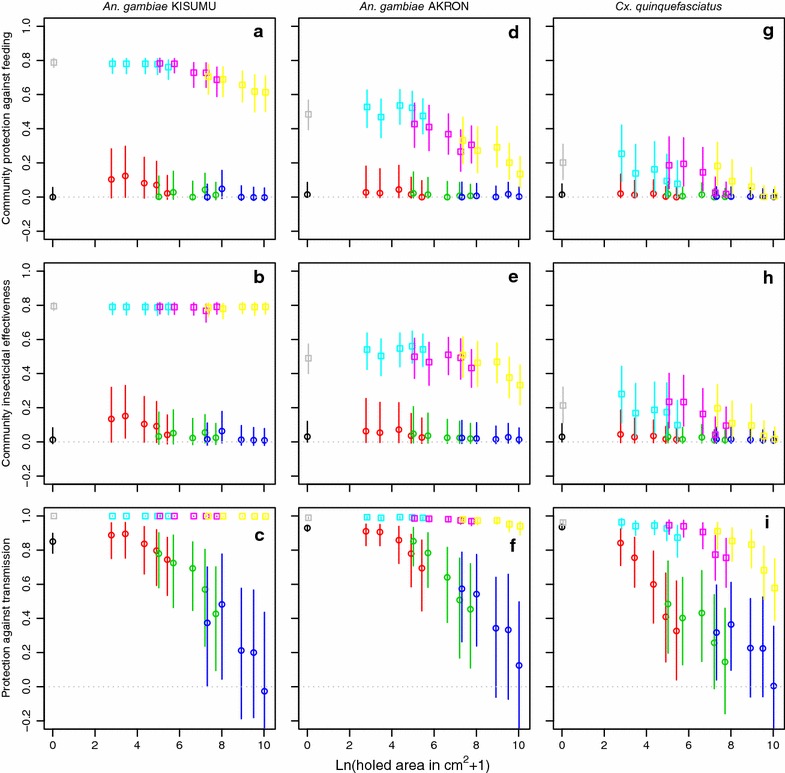
Personal protection by both LLINs and untreated nets decreased exponentially with increasing holed surface area, without evidence for a specific threshold beyond which LLINs could be considered as ineffective. The insecticidal effect of LLINs was lower in resistant mosquitoes than in susceptible mosquitoes, but holed surface area had little or no impact on the insecticidal effect of LLINs. LLINs with 22,500 cm(2) holed surface area and target insecticide content provided a personal protection of 0.60 (95 % CI 0.44-0.73) and a low insecticidal effect of 0.20 (95 % CI 0.12-0.30) against resistant An. gambiae. Nevertheless, mathematical models suggested that if 80 % of the population uses such nets, they could still prevent 94 % (95 % CI 89-97 %) of transmission by pyrethroid-resistant An. gambiae.
Even though personal protection by LLINs against feeding mosquitoes is strongly reduced by holes, the insecticidal effect of LLINs is independent of the holed surface area, but strongly dependent on insecticide resistance. Badly torn nets that still contain insecticide have potential to reduce malaria transmission. The relationship between LLIN integrity and efficacy needs to be understood in order to guide LLIN distribution policy.
疟蚊对拟除虫菊酯产生抗性,威胁到长效驱虫蚊帐(LLINs)作为疟疾防控工具的有效性。近期在贝宁进行的实验小屋和观察性研究表明,拟除虫菊酯抗性会降低LLINs的杀虫效果和个人防护能力,尤其是当蚊帐出现破损时。世界卫生组织提出了蚊帐“破损过度”的阈值,矩形孔为1000平方厘米,圆形孔为790平方厘米。本研究旨在探讨是否存在一个阈值,超过该阈值LLINs就不再能减少疟疾传播。
在西非贝宁南部的封闭实验小屋中,通过释放来自易感冈比亚按蚊群体、对拟除虫菊酯具有抗性的冈比亚按蚊群体以及抗性致倦库蚊群体的蚊子,对三个月内的完整和人工打孔的LLINs以及未处理的蚊帐进行测试。根据防叮咬、杀虫效果以及对疟疾传播的潜在影响,评估LLINs和未处理蚊帐的效果。
LLINs和未处理蚊帐的个人防护能力均随着打孔表面积的增加呈指数下降,没有证据表明存在一个特定阈值,超过该阈值LLINs就可被视为无效。在抗性蚊子中,LLINs的杀虫效果低于易感蚊子,但打孔表面积对LLINs的杀虫效果影响很小或没有影响。打孔表面积为22500平方厘米且含有目标杀虫剂含量的LLINs,对具有抗性的冈比亚按蚊的个人防护能力为0.60(95%置信区间0.44 - 0.73),杀虫效果较低,为0.20(95%置信区间0.12 - 0.30)。然而,数学模型表明,如果80%的人群使用此类蚊帐,它们仍可预防94%(95%置信区间89 - 97%)由对拟除虫菊酯具有抗性的冈比亚按蚊传播的疟疾。
尽管LLINs对叮咬蚊子的个人防护能力因孔洞而大幅降低,但其杀虫效果与打孔表面积无关,而是强烈依赖于杀虫剂抗性。仍然含有杀虫剂的严重破损蚊帐仍有减少疟疾传播的潜力。为指导LLINs分发政策,需要了解LLINs完整性与效果之间的关系。