Norberg Åke, Rooyackers Olav, Segersvärd Ralf, Wernerman Jan
Department of Anaesthesia and Intensive Care, Karolinska University Hospital Huddinge, Stockholm, Sweden; Department of Clinical Science, Intervention and Technology (CLINTEC), Karolinska Institutet, Stockholm, Sweden.
Division of Surgery, Department of Clinical Science, Intervention and Technology (CLINTEC), Karolinska Institutet at Karolinska University Hospital Huddinge, Stockholm, Sweden.
PLoS One. 2015 Aug 27;10(8):e0136371. doi: 10.1371/journal.pone.0136371. eCollection 2015.
The drop in plasma albumin concentration following surgical trauma is well known, but the temporal pattern of the detailed mechanisms behind are less well described. The aim of this explorative study was to assess changes in albumin synthesis and transcapillary escape rate (TER) following major surgical trauma, at the time of peak elevations in two well-recognized markers of inflammation.
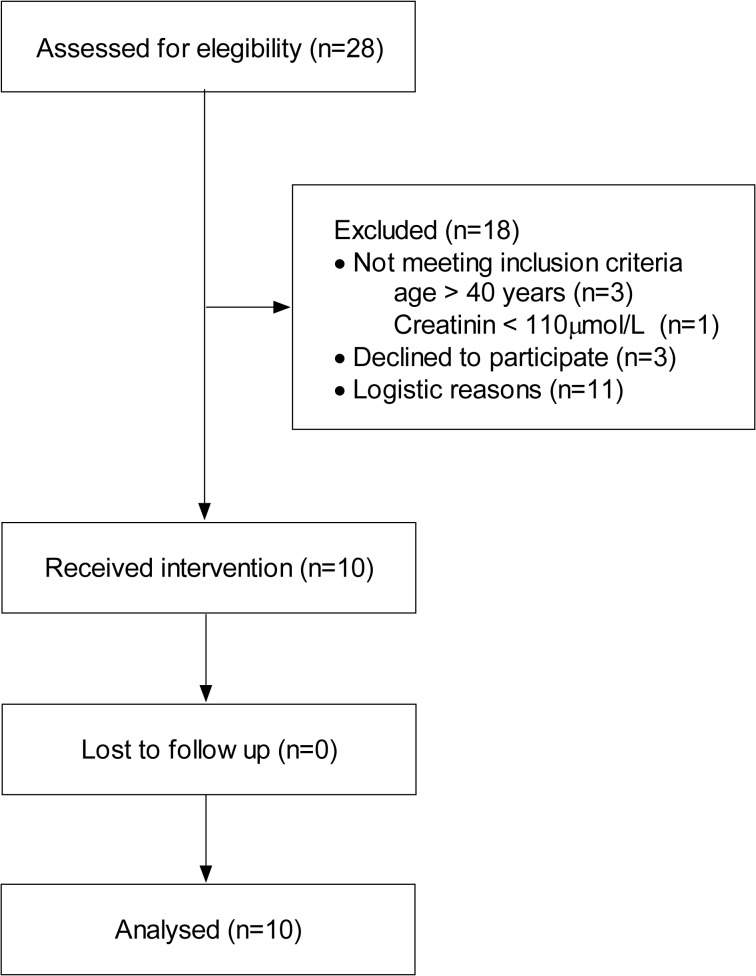
This was a clinical trial of radiolabeled human serum albumin for the study of TER and plasma volume. Ten patients were studied immediately preoperatively and on the 2nd postoperative day after major pancreatic surgery. Albumin synthesis rate was measured by the flooding dose technique employing incorporation of isotopically labelled phenylalanine.
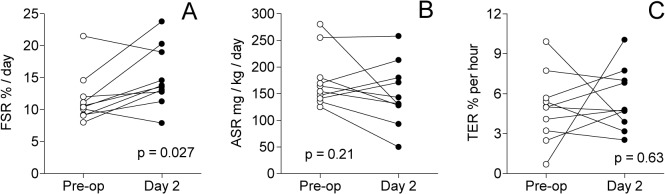
Fractional synthesis rate of albumin increased from 11.7 (95% CI: 8.9, 14.5) to 15.0 (11.7, 18.4) %/day (p = 0.027), whereas the corresponding absolute synthesis rate was unchanged, 175 (138, 212) versus 150 (107, 192) mg/kg/day (p = 0.21). TER was unchanged, 4.9 (3.1, 6.8) %/hour versus 5.5 (3.9, 7.2) (p = 0.63). Plasma volume was unchanged but plasma albumin decreased from 33.5 (30.9, 36.2) to 22.1 (19.8, 24.3) g/L. (p<0.001).
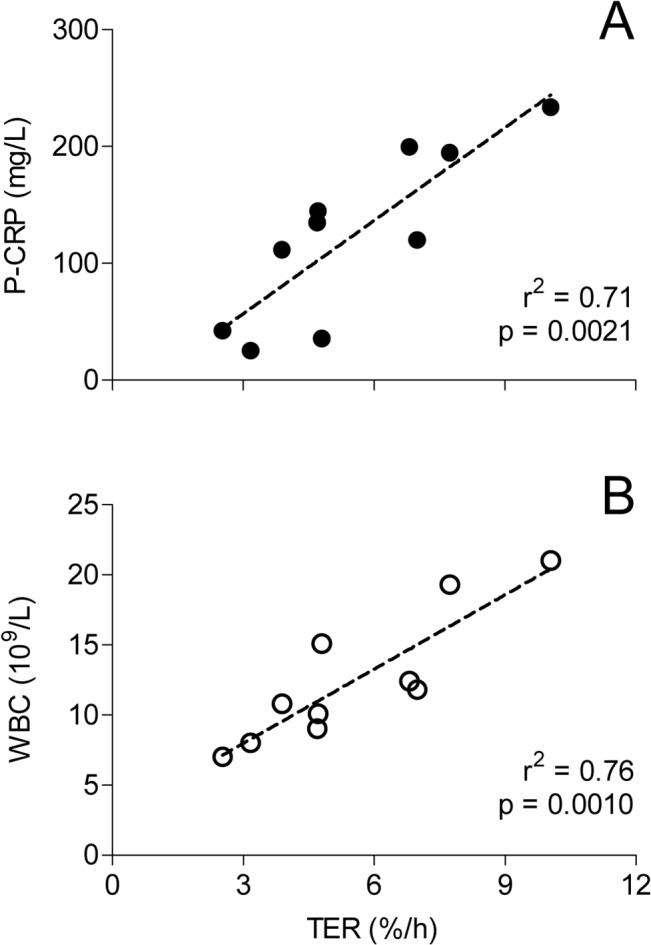
Two days after major abdominal surgery, at the time-point when two biomarkers of generalised inflammation were at their peak and the plasma albumin concentration had decreased by 33%, we were unable to show any difference in the absolute synthesis rate of albumin, TER and plasma volume as compared with values obtained immediately pre-operatively. This suggests that capillary leakage, if elevated postoperatively, had ceased at that time-point. The temporal relations between albumin kinetics, capillary leakage and generalised inflammation need to be further explored.
clinicaltrialsregister.eu: EudraCT 2010-08529-21 ClinicalTrials.gov NCT01194492.
手术创伤后血浆白蛋白浓度下降是众所周知的,但背后详细机制的时间模式却较少被描述。这项探索性研究的目的是在两种公认的炎症标志物峰值升高时,评估重大手术创伤后白蛋白合成和毛细血管逃逸率(TER)的变化。
这是一项使用放射性标记人血清白蛋白研究TER和血浆容量的临床试验。对10例患者在大胰手术后术前即刻及术后第2天进行研究。采用同位素标记苯丙氨酸掺入的灌注剂量技术测量白蛋白合成率。
白蛋白的分数合成率从11.7(95%可信区间:8.9,14.5)%/天增加至15.0(11.7,18.4)%/天(p = 0.027),而相应的绝对合成率未改变,分别为175(138,212)与150(107,192)mg/kg/天(p = 0.21)。TER未改变,分别为4.9(3.1,6.8)%/小时与5.5(3.9,7.2)%/小时(p = 0.63)。血浆容量未改变,但血浆白蛋白从33.5(30.9,36.2)g/L降至22.1(19.8,24.3)g/L(p<0.001)。
在大腹部手术后两天,即全身炎症的两种生物标志物处于峰值且血浆白蛋白浓度下降了33%的时间点,与术前即刻获得的值相比,我们未能显示白蛋白绝对合成率、TER和血浆容量有任何差异。这表明,如果术后毛细血管渗漏增加,在该时间点已经停止。白蛋白动力学、毛细血管渗漏和全身炎症之间的时间关系需要进一步探索。
clinicaltrialsregister.eu:EudraCT 2010 - 08529 - 21;ClinicalTrials.gov NCT01194492。