Choi Jeong-Hwa, Woo Hae Dong, Lee Jeong-Hee, Kim Jeongseon
From the Molecular Epidemiology Branch, National Cancer Center, Ilsandong-gu, Goyang-si, Gyonggi-do, Korea (J-HC, HDW, J-HL, JK).
Medicine (Baltimore). 2015 Aug;94(34):e1424. doi: 10.1097/MD.0000000000001424.
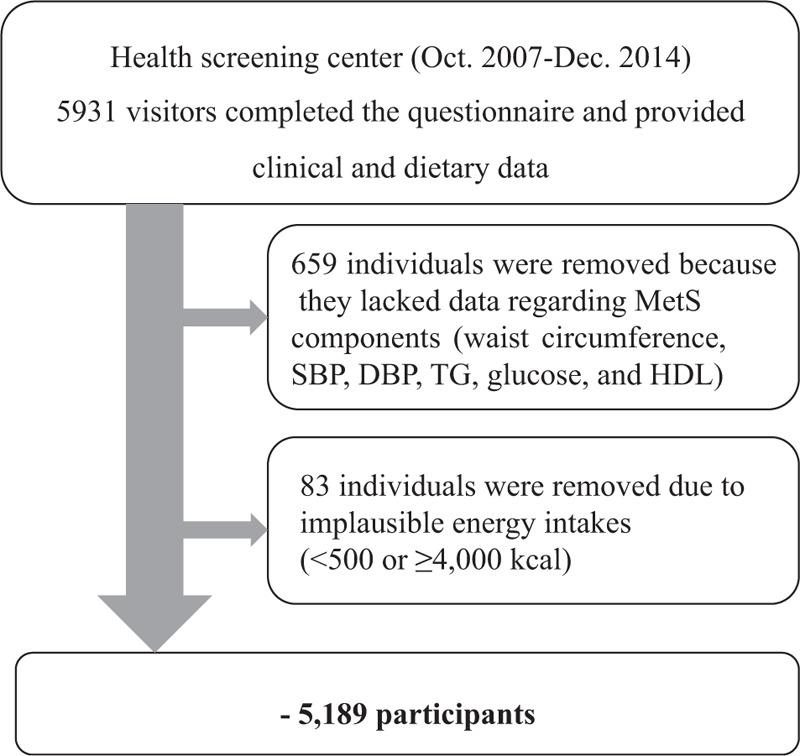
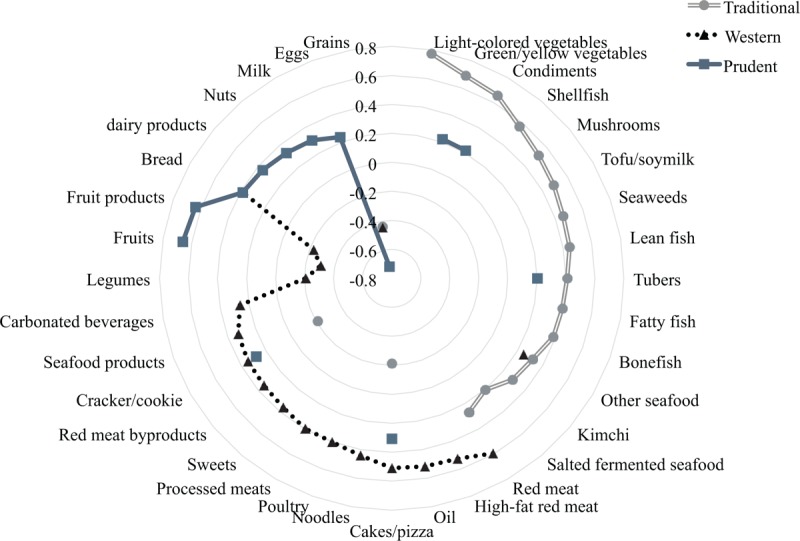
Dietary patterns are a risk factor for metabolic syndrome (MetS). The prevalence of MetS has increased in Korea, and this condition has become a public health issue. Therefore, the present cross-sectional study aimed to identify the associations between dietary patterns and the risk of MetS among Korean women.The data of 5189 participants were analyzed to determine dietary intake and lifestyle. A principal components analysis was employed to determine participant dietary patterns with regard to 106 food items. MetS was diagnosed using the National Cholesterol Education Program, Adult Treatment Panel III. Logistic regression analyses were applied to evaluate the associations between dietary pattern quintiles and MetS and to generate odds ratios (ORs) and 95% confidence intervals (CIs) after adjusting for potential confounders.Three dietary patterns were identified: "traditional," "western," and "prudent." The "prudent" dietary pattern consisted of a high intake of fruits and fruit products as well as nuts, dairy, and a low consumption of grains; this pattern was negatively associated with the risk of MetS. The highest quintile of the "prudent" dietary pattern was significantly less likely to develop MetS (OR: 0.5, 95% CI: 0.36-0.68, P for trend <0.001) compared with the lowest quintile. This pattern was also negatively associated with all of the MetS diagnostic criteria: abdominal obesity (OR: 0.52, 95% CI: 0.41-0.65), blood pressure (OR: 0.72, 95% CI: 0.59-0.87), triglycerides (OR: 0.67, 95% CI: 0.52-0.85), fasting glucose (OR: 0.64, 95% CI: 0.43-0.95), and high-density lipoprotein cholesterol (OR: 0.53, 95% CI: 0.42-0.68). However, the "traditional" and "western" dietary patterns were not associated with the risk of MetS.The "prudent" dietary pattern was negatively associated with the risk of developing MetS among Korean women.
饮食模式是代谢综合征(MetS)的一个风险因素。韩国代谢综合征的患病率有所上升,这种情况已成为一个公共卫生问题。因此,本横断面研究旨在确定韩国女性饮食模式与代谢综合征风险之间的关联。分析了5189名参与者的数据以确定饮食摄入量和生活方式。采用主成分分析法根据106种食物确定参与者的饮食模式。使用美国国家胆固醇教育计划成人治疗小组第三次报告的标准诊断代谢综合征。应用逻辑回归分析来评估饮食模式五分位数与代谢综合征之间的关联,并在调整潜在混杂因素后生成比值比(OR)和95%置信区间(CI)。
“传统型”、“西方型”和“谨慎型”。“谨慎型”饮食模式包括大量摄入水果及水果制品、坚果、乳制品,以及少量食用谷物;这种模式与代谢综合征风险呈负相关。与最低五分位数相比,“谨慎型”饮食模式的最高五分位数患代谢综合征的可能性显著降低(OR:0.5,95%CI:0.36 - 0.68,趋势P<0.001)。这种模式还与所有代谢综合征诊断标准呈负相关:腹型肥胖(OR:0.52,95%CI:0.41 - 0.65)、血压(OR:0.72,95%CI:0.59 - 0.87)、甘油三酯(OR:0.67,95%CI:0.52 - 0.85)、空腹血糖(OR:0.64,95%CI:0.43 - 0.95)和高密度脂蛋白胆固醇(OR:0.53,95%CI:0.42 - 0.68)。然而,“传统型”和“西方型”饮食模式与代谢综合征风险无关。
“谨慎型”饮食模式与韩国女性患代谢综合征的风险呈负相关。