Department of Preventive Medicine, Seoul National University College of Medicine, Seoul, 03080, South Korea.
Integrated Major in Innovative Medical Science, Seoul National University College of Medicine, Seoul, 03080, South Korea.
BMC Cancer. 2022 Jun 14;22(1):656. doi: 10.1186/s12885-022-09735-6.
The effects of diet on the interaction between microbes and host health have been widely studied. However, its effects on the gut microbiota of patients with colorectal cancer (CRC) have not been elucidated. This study aimed to investigate the association between diet and the overall diversity and different taxa levels of the gut microbiota in CRC patients via the nutrition-wide association approach.
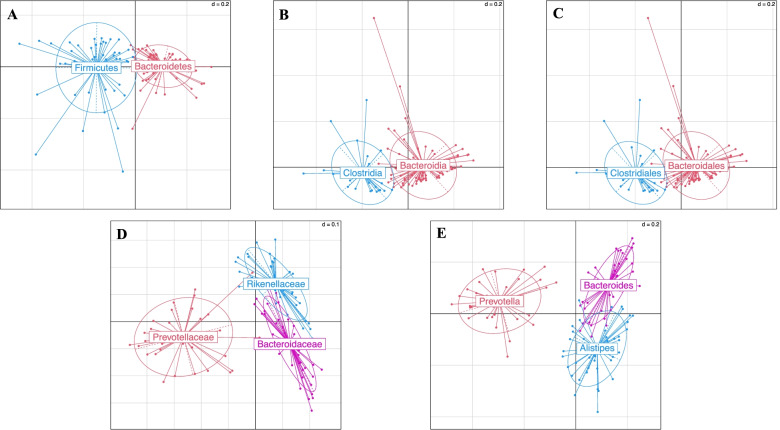
This hospital-based study utilized data of 115 CRC patients who underwent CRC surgery in Department of Surgery, Seoul National University Hospital. Spearman correlation analyses were conducted for 216 dietary features and three alpha-diversity indices, Firmicutes/Bacteroidetes ratio, and relative abundance of 439 gut microbial taxonomy. To identify main enterotypes of the gut microbiota, we performed the principal coordinate analysis based on the β-diversity index. Finally, we performed linear regression to examine the association between dietary intake and main microbiome features, and linear discriminant analysis effect size (LEfSe) to identify bacterial taxa phylogenetically enriched in the low and high diet consumption groups.
Several bacteria were enriched in patients with higher consumption of mature pumpkin/pumpkin juice (ρ, 0.31 to 0.41) but lower intake of eggs (ρ, -0.32 to -0.26). We observed negative correlations between Bacteroides fragilis abundance and intake of pork (belly), beef soup with vegetables, animal fat, and fatty acids (ρ, -0.34 to -0.27); an inverse correlation was also observed between Clostridium symbiosum abundance and intake of some fatty acids, amines, and amino acids (ρ, -0.30 to -0.24). Furthermore, high intake of seaweed was associated with a 6% (95% CI, 2% to 11%) and 7% (95% CI, 2% to 11%) lower abundance of Rikenellaceae and Alistipes, respectively, whereas overall beverage consumption was associated with an 10% (95% CI, 2% to 18%) higher abundance of Bacteroidetes, Bacteroidia, and Bacteroidales, compared to that in the low intake group. LEfSe analysis identified phylogenetically enriched taxa associated with the intake of sugars and sweets, legumes, mushrooms, eggs, oils and fats, plant fat, carbohydrates, and monounsaturated fatty acids.
Our data elucidates the diet-microbe interactions in CRC patients. Additional research is needed to understand the significance of these results in CRC prognosis.
饮食对微生物与宿主健康相互作用的影响已得到广泛研究。然而,其对结直肠癌(CRC)患者肠道微生物群的影响尚未阐明。本研究旨在通过营养广泛关联方法,研究饮食与 CRC 患者肠道微生物群整体多样性和不同分类群水平之间的关系。
这是一项基于医院的研究,纳入了在首尔国立大学医院外科接受 CRC 手术的 115 名 CRC 患者的数据。对 216 种饮食特征和三个 alpha 多样性指数(厚壁菌门/拟杆菌门比值、439 种肠道微生物分类群的相对丰度)进行 Spearman 相关分析。为了确定肠道微生物群的主要肠型,我们基于β多样性指数进行了主坐标分析。最后,我们进行线性回归来检验饮食摄入与主要微生物组特征之间的关系,并进行线性判别分析效应量(LEfSe)来识别在低和高饮食摄入组中丰度较高的细菌分类群。
一些细菌在南瓜/南瓜汁摄入较高的患者中丰度较高(ρ值为 0.31 至 0.41),而鸡蛋摄入较低的患者中丰度较低(ρ值为-0.32 至-0.26)。我们观察到脆弱拟杆菌丰度与猪肉(五花肉)、牛肉蔬菜汤、动物脂肪和脂肪酸摄入呈负相关(ρ值为-0.34 至-0.27);梭状芽胞杆菌丰度与某些脂肪酸、胺和氨基酸摄入也呈负相关(ρ值为-0.30 至-0.24)。此外,海藻摄入较高与雷肯氏菌科和 Alistipes 的丰度分别降低 6%(95%CI,2%至 11%)和 7%(95%CI,2%至 11%)有关,而总饮料摄入与拟杆菌门、拟杆菌纲和拟杆菌目丰度增加 10%(95%CI,2%至 18%)有关,与低摄入组相比。LEfSe 分析确定了与糖和甜食、豆类、蘑菇、鸡蛋、油和脂肪、植物脂肪、碳水化合物和单不饱和脂肪酸摄入相关的具有系统发育意义的分类群。
我们的数据阐明了结直肠癌患者的饮食-微生物相互作用。需要进一步的研究来了解这些结果在结直肠癌预后中的意义。