Huang Tzu-Yen, Huang Ting-Shuo, Wang Yao-Chang, Huang Pin-Fu, Yu Hsiu-Chin, Yeh Chi-Hsiao
From the Department of Thoracic and Cardiovascular Surgery (T-YH, Y-CW, P-FH, C-HY), Chang Gung Memorial, Hospital, Keelung; College of Medicine (T-YH, T-SH, C-HY), Chang Gung University, Tao-Yuan; Department of General Surgery (T-SH), Chang Gung Memorial Hospital, Keelung; and Department of Nursing (H-CY), Chang Gung Memorial Hospital, Keelung, Taiwan, ROC.
Medicine (Baltimore). 2015 Aug;94(34):e1427. doi: 10.1097/MD.0000000000001427.
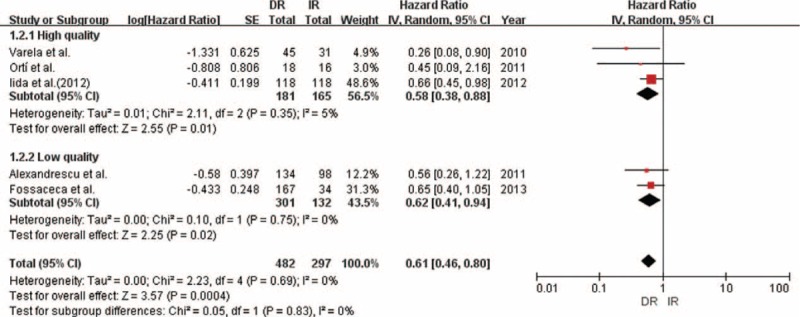
The angiosome concept provides practical information regarding the vascular anatomy of reconstructive and vascular surgery for the treatment of peripheral arterial occlusive disease and, particularly, critical lower limb ischemia.The aim of the study was to confirm the efficacy of direct revascularization with the angiosome concept (DR) for lower limb ischemia.Complementary manual searches were performed through the Pubmed, Cochrane Library, and EMBASE databases.We searched all randomized and nonrandomized studies (NRSs) comparing DR with indirect revascularization (IR) (without the angiosome concept) for lower limb ischemia. Only 9 nonrandomized controlled retrospective cohort studies were found and included. Trials published in any language were included.Primary endpoints were time to limb amputation and time to wound healing. Data extraction and trial quality assessment were performed by two authors independently. A third author was consulted for disagreements settlement and quality assurance.Five NRSs involving 779 lower limbs revealed that DR significantly improved the overall survival of limbs (hazard ratio [HR] 0.61; 95% confidence interval [CI] = 0.46-0.80; P < 0.001; I = 0%). In addition, DR significantly improved time to wound healing (HR 1.38; 95% CI = 1.13-1.69; P = 0.002; I = 0%, in 5 studies including 605 limbs).All included studies were retrospective comparative studies, and no consensus was obtained in describing wound conditions in the included studies.Our results suggested that treatment of lower limb ischemia using DR is more effective in salvaging limbs and healing wounds than IR is. Additional randomized controlled studies are necessary to confirm these results.
血管体概念为治疗外周动脉闭塞性疾病,尤其是严重下肢缺血的重建和血管手术的血管解剖学提供了实用信息。本研究的目的是证实采用血管体概念的直接血运重建术(DR)治疗下肢缺血的疗效。通过Pubmed、Cochrane图书馆和EMBASE数据库进行了补充手工检索。我们检索了所有比较DR与间接血运重建术(IR,不采用血管体概念)治疗下肢缺血的随机和非随机研究(NRSs)。仅发现并纳入了9项非随机对照回顾性队列研究。纳入了以任何语言发表的试验。主要终点为肢体截肢时间和伤口愈合时间。由两名作者独立进行数据提取和试验质量评估。如有分歧,则咨询第三位作者以解决分歧并确保质量。5项涉及779条下肢的NRSs显示,DR显著提高了肢体的总体存活率(风险比[HR]0.61;95%置信区间[CI]=0.46-0.80;P<0.001;I=0%)。此外,DR显著缩短了伤口愈合时间(HR 1.38;95%CI=1.13-1.69;P=0.002;I=0%,在包括605条肢体的5项研究中)。所有纳入研究均为回顾性比较研究,在所纳入研究中描述伤口情况时未达成共识。我们的结果表明,与IR相比,采用DR治疗下肢缺血在挽救肢体和伤口愈合方面更有效。需要更多的随机对照研究来证实这些结果。