Halasa Natasha, Williams John, Faouri Samir, Shehabi Asem, Vermund Sten H, Wang Li, Fonnesbeck Christopher, Khuri-Bulos Najwa
Departments of Pediatrics, Vanderbilt University, Nashville, TN, USA; Institute for Global Health, Vanderbilt University, Nashville, TN, USA.
Department of Pediatrics, University of Pittsburgh, Pittsburgh, PA, USA.
Vaccine. 2015 Nov 25;33(47):6479-87. doi: 10.1016/j.vaccine.2015.08.048. Epub 2015 Aug 24.
Respiratory syncytial virus (RSV) is the leading cause of bronchiolitis and viral pneumonia in infants and young children worldwide. In the Middle East and Arab countries, the burden of RSV-associated hospitalizations is not well characterized. We sought to determine the burden and clinical/epidemiological characteristics of RSV hospitalization in young children in Amman, Jordan. We investigated risk factors for severity including vitamin D levels.
We conducted viral surveillance with clinical and demographic data in children <2 years admitted with respiratory symptoms and/or fever at the Al-Bashir Government Hospital from March16, 2010 to March 31, 2013. Nasal/throat swabs were obtained and placed into lysis buffer, and frozen at -80°C until testing by real-time RT-PCR for 11 respiratory viruses. Heel stick blood or sera samples for 25-hydroxyvitamin D [25(OH)D] levels were obtained and sent to a central laboratory for mass spectrometry.
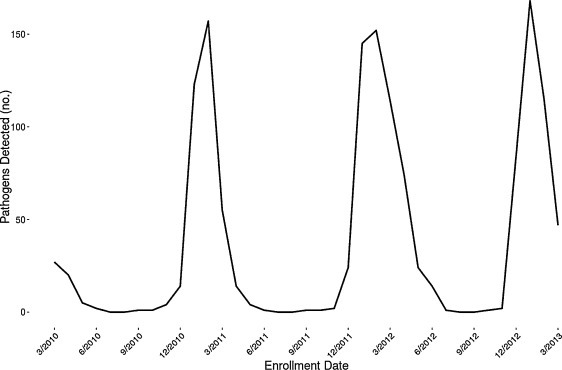
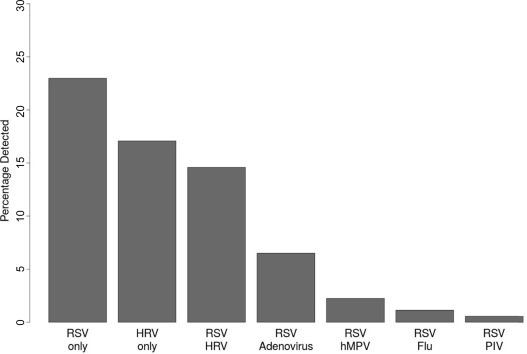
Of the 3168 children, >80% testing positive for one virus, with RSV the most common virus detected (44%). The RSV-associated hospitalization rate was highest in children <6 months with an annual range of 21.1-25.9 per 1000, compared to 6.0-8.0 in 6-11-month-olds and 1.6-2.5 in 12-23-month-olds. RSV-positive children compared with RSV-negative were more likely to be previously healthy without underlying medical conditions, less likely to be born prematurely, had a higher frequency of supplemental oxygen use, and had lower median vitamin D levels. Risk factors for oxygen use in RSV-positive children included underlying medical conditions, lack of breastfeeding, younger age, and higher viral load.
RSV is a major cause of illness in hospitalized Jordanian children and is associated with increased severity compared to other respiratory viruses. Children with RSV in the Middle East would benefit from future RSV vaccines and antiviral therapy.
呼吸道合胞病毒(RSV)是全球婴幼儿毛细支气管炎和病毒性肺炎的主要病因。在中东和阿拉伯国家,RSV相关住院负担的特征尚不明确。我们试图确定约旦安曼市幼儿RSV住院的负担以及临床/流行病学特征。我们研究了包括维生素D水平在内的严重程度风险因素。
2010年3月16日至2013年3月31日期间,我们在Al-Bashir政府医院对因呼吸道症状和/或发热入院的2岁以下儿童进行了病毒监测,并收集了临床和人口统计学数据。采集鼻/咽拭子并置于裂解缓冲液中,在-80°C下冷冻,直至通过实时逆转录聚合酶链反应检测11种呼吸道病毒。采集足跟血或血清样本检测25-羟维生素D[25(OH)D]水平,并送至中央实验室进行质谱分析。
在3168名儿童中,超过80%的儿童检测出一种病毒呈阳性,其中RSV是最常见的检测到的病毒(44%)。RSV相关住院率在6个月以下儿童中最高,每年每1000例中有21.1-25.9例,相比之下,6-11个月大的儿童为6.0-8.0例,12-23个月大的儿童为1.6-2.5例。与RSV阴性儿童相比,RSV阳性儿童更可能既往健康无基础疾病,早产可能性更小,补充氧气使用频率更高,且维生素D中位数水平更低。RSV阳性儿童使用氧气的风险因素包括基础疾病、未母乳喂养、年龄较小和病毒载量较高。
RSV是约旦住院儿童疾病的主要病因,与其他呼吸道病毒相比,其严重程度更高。中东地区感染RSV的儿童将从未来的RSV疫苗和抗病毒治疗中受益。