Biter L Ulas, Gadiot Ralph P M, Grotenhuis Brechtje A, Dunkelgrün Martin, van Mil Stefanie R, Zengerink Hans J J, Smulders J Frans, Mannaerts Guido H H
Department of Surgery, St. Franciscus Gasthuis, Rotterdam, The Netherlands.
Department of Surgery, Catharina Ziekenhuis, Eindhoven, The Netherlands.
BMC Obes. 2015 Aug 26;2:30. doi: 10.1186/s40608-015-0058-0. eCollection 2015.
Obesity is an increasing disease worldwide. Bariatric surgery is the only effective therapy to induce sufficient long-term weight loss for morbidly obese patients. Laparoscopic Roux-en-Y Gastric Bypass (LRYGB) is the gold standard surgical technique. Laparoscopic Sleeve Gastrectomy (LSG) is a new promising bariatric procedure which has the advantage of maintaining an intact gastrointestinal tract. The aim of this study is to evaluate the efficiency of both techniques. Our hypothesis is that LSG has a similar percentage excess BMI loss (%EBMIL) after 5 years compared to LRYGB.
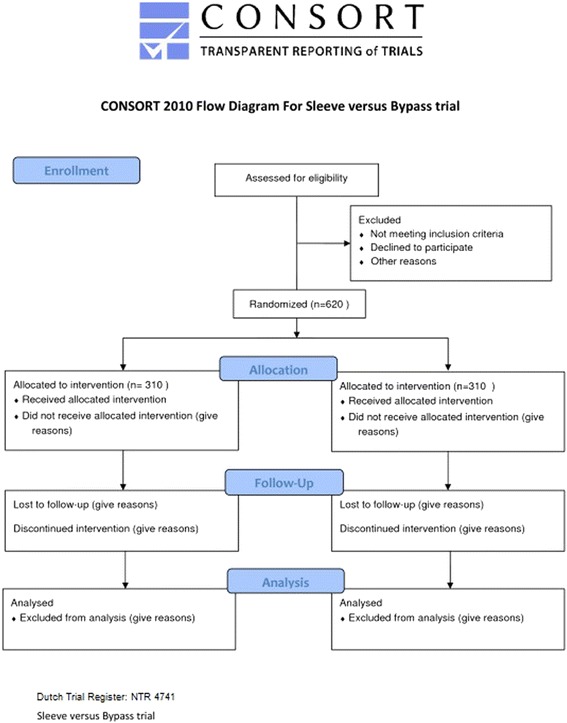
METHODS/DESIGN: The Sleeve Bypass Trial is a randomized multicentre clinical trial: patients eligible for bariatric surgery are randomized to either LSG or LRYGB. Patients with a body mass index (BMI) ≥ 40 kg/m(2) or BMI 35 kg/m(2) with obesity related comorbidity (T2 DM, sleep apnoea, hypertension) are eligible for randomization. At randomization patients are stratified for centre, sex, T2 DM and BMI ≥ 50 kg/m(2). A total number of 620 patients will be enrolled and equally (1:1) randomized to both treatment arms. Only surgeons experienced in both operation techniques will participate in the Sleeve Bypass trial. The primary endpoint is the 5-year weight loss (%EBMIL) of LSG and LRYGB. Secondary endpoints are resolution of obesity related comorbidity, complications, revision bariatric surgery and quality of life (QOL) defined in various questionnaires.
Long-term %EBMIL between the two treatment strategies used to be in favour of LRYGB, but more recent results throughout the world show similar %EBMIL in both techniques. If weight loss is comparable, obesity-related comorbidity and QOL after bariatric procedures should be taken into account when deciding on which surgical technique is to be preferred for certain subgroups in the future.
Dutch Trial Register: NTR 4741.
肥胖症在全球范围内呈日益增多之势。减重手术是为病态肥胖患者实现充分长期体重减轻的唯一有效疗法。腹腔镜Roux-en-Y胃旁路术(LRYGB)是金标准手术技术。腹腔镜袖状胃切除术(LSG)是一种新的有前景的减重手术,其优点是保持胃肠道完整。本研究的目的是评估这两种技术的疗效。我们的假设是,与LRYGB相比,LSG在5年后的超重BMI损失百分比(%EBMIL)相似。
方法/设计:袖状胃旁路试验是一项随机多中心临床试验:符合减重手术条件的患者被随机分为LSG组或LRYGB组。体重指数(BMI)≥40kg/m²或BMI 35kg/m²且伴有肥胖相关合并症(2型糖尿病、睡眠呼吸暂停、高血压)的患者符合随机分组条件。随机分组时,患者按中心、性别、2型糖尿病和BMI≥50kg/m²进行分层。总共将招募620名患者,并等比例(1:1)随机分配至两个治疗组。只有对两种手术技术都有经验的外科医生才会参与袖状胃旁路试验。主要终点是LSG和LRYGB的5年体重减轻情况(%EBMIL)。次要终点是肥胖相关合并症的缓解、并发症、减重手术翻修以及各种问卷所定义的生活质量(QOL)。
过去两种治疗策略的长期%EBMIL更倾向于LRYGB,但世界各地最近的结果显示两种技术的%EBMIL相似。如果体重减轻情况相当,那么在未来为某些亚组患者选择哪种手术技术时,应考虑减重手术后的肥胖相关合并症和QOL。
荷兰试验注册库:NTR 4741。