Müller-Redetzky Holger, Lienau Jasmin, Suttorp Norbert, Witzenrath Martin
Dept of Infectious Diseases and Pulmonary Medicine, Charité - Universitätsmedizin Berlin, Berlin, Germany.
Dept of Infectious Diseases and Pulmonary Medicine, Charité - Universitätsmedizin Berlin, Berlin, Germany
Eur Respir Rev. 2015 Sep;24(137):516-24. doi: 10.1183/16000617.0034-2015.
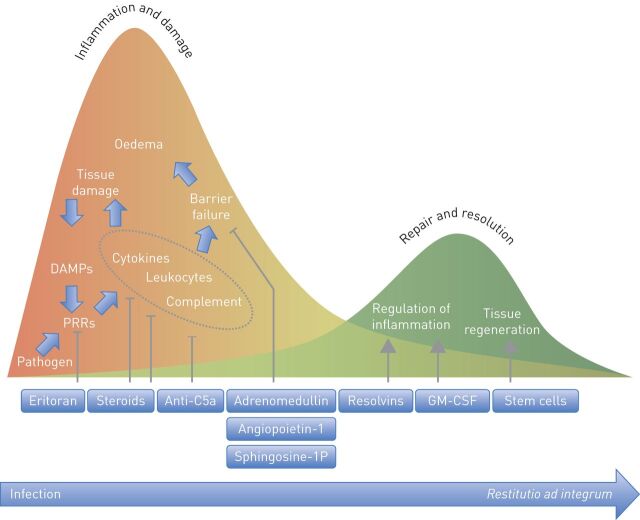
Dysregulation of the innate immune system drives lung injury and its systemic sequelae due to breakdown of vascular barrier function, harmful hyperinflammation and microcirculatory failure, which contribute to the unfavourable outcome of patients with severe pneumonia. A variety of promising therapeutic targets have been identified and numerous innovative therapeutic approaches demonstrated to improve lung injury in experimental preclinical studies. However, at present specific preventive or curative strategies for the treatment of lung failure in pneumonia in addition to antibiotics are still missing. The aim of this mini-review is to give a short overview of some, but not all, adjuvant therapeutic strategies for pneumonia and its most important complications, sepsis and acute respiratory distress syndrome, and briefly discuss future perspectives.
先天性免疫系统失调会导致肺损伤及其全身后遗症,原因包括血管屏障功能破坏、有害的过度炎症反应和微循环衰竭,这些因素会导致重症肺炎患者预后不良。在临床前实验研究中,已经确定了多种有前景的治疗靶点,并证明了许多创新治疗方法可改善肺损伤。然而,目前除抗生素外,仍缺乏治疗肺炎所致肺衰竭的特异性预防或治疗策略。本综述的目的是简要概述一些(而非全部)针对肺炎及其最重要并发症(脓毒症和急性呼吸窘迫综合征)的辅助治疗策略,并简要讨论未来前景。