Pomeroy Laura W, Bjørnstad Ottar N, Kim Hyeyoung, Jumbo Simon Dickmu, Abdoulkadiri Souley, Garabed Rebecca
Department of Veterinary Preventive Medicine, Ohio State University, Columbus, OH, United States of America.
Department of Biology, Pennsylvania State University, University Park, PA, United States of America; Department of Entomology, Pennsylvania State University, University Park, PA, United States of America; Center for Infectious Disease Dynamics, The Pennsylvania State University, University Park, Pennsylvania, United States of America; Fogarty International Center, National Institutes of Health, Bethesda, Maryland, United States of America.
PLoS One. 2015 Sep 1;10(9):e0136642. doi: 10.1371/journal.pone.0136642. eCollection 2015.
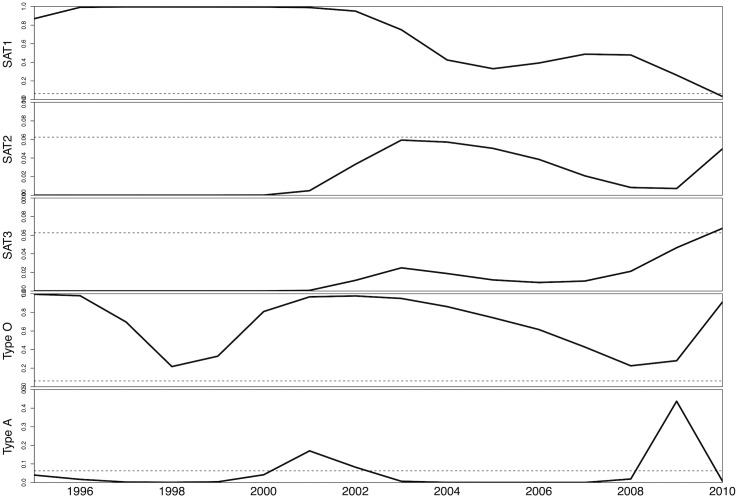
Foot-and-mouth disease virus (FMDV) causes morbidity and mortality in a range of animals and threatens local economies by acting as a barrier to international trade. The outbreak in the United Kingdom in 2001 that cost billions to control highlighted the risk that the pathogen poses to agriculture. In response, several mathematical models have been developed to parameterize and predict both transmission dynamics and optimal disease control. However, a lack of understanding of the multi-strain etiology prevents characterization of multi-strain dynamics. Here, we use data from FMDV serology in an endemic setting to probe strain-specific transmission and immunodynamics. Five serotypes of FMDV affect cattle in the Far North Region of Cameroon. We fit both catalytic and reverse catalytic models to serological data to estimate the force of infection and the rate of waning immunity, and to detect periods of sustained transmission. For serotypes SAT2, SAT3, and type A, a model assuming life-long immunity fit better. For serotypes SAT1 and type O, the better-fit model suggests that immunity may wane over time. Our analysis further indicates that type O has the greatest force of infection and the longest duration of immunity. Estimates for the force of infection were time-varying and indicated that serotypes SAT1 and O displayed endemic dynamics, serotype A displayed epidemic dynamics, and SAT2 and SAT3 did not sustain local chains of transmission. Since these results were obtained from the same population at the same time, they highlight important differences in transmission specific to each serotype. They also show that immunity wanes at rates specific to each serotype, which influences patterns of local persistence. Overall, this work shows that viral serotypes can differ significantly in their epidemiological and immunological characteristics. Patterns and processes that drive transmission in endemic settings must consider complex viral dynamics for accurate representation and interpretation.
口蹄疫病毒(FMDV)可导致多种动物发病和死亡,并因阻碍国际贸易而威胁当地经济。2001年英国爆发的口蹄疫疫情,控制成本高达数十亿美元,凸显了该病原体对农业构成的风险。作为回应,已开发出几种数学模型来参数化和预测传播动态及最佳疾病控制措施。然而,由于对多毒株病因缺乏了解,无法对多毒株动态进行特征描述。在此,我们利用地方流行环境中口蹄疫病毒血清学数据来探究毒株特异性传播和免疫动态。口蹄疫病毒的五种血清型影响喀麦隆远北地区的牛群。我们将催化模型和反向催化模型与血清学数据进行拟合,以估计感染强度和免疫衰退率,并检测持续传播期。对于血清型SAT2、SAT3和A型,假设终身免疫的模型拟合效果更好。对于血清型SAT1和O型,拟合效果更好的模型表明免疫力可能会随时间减弱。我们的分析进一步表明,O型具有最大的感染强度和最长的免疫持续时间。感染强度估计值随时间变化,表明血清型SAT1和O型呈现地方流行动态,血清型A型呈现流行动态,而SAT2和SAT3未维持本地传播链。由于这些结果是在同一时间从同一人群中获得的,它们突出了每种血清型在传播方面的重要差异。它们还表明,每种血清型的免疫力以特定速率减弱,这会影响本地持续存在模式。总体而言,这项工作表明病毒血清型在流行病学和免疫学特征上可能存在显著差异。在地方流行环境中驱动传播的模式和过程必须考虑复杂的病毒动态,以便进行准确的呈现和解释。