School of Life Sciences, University of Warwick, Gibbet Hill Road, Coventry, United Kingdom.
Prev Vet Med. 2012 Jun 1;105(1-2):110-7. doi: 10.1016/j.prevetmed.2011.12.016. Epub 2012 Feb 8.
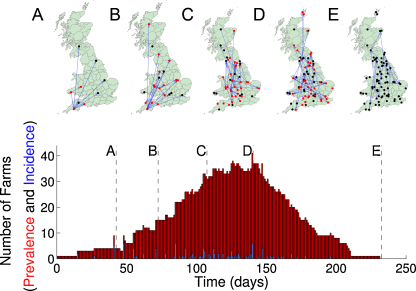
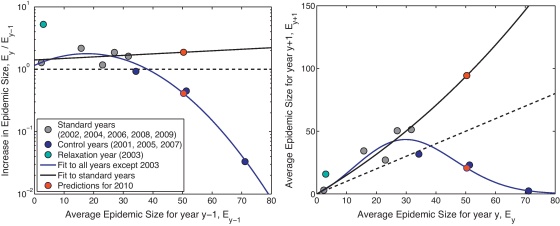
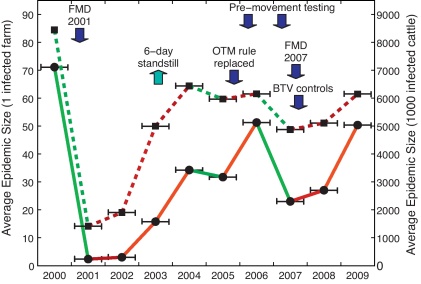
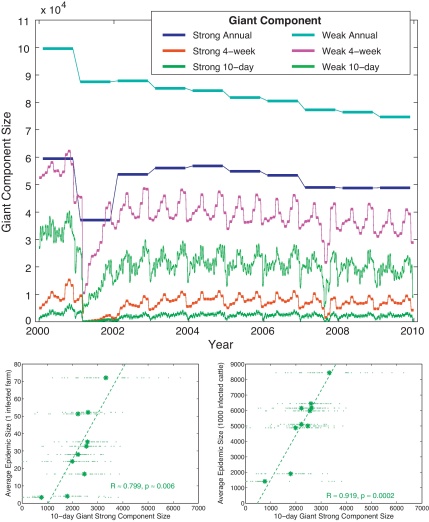
During the past decade the British livestock industry has suffered from several major pathogen outbreaks, and a variety of regulatory and disease control measures have been applied to the movement of livestock with the express aim of mitigating the spread of infection. The Rapid Analysis and Detection of Animal-related Risks (RADAR) project, which has been collecting data on the movement of cattle since 1998, provides a relatively comprehensive record of how these policies have influenced the movement of cattle between animal holdings, markets, and slaughterhouses in Britain. Many previous studies have focused on the properties of the network that can be derived from these movements--treating farms as nodes and movements as directed (and potentially weighted) edges in the network. However, of far greater importance is how these policy changes have influenced the potential spread of infectious diseases. Here we use a stochastic fully individual-based model of cattle in Britain to assess how the epidemic potential has varied from 2000 to 2009 as the pattern of movements has changed in response to legislation and market forces. Our simulations show that the majority of policy changes lead to significant decreases in the epidemic potential (measured in multiple ways), but that this potential then increases through time as cattle farmers modify their behaviour in response. Our results suggest that the cattle industry is likely to experience boom-bust dynamics, with the actions that farmers take during epidemic-free periods to maximise their profitability likely to increase the potential for large-scale epidemics to occur.
在过去的十年中,英国的畜牧业遭受了几次重大病原体爆发的影响,为了减轻感染的传播,已经采取了各种监管和疾病控制措施来控制牲畜的流动。自 1998 年以来一直在收集有关牛群流动数据的快速分析和检测动物相关风险(RADAR)项目,为这些政策如何影响英国牲畜养殖场、市场和屠宰场之间的牛群流动提供了相对全面的记录。许多先前的研究都集中在可以从这些运动中得出的网络特性上-将农场视为网络中的节点,将运动视为有向(和潜在加权)的边缘。然而,更为重要的是这些政策变化如何影响传染病的潜在传播。在这里,我们使用英国牛的随机完全个体模型来评估随着立法和市场力量的变化,运动模式的变化如何导致 2000 年至 2009 年的流行病潜力发生变化。我们的模拟表明,大多数政策变化都会导致流行病潜力(以多种方式衡量)显著降低,但随着农民为应对疫情而改变行为,这种潜力会随着时间的推移而增加。我们的研究结果表明,牛产业可能会经历繁荣-萧条的动态变化,农民在无疫情期间为最大程度地提高利润而采取的行动可能会增加大规模疫情发生的可能性。