Beydoun May A, Beydoun Hind A, Rostant Ola S, Dore Greg A, Fanelli-Kuczmarski Marie T, Evans Michele K, Zonderman Alan B
NIH Biomedical Research Center, National Institute on Aging, NIA/NIH/IRP, Baltimore, MD, USA.
Graduate Program in Public Health, Eastern Virginia Medical School, Norfolk, VA, USA.
Neurobiol Aging. 2015 Nov;36(11):3056-3066. doi: 10.1016/j.neurobiolaging.2015.08.002. Epub 2015 Aug 8.
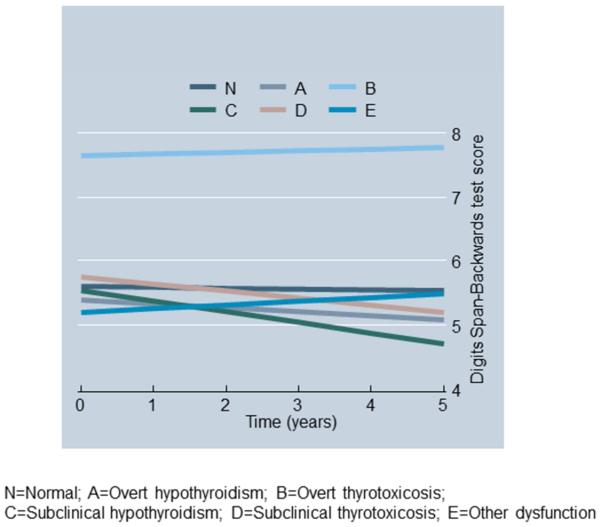
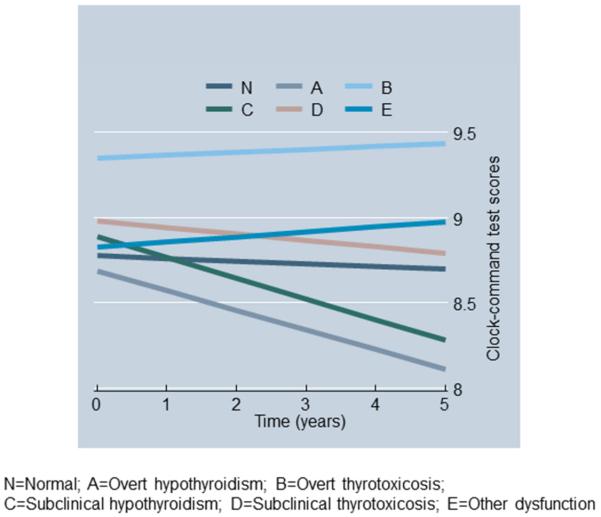
Recent evidence indicates that thyroid hormones may be closely linked to cognition among adults. We investigated associations between thyroid hormones and longitudinal cognitive change, within and outside of reference ranges, stratifying by sex and race. This longitudinal study used data from the Healthy Aging in Neighborhoods of Diversity Across the Lifespan study, set in Baltimore City, MD, 2004-2013, on adults aged 30-64 years at baseline visit, with a length of follow-up between visits 1 and 2 ranging from <1 to 8 years; mean ± standard deviation: 4.64 ± 0.93. The final analytic sample sizes ranged from 1486 to 1602 participants with 1.6-1.7 visits per participant (total visits: 2496-2757), depending on the cognitive test. Eleven cognitive test scores spanning domains of learning or memory, language or verbal, attention, visuospatial and/or visuoconstruction, psychomotor speed, executive function, and mental status were used. Mixed-effects regression models were conducted, interacting time of follow-up with several thyroid exposures. Whites performed better than African Americans, with only 4 cognitive test scores of 11 declining significantly over time. Importantly, above reference range thyroid stimulating hormone (vs. reference range, thyroid stimulating hormone, above reference range [TSHarr]) was linked to faster rates of decline on the digits span backwards test, reflecting working memory (TSHarr × time γ ± standard error: -0.14 ± 0.05, p = 0.006) and clock-command, at test of visuospatial and/or visuoconstruction abilities (TSHarr × Time γ ± standard error: -0.10 ± 0.04, p = 0.004). The latter finding was replicated when comparing normal thyroid function to "subclinical hypothyroidism". Within-reference ranges, a higher thyroid stimulating hormone was related to faster decline on the clock-command test scores in women. In sum, higher baseline thyroid stimulating hormone was associated with faster cognitive decline over-time among urban US adults, specifically in domains of working memory and visuospatial and/or visuoconstruction abilities.
近期证据表明,甲状腺激素可能与成年人的认知密切相关。我们研究了甲状腺激素与纵向认知变化之间的关联,包括参考范围以内和以外的情况,并按性别和种族进行分层。这项纵向研究使用了“全生命周期多元社区健康老龄化”研究的数据,该研究于2004年至2013年在马里兰州巴尔的摩市开展,研究对象为基线访视时年龄在30至64岁之间的成年人,第1次和第2次访视之间的随访时长为<1至8年;均值±标准差:4.64±0.93。最终分析样本量为1486至1602名参与者,每位参与者有1.6至1.7次访视(总访视次数:2496至2757次),具体取决于认知测试。使用了11项认知测试分数,涵盖学习或记忆、语言或言语、注意力、视觉空间和/或视觉构建、心理运动速度、执行功能以及精神状态等领域。进行了混合效应回归模型分析,将随访时间与几种甲状腺暴露因素进行交互分析。白人的表现优于非裔美国人,11项认知测试分数中只有4项随时间显著下降。重要的是,高于参考范围的促甲状腺激素(与参考范围相比,高于参考范围的促甲状腺激素[TSHarr])与数字倒背测试(反映工作记忆)的更快下降速度相关(TSHarr×时间γ±标准误:-0.14±0.05,p=0.006),以及与视觉空间和/或视觉构建能力测试中的时钟指令测试相关(TSHarr×时间γ±标准误:-0.10±0.04,p=0.004)。当将正常甲状腺功能与“亚临床甲状腺功能减退”进行比较时,后一项发现得到了重复验证。在参考范围内,较高的促甲状腺激素与女性时钟指令测试分数的更快下降相关。总之,较高的基线促甲状腺激素与美国城市成年人随时间更快的认知衰退相关,特别是在工作记忆以及视觉空间和/或视觉构建能力领域。