Choi Ji Hae, Jang A Yeung, Lin Shunmei, Lim Sangyong, Kim Dongho, Park Kyungho, Han Sang-Mi, Yeo Joo-Hong, Seo Ho Seong
Radiation Biotechnology Research Division, Advanced Radiation Technology Institute, Korea Atomic Energy Research Institute, Jeongeup Si, North Jeolla 580‑185, Republic of Korea.
Department of Dermatology, University of California, San Francisco and Northern California Institute for Research and Education, San Francisco, CA 94121, USA.
Mol Med Rep. 2015 Nov;12(5):6483-90. doi: 10.3892/mmr.2015.4275. Epub 2015 Sep 1.
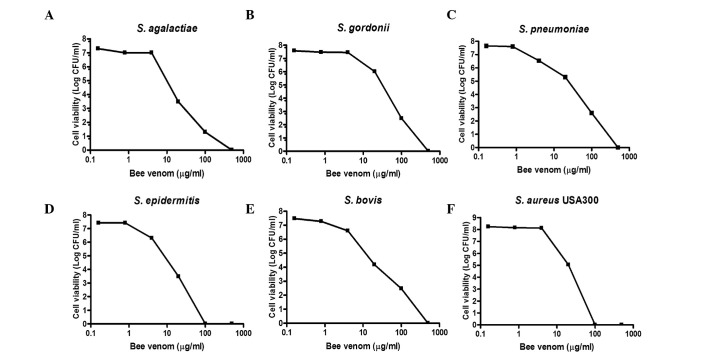
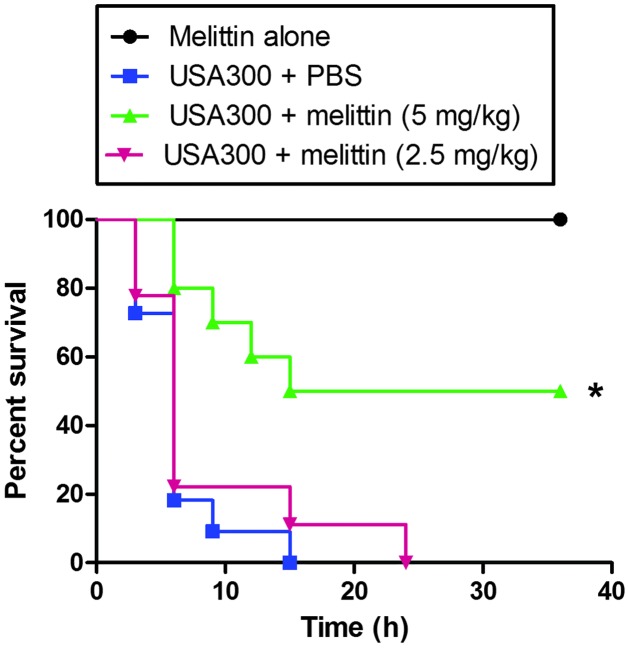
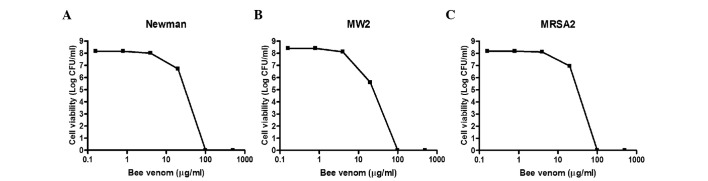
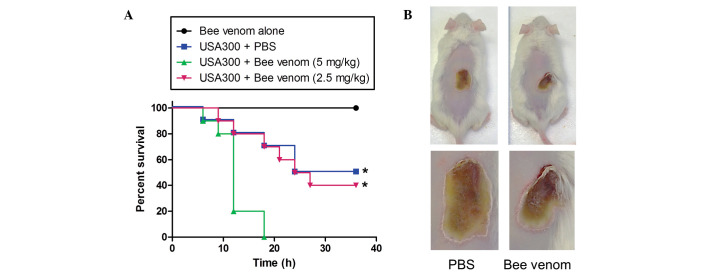
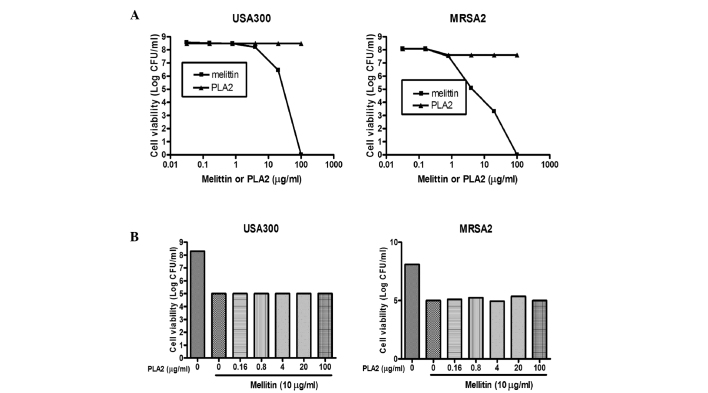
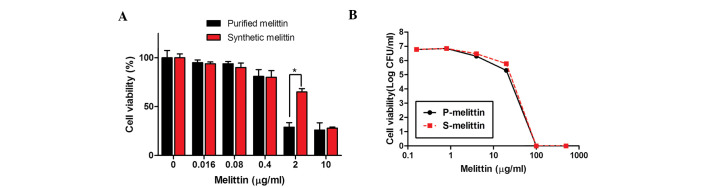
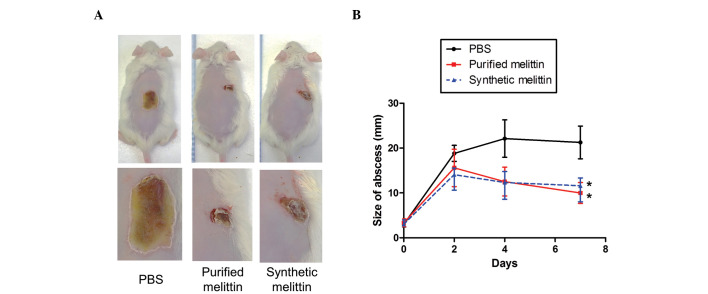
Methicillin‑resistant Staphylococcus aureus (MRSA) is difficult to treat using available antibiotic agents. Honeybee venom has been widely used as an oriental treatment for several inflammatory diseases and bacterial infections. The venom contains predominantly biologically active compounds, however, the therapeutic effects of such materials when used to treat MRSA infections have not been investigated extensively. The present study evaluated bee venom and its principal active component, melittin, in terms of their antibacterial activities and in vivo protection against MRSA infections. In vitro, bee venom and melittin exhibited comparable levels of antibacterial activity, which was more marked against MRSA strains, compared with other Gram‑positive bacteria. When MRSA‑infected mice were treated with bee venom or melittin, only the latter animals were successfully rescued from MRSA‑ induced bacteraemia or exhibited recovery from MRSA‑infected skin wounds. Together, the data of the present study demonstrated for the first time, to the best of our knowledge, that melittin may be used as a promising antimicrobial agent to enhance the healing of MRSA‑induced wounds.
耐甲氧西林金黄色葡萄球菌(MRSA)难以用现有的抗生素药物进行治疗。蜂毒已被广泛用作治疗多种炎症性疾病和细菌感染的东方疗法。蜂毒主要含有生物活性化合物,然而,这些物质用于治疗MRSA感染时的治疗效果尚未得到广泛研究。本研究评估了蜂毒及其主要活性成分蜂毒肽的抗菌活性以及对MRSA感染的体内保护作用。在体外,蜂毒和蜂毒肽表现出相当的抗菌活性水平,与其他革兰氏阳性菌相比,对MRSA菌株的抗菌活性更显著。当用蜂毒或蜂毒肽治疗感染MRSA的小鼠时,只有后者成功地从MRSA诱导的菌血症中获救或从MRSA感染的皮肤伤口中恢复。本研究的数据首次表明,据我们所知,蜂毒肽可能作为一种有前景的抗菌剂来促进MRSA诱导伤口的愈合。