
β-神经生长因子在骨缺损修复过程中促进神经发生和血管生成。
Beta-nerve growth factor promotes neurogenesis and angiogenesis during the repair of bone defects.
作者信息
Chen Wei-Hui, Mao Chuan-Qing, Zhuo Li-Li, Ong Joo L
机构信息
Department of Oral Surgery, Union Hospital, Fujian Medical University, Fuzhou, Fujian Province, China.
Department of Biomedical Engineering, University of Texas at San Antonio, San Antonio, TX, USA.
出版信息
Neural Regen Res. 2015 Jul;10(7):1159-65. doi: 10.4103/1673-5374.160114.
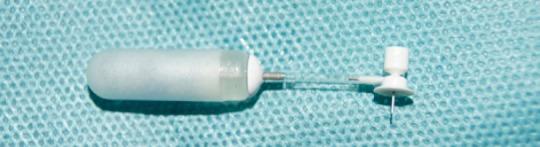
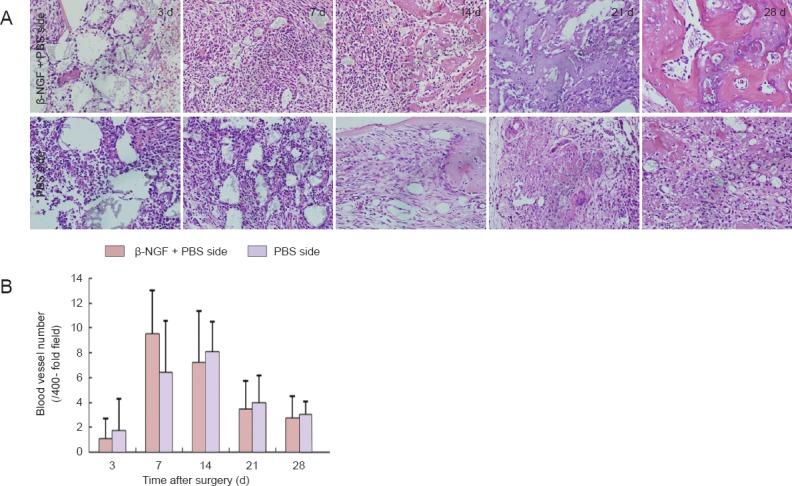
We previously showed that the repair of bone defects is regulated by neural and vascular signals. In the present study, we examined the effect of topically applied β-nerve growth factor (β-NGF) on neurogenesis and angiogenesis in critical-sized bone defects filled with collagen bone substitute. We created two symmetrical defects, 2.5 mm in diameter, on either side of the parietal bone of the skull, and filled them with bone substitute. Subcutaneously implanted osmotic pumps were used to infuse 10 μg β-NGF in PBS (β-NGF + PBS) into the right-hand side defect, and PBS into the left (control) defect, over the 7 days following surgery. Immunohistochemical staining and hematoxylin-eosin staining were carried out at 3, 7, 14, 21 and 28 days postoperatively. On day 7, expression of β III-tubulin was lower on the β-NGF + PBS side than on the control side, and that of neurofilament 160 was greater. On day 14, β III-tubulin and protein gene product 9.5 were greater on the β-NGF + PBS side than on the control side. Vascular endothelial growth factor expression was greater on the experimental side than the control side at 7 days, and vascular endothelial growth factor receptor 2 expression was elevated on days 14 and 21, but lower than control levels on day 28. However, no difference in the number of blood vessels was observed between sides. Our results indicate that topical application of β-NGF promoted neurogenesis, and may modulate angiogenesis by promoting nerve regeneration in collagen bone substitute-filled defects.
我们之前表明,骨缺损的修复受神经和血管信号调控。在本研究中,我们检测了局部应用β-神经生长因子(β-NGF)对填充胶原骨替代物的临界尺寸骨缺损中神经发生和血管生成的影响。我们在颅骨顶骨两侧制造了两个对称的直径为2.5毫米的缺损,并将其填充骨替代物。在术后7天内,使用皮下植入的渗透泵将10μg溶于磷酸盐缓冲液(PBS)的β-NGF(β-NGF + PBS)注入右侧缺损,将PBS注入左侧(对照)缺损。术后3、7、14、21和28天进行免疫组织化学染色和苏木精-伊红染色。在第7天,β-NGF + PBS侧βIII-微管蛋白的表达低于对照侧,而神经丝160的表达更高。在第14天,β-NGF + PBS侧βIII-微管蛋白和蛋白基因产物9.5的表达高于对照侧。在第7天,实验侧血管内皮生长因子的表达高于对照侧,在第14天和21天血管内皮生长因子受体2的表达升高,但在第28天低于对照水平。然而,两侧血管数量未观察到差异。我们的结果表明,局部应用β-NGF可促进神经发生,并可能通过促进填充胶原骨替代物的缺损中的神经再生来调节血管生成。



 Zotero 插件