Bonner Kimberly, Welch Emily, Elder Kate, Cohn Jennifer
Médecins Sans Frontières, Access Campaign, Geneva, Switzerland.
School of Public Health, Boston University, Boston, Massachusetts, United States of America.
PLoS One. 2015 Sep 2;10(8):e0135270. doi: 10.1371/journal.pone.0135270. eCollection 2015.
Pneumococcal conjugate vaccine (PCV) is included in the World Health Organization's routine immunization schedule and is recommended by WHO for vaccination in high-risk children up to 60 months. However, many countries do not recommend vaccination in older age groups, nor have donors committed to supporting extended age group vaccination. To better inform decision-making, this systematic review examines the direct impact of extended age group vaccination in children over 12 months in low and middle income countries.
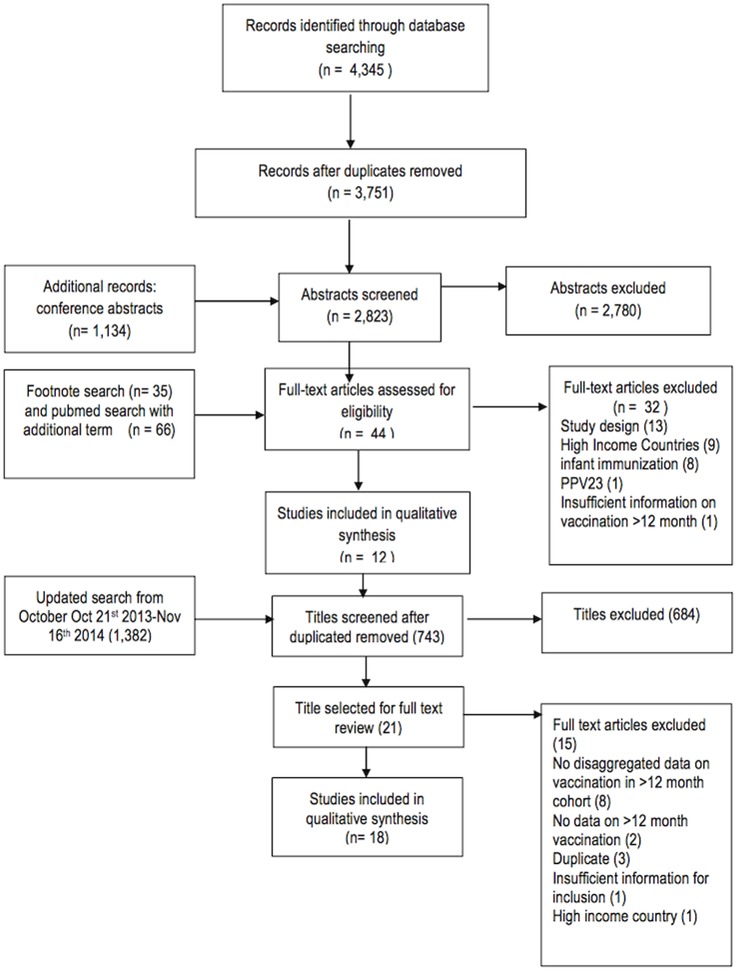
An a priori protocol was used. Using pre-specified terms, a search was conducted using PubMed, LILACS, Cochrane Infectious Diseases Group Specialized Register, Cochrane Central Register of Controlled Trials, CAB Abstracts, clinicaltrials.gov and the International Symposium on Pneumococci and Pneumococcal Diseases abstracts. The primary outcome was disease incidence, with antibody titers and nasopharyngeal carriage included as secondary outcomes.
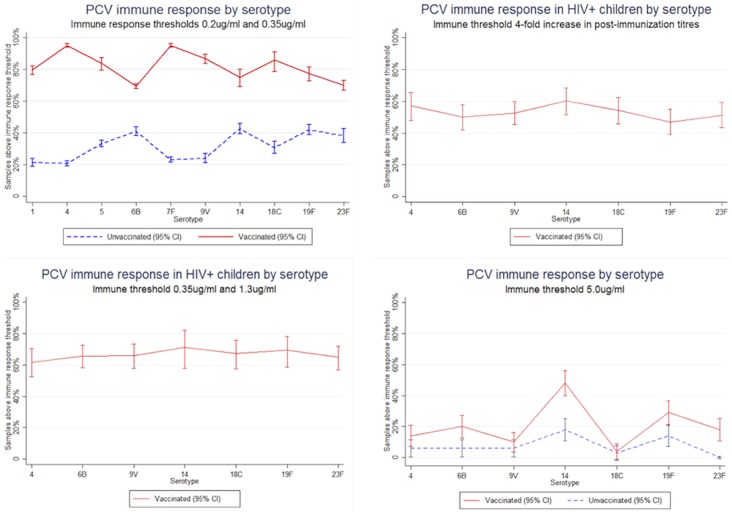
Eighteen studies reported on disease incidence, immune response, and nasopharyngeal carriage. PCV administered after 12 months of age led to significant declines in invasive pneumococcal disease. Immune response to vaccine type serotypes was significantly higher for those vaccinated at older ages than the unimmunized at the established 0.2 ug/ml and 0.35 ug/ml thresholds. Vaccination administered after one year of age significantly reduced VT carriage with odds ratios ranging from 0.213 to 0.69 over four years. A GRADE analysis indicated that the studies were of high quality.
PCV administration in children over 12 months leads to significant protection. The direct impact of PCV administration, coupled with the large cohort of children missed in first year vaccination, indicates that countries should initiate or expand PCV immunization for extended age group vaccinations. Donors should support implementation of PCV as part of delayed or interrupted immunization for older children. For countries to effectively implement extended age vaccinations, access to affordably-priced PCV is critical.
肺炎球菌结合疫苗(PCV)已被列入世界卫生组织的常规免疫规划,世界卫生组织建议对60个月以下的高危儿童进行接种。然而,许多国家不建议在年龄较大的人群中接种疫苗,捐赠者也未承诺支持扩大年龄组的疫苗接种。为了更好地为决策提供依据,本系统评价研究了在低收入和中等收入国家对12个月以上儿童扩大年龄组接种疫苗的直接影响。
采用预先制定的方案。使用预先指定的检索词,通过PubMed、LILACS、Cochrane传染病组专业注册库、Cochrane对照试验中心注册库、CAB文摘数据库、clinicaltrials.gov以及肺炎球菌和肺炎球菌疾病国际研讨会摘要进行检索。主要结局为疾病发病率,抗体滴度和鼻咽部携带情况作为次要结局。
18项研究报告了疾病发病率、免疫反应和鼻咽部携带情况。12月龄后接种PCV可使侵袭性肺炎球菌疾病显著下降。在既定的0.2μg/ml和0.35μg/ml阈值下,年龄较大时接种疫苗的人群对疫苗型血清型的免疫反应明显高于未接种疫苗的人群。1岁后接种疫苗在4年内使VT携带率显著降低,比值比范围为0.213至0.69。GRADE分析表明这些研究质量较高。
对12个月以上儿童接种PCV可提供显著保护。接种PCV的直接影响,再加上第一年疫苗接种中大量漏种的儿童群体,表明各国应启动或扩大PCV免疫接种以进行扩大年龄组接种。捐赠者应支持将PCV作为大龄儿童延迟或中断免疫接种的一部分来实施。对于各国有效实施扩大年龄组接种,获得价格可承受的PCV至关重要。