Kerkhof Karen, Canier Lydie, Kim Saorin, Heng Somony, Sochantha Tho, Sovannaroth Siv, Vigan-Womas Inès, Coosemans Marc, Sluydts Vincent, Ménard Didier, Durnez Lies
Department of Biomedical Sciences, Institute of Tropical Medicine, Antwerp, Belgium.
Department of Biomedical Sciences, University of Antwerp, Antwerp, Belgium.
Malar J. 2015 Sep 4;14:338. doi: 10.1186/s12936-015-0868-z.
Epidemiological surveillance is a key activity in malaria control and elimination in low-transmission and pre-elimination settings. Hence, sensitive tools for estimating malaria force of infection are crucial. Serological markers might provide additional information in estimating force of infection in low-endemic areas along with classical parasite detection methods. Serological markers can be used to estimate recent, past or present malaria exposure, depending on the used markers and their half-life.
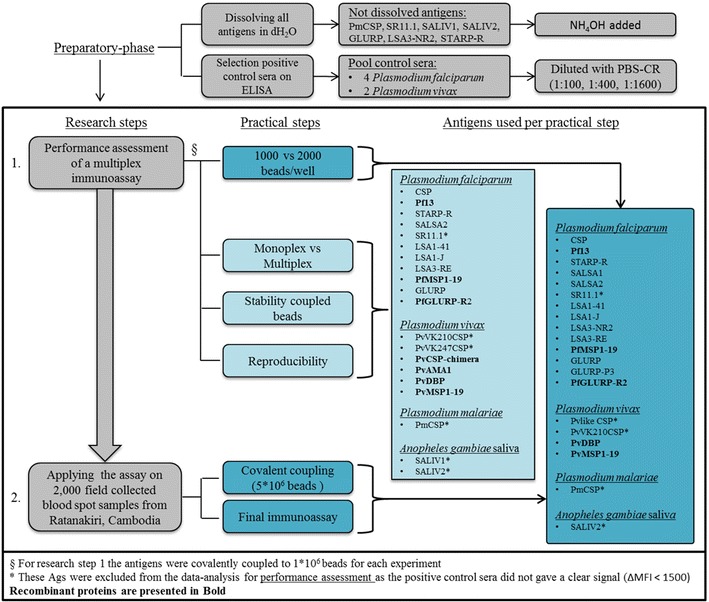
An assay based on 14 Plasmodium-specific peptides, one peptide specific for Anopheles gambiae saliva protein and five Plasmodium-specific recombinant proteins was developed for the MAGPIX system, assessed for its performance, and applied on blood spots from 2000 individuals collected in the Ratanakiri Province, Cambodia.
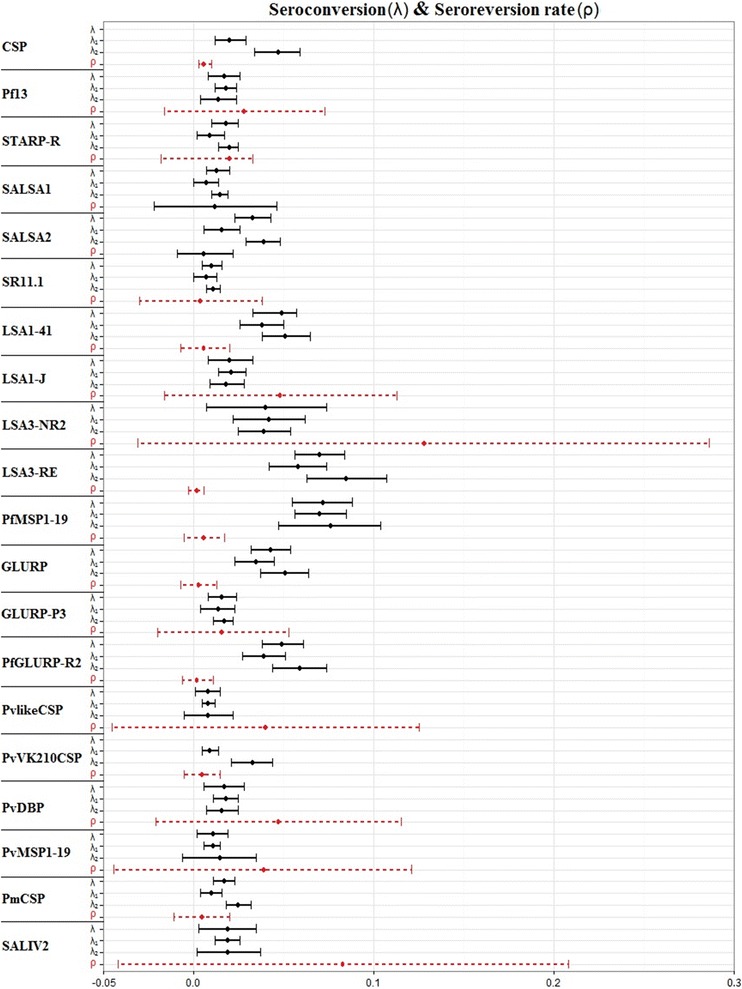
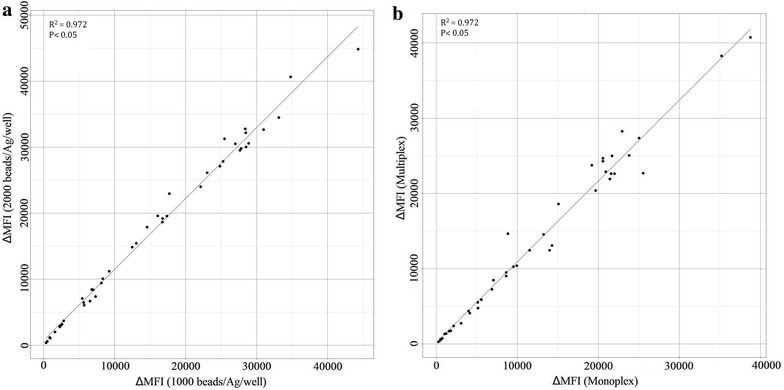
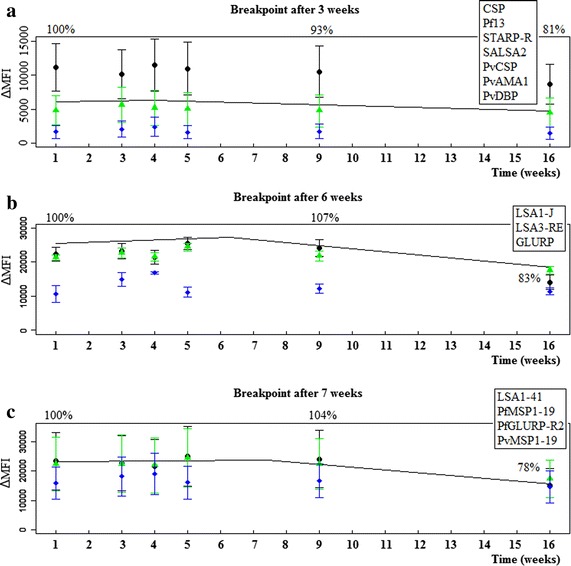
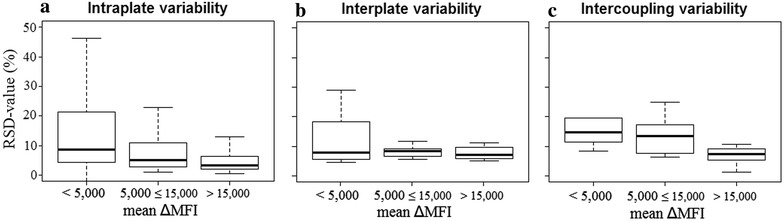
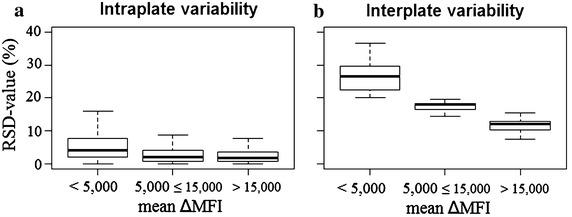
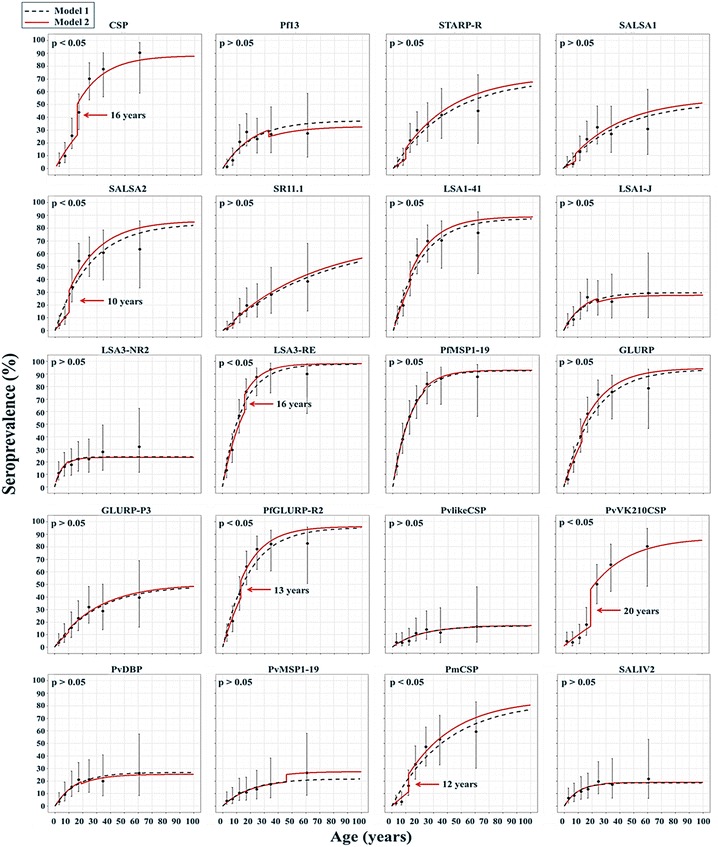
A significant correlation for the use of 1000 and 2000 beads/antigen/well as well as for the monoplex versus multiplex assay was observed for all antigens (p < 0.05). For the majority of antigens, antigen-coupled beads were stable for at least 2 months. The assay was very reproducible with limited intercoupling, interplate and intraplate variability (mean RSD <15 %). Estimating seroconversion and seroreversion per antigen using reversible catalytic models and models allowing two seroconversion rates showed higher seroconversion rates in adults.
The multiplex bead-based immunoassay was successfully implemented and analysis of field blood samples shows that changes detected in force of malaria infection vary according to the serological markers used. Multivariate analysis of the antibody responses and insights into the half-life of antibodies are crucial for improving the interpretation of these results and for identifying the most useful serological markers of past and recent malaria infection.
在低传播和疟疾消除前的环境中,流行病学监测是疟疾控制和消除的关键活动。因此,用于估计疟疾感染强度的灵敏工具至关重要。血清学标志物可能会在估计低流行地区的感染强度时提供额外信息,同时结合经典的寄生虫检测方法。根据所使用的标志物及其半衰期,血清学标志物可用于估计近期、过去或当前的疟疾暴露情况。
基于14种疟原虫特异性肽、1种冈比亚按蚊唾液蛋白特异性肽和5种疟原虫特异性重组蛋白,开发了一种用于MAGPIX系统的检测方法,评估其性能,并应用于柬埔寨腊塔纳基里省收集的2000名个体的血斑样本。
对于所有抗原,观察到使用1000和2000个珠子/抗原/孔以及单重检测与多重检测之间存在显著相关性(p < 0.05)。对于大多数抗原,抗原偶联珠子至少稳定2个月。该检测方法具有高度可重复性,组间、板间和板内变异性有限(平均相对标准偏差<15%)。使用可逆催化模型和允许两种血清转化率的模型估计每种抗原的血清转化和血清逆转,结果显示成人的血清转化率更高。
基于珠子的多重免疫检测方法成功实施,对现场血样的分析表明,根据所使用的血清学标志物不同,检测到的疟疾感染强度变化也不同。对抗体反应进行多变量分析以及深入了解抗体半衰期,对于改进这些结果的解释以及确定过去和近期疟疾感染最有用的血清学标志物至关重要。