
针刺治疗对烟雾诱导的慢性阻塞性肺疾病大鼠模型气道平滑肌的长期影响。
Long-term effects of acupuncture treatment on airway smooth muscle in a rat model of smoke-induced chronic obstructive pulmonary disease.
作者信息
Li Jia, Wu Song, Tang Hongtu, Huang Wei, Wang Lushan, Zhou Huanjiao, Zhou Miao, Wang Hua, Li Jing
机构信息
Hubei University of Chinese Medicine/Hubei Provincial Collaborative Innovation Center of Preventive Treatment by Acupuncture and Moxibustion, Wuhan, China.
Hubei University of Chinese Medicine/Hubei Provincial Collaborative Innovation Center of Preventive Treatment by Acupuncture and Moxibustion, Wuhan, China Taihe Hospital, Affiliated to Hubei University of Medicine, Shiyan, China.
出版信息
Acupunct Med. 2016 Apr;34(2):107-13. doi: 10.1136/acupmed-2014-010674. Epub 2015 Sep 7.
BACKGROUND
Chronic obstructive pulmonary disease (COPD) is one of the most common lung diseases. It is a chronic inflammatory process characterised by airway obstruction and progressive lung inflammation, associated with difficulty breathing and insensitivity to corticosteroid therapy. Although there is some preliminary evidence to suggest a beneficial effect of acupuncture on COPD, its mechanism of action has not been investigated. Our aim was to examine the anti-inflammatory effects of acupuncture in a rat model of COPD induced by exposure to cigarette smoke (CS).
METHODS
Sixty Sprague-Dawley rats were exposed to the smoke of 15 cigarettes for 1 h/day, 6 days/week for 3 months to induce COPD and treated with acupuncture at BL13 (Feishu), BL23 (Shenshu) and Dingchuan (COPD+Acupuncture, n=15), sham acupuncture (COPD+Sham, n=15) or left untreated (n=15). Exposed rats were compared with controls not exposed to CS (control, n=15). Pulmonary function was measured, and tumour necrosis factor-α (TNF-α) and interleukin-8 (IL-8) levels were determined in bronchoalveolar lavage fluid by ELISA. Histone deacetylase 2 (HDAC2) protein and mRNA expression were examined in lung tissue and in bronchus.
RESULTS
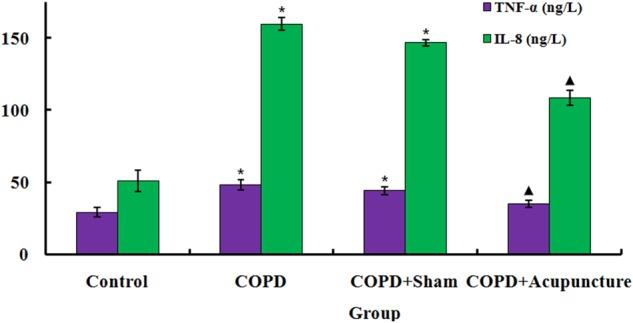
Acupuncture treatment appeared to protect pulmonary function and reduce the COPD-induced inflammatory response by decreasing cell inflammation and the production of TNF-α and IL-8. Acupuncture also enhanced HDAC2 mRNA and protein expression, suggesting a possible direct effect on protein structure through post-translational modifications.
CONCLUSIONS
Our results suggest that acupuncture regulates inflammatory cytokines and contributes to lung protection in a rat model of smoke-induced COPD by modulating HDAC2.
背景
慢性阻塞性肺疾病(COPD)是最常见的肺部疾病之一。它是一种慢性炎症过程,其特征为气道阻塞和进行性肺部炎症,伴有呼吸困难且对皮质类固醇治疗不敏感。尽管有一些初步证据表明针刺对COPD有有益作用,但其作用机制尚未得到研究。我们的目的是在暴露于香烟烟雾(CS)诱导的COPD大鼠模型中研究针刺的抗炎作用。
方法
60只Sprague-Dawley大鼠每天暴露于15支香烟的烟雾中1小时,每周6天,持续3个月以诱导COPD,并在BL13(肺俞)、BL23(肾俞)和定喘穴接受针刺治疗(COPD+针刺组,n = 15)、假针刺治疗(COPD+假针刺组,n = 15)或不进行治疗(n = 15)。将暴露的大鼠与未暴露于CS的对照组(对照组,n = 15)进行比较。测量肺功能,并通过ELISA测定支气管肺泡灌洗液中肿瘤坏死因子-α(TNF-α)和白细胞介素-8(IL-8)水平。检测肺组织和支气管中组蛋白去乙酰化酶2(HDAC2)蛋白和mRNA表达。
结果
针刺治疗似乎通过减少细胞炎症以及TNF-α和IL-8的产生来保护肺功能并减轻COPD诱导的炎症反应。针刺还增强了HDAC2 mRNA和蛋白表达,提示可能通过翻译后修饰对蛋白质结构产生直接影响。
结论
我们的结果表明,针刺通过调节HDAC2来调节炎症细胞因子,并有助于在烟雾诱导的COPD大鼠模型中保护肺脏。




 Zotero 插件