Tennessen Jacob A, Bonner Kaitlin M, Bollmann Stephanie R, Johnstun Joel A, Yeh Jan-Ying, Marine Melanie, Tavalire Hannah F, Bayne Christopher J, Blouin Michael S
Department of Integrative Biology, Oregon State University, Corvallis, Oregon, United States of America.
PLoS Negl Trop Dis. 2015 Sep 15;9(9):e0004077. doi: 10.1371/journal.pntd.0004077. eCollection 2015.
New strategies to combat the global scourge of schistosomiasis may be revealed by increased understanding of the mechanisms by which the obligate snail host can resist the schistosome parasite. However, few molecular markers linked to resistance have been identified and characterized in snails.
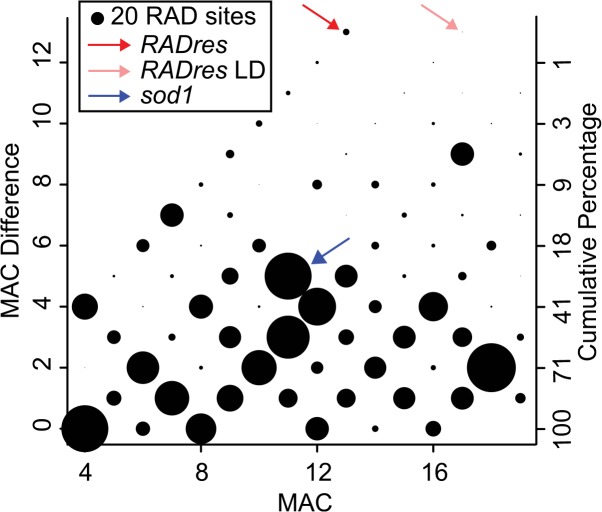
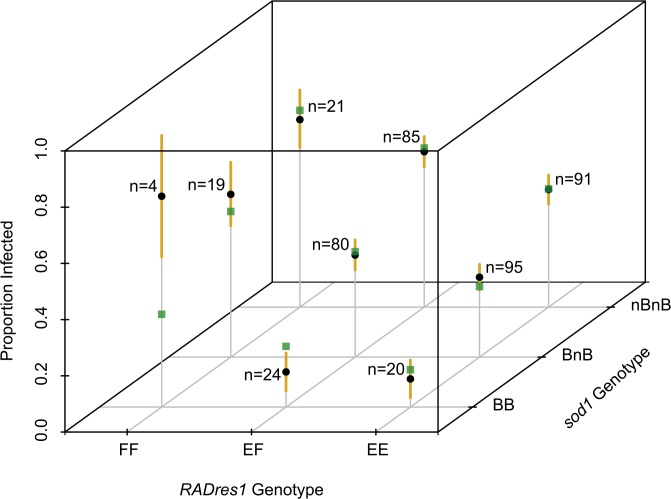
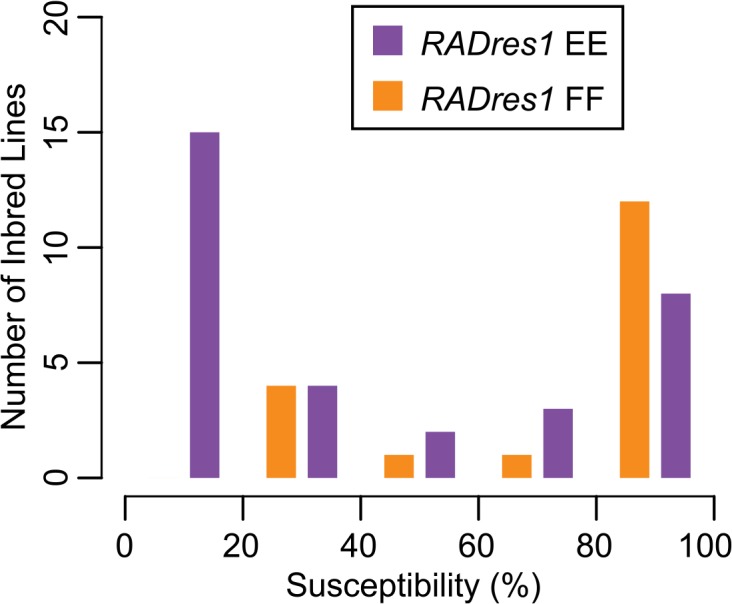
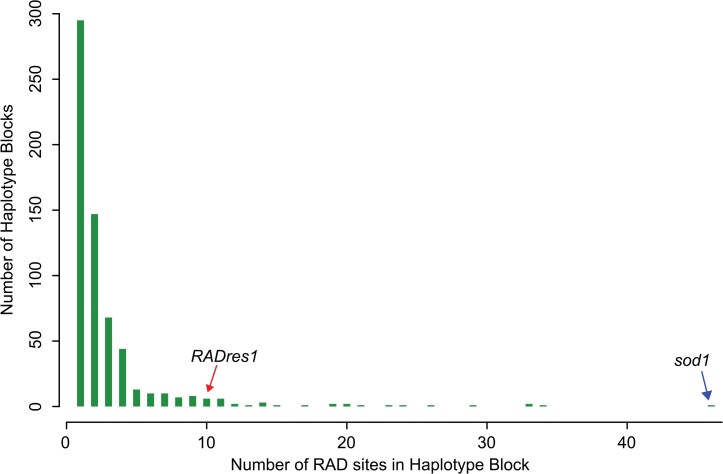
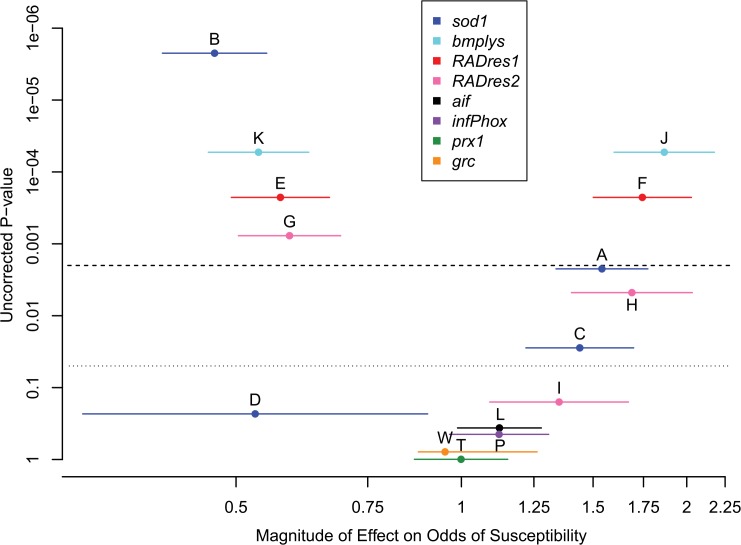
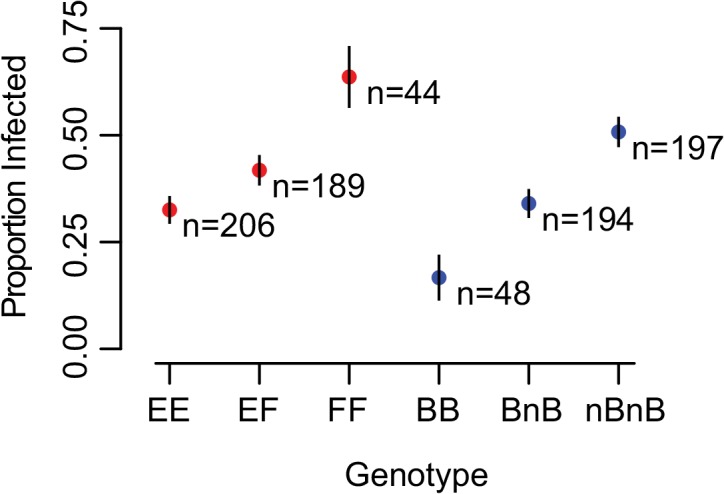
METHODOLOGY/PRINCIPAL FINDINGS: Here we test six independent genetic loci for their influence on resistance to Schistosoma mansoni strain PR1 in the 13-16-R1 strain of the snail Biomphalaria glabrata. We first identify a genomic region, RADres, showing the highest differentiation between susceptible and resistant inbred lines among 1611 informative restriction-site associated DNA (RAD) markers, and show that it significantly influences resistance in an independent set of 439 outbred snails. The additive effect of each RADres resistance allele is 2-fold, similar to that of the previously identified resistance gene sod1. The data fit a model in which both loci contribute independently and additively to resistance, such that the odds of infection in homozygotes for the resistance alleles at both loci (13% infected) is 16-fold lower than the odds of infection in snails without any resistance alleles (70% infected). Genome-wide linkage disequilibrium is high, with both sod1 and RADres residing on haplotype blocks >2 Mb, and with other markers in each block also showing significant effects on resistance; thus the causal genes within these blocks remain to be demonstrated. Other candidate loci had no effect on resistance, including the Guadeloupe Resistance Complex and three genes (aif, infPhox, and prx1) with immunological roles and expression patterns tied to resistance, which must therefore be trans-regulated.
CONCLUSIONS/SIGNIFICANCE: The loci RADres and sod1 both have strong effects on resistance to S. mansoni. Future approaches to control schistosomiasis may benefit from further efforts to characterize and harness this natural genetic variation.
通过深入了解专性蜗牛宿主抵抗血吸虫寄生虫的机制,或许能揭示出对抗全球血吸虫病这一灾祸的新策略。然而,在蜗牛中,与抗性相关的分子标记很少被鉴定和表征。
方法/主要发现:在此,我们测试了六个独立的基因位点对光滑双脐螺13 - 16 - R1品系抵抗曼氏血吸虫PR1株的影响。我们首先在1611个信息丰富的限制性位点相关DNA(RAD)标记中,确定了一个基因组区域RADres,它在易感和抗性近交系之间表现出最高的分化,并表明它在独立的439只远交蜗牛中显著影响抗性。每个RADres抗性等位基因的加性效应为2倍,与先前鉴定的抗性基因sod1相似。数据符合一个模型,即两个位点对抗性独立且加性地起作用,使得两个位点均为抗性等位基因纯合子的蜗牛(13%被感染)的感染几率比没有任何抗性等位基因的蜗牛(70%被感染)低16倍。全基因组连锁不平衡程度很高,sod1和RADres都位于大于2 Mb的单倍型块上,并且每个块中的其他标记也显示出对抗性有显著影响;因此,这些块内的致病基因仍有待证实。其他候选位点对抗性没有影响,包括瓜德罗普抗性复合体以及三个具有免疫作用且表达模式与抗性相关的基因(aif、infPhox和prx1),因此它们必定是受反式调控的。
结论/意义:RADres和sod1位点对曼氏血吸虫的抗性都有很强的影响。未来控制血吸虫病的方法可能会受益于进一步努力来表征和利用这种自然遗传变异。