Department of Zoology, Oregon State University, Corvallis, OR 97331-2914, USA.
Department of Zoology, Oregon State University, Corvallis, OR 97331-2914, USA.
Int J Parasitol. 2014 May;44(6):343-53. doi: 10.1016/j.ijpara.2013.11.004. Epub 2014 Mar 28.
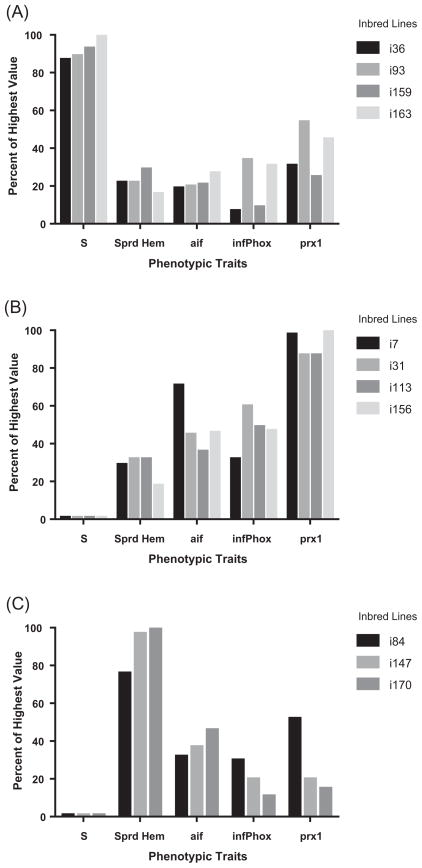
Continuing transmission of human intestinal schistosomiasis depends on the parasite's access to susceptible snail intermediate hosts (often Biomphalaria glabrata). Transmission fails when parasite larvae enter resistant individuals in wild snail populations. The genetic basis for differences in snail susceptibility/resistance is being intensively investigated as a means to devise novel control strategies based on resistance genes. Reactive oxygen species produced by the snail's defence cells (haemocytes) are effectors of resistance. We hypothesised that genes relevant to production and consumption of reactive oxygen species would be expressed differentially in the haemocytes of snail hosts with different susceptibility/resistance phenotypes. By restricting the genetic diversity of snails, we sought to facilitate identification of resistance genes. By inbreeding, we procured from a 13-16-R1 snail population with both susceptible and resistant individuals 52 lines of B. glabrata (expected homozygosity ~87.5%), and determined the phenotype of each in regard to susceptibility/resistance to Schistosoma mansoni. The inbred lines were found to have line-specific differences in numbers of spreading haemocytes; these were enumerated in both juvenile and adult snails. Lines with high cell numbers were invariably resistant to S. mansoni, whereas lines with lower cell numbers could be resistant or susceptible. Transcript levels in haemocytes were quantified for 18 potentially defence-related genes. Among snails with low cell numbers, the different susceptibility/resistance phenotypes correlated with differences in transcript levels for two redox-relevant genes: an inferred phagocyte oxidase component and a peroxiredoxin. Allograft inflammatory factor (potentially a regulator of leucocyte activation) was expressed at higher levels in resistant snails regardless of spread cell number. Having abundant spreading haemocytes is inferred to enable a snail to kill parasite sporocysts. In contrast, snails with fewer spreading haemocytes seem to achieve resistance only if specific genes are expressed constitutively at levels that are high for the species.
人体肠道血吸虫病的持续传播取决于寄生虫接触易感中间宿主(通常是光滑双脐螺)。当寄生虫幼虫进入野生蜗牛种群中的抗性个体时,传播就会失败。蜗牛易感性/抗性的遗传基础正在被深入研究,作为基于抗性基因设计新控制策略的一种手段。蜗牛防御细胞(血细胞)产生的活性氧是抗性的效应物。我们假设与活性氧产生和消耗相关的基因在具有不同易感性/抗性表型的蜗牛宿主血细胞中会有差异表达。通过限制蜗牛的遗传多样性,我们试图促进抗性基因的鉴定。通过近亲繁殖,我们从一个同时具有易感和抗性个体的 13-16-R1 蜗牛种群中获得了 52 条光滑双脐螺(预期纯合度~87.5%),并确定了它们对曼氏血吸虫的易感性/抗性表型。发现近交系在扩散血细胞数量上存在系特异性差异;在幼螺和成年螺中都对这些进行了计数。具有高细胞数的系总是对曼氏血吸虫具有抗性,而细胞数较低的系可能具有抗性或敏感性。在血细胞中定量了 18 个潜在的防御相关基因的转录水平。在细胞数较低的蜗牛中,不同的易感性/抗性表型与两个与氧化还原相关的基因的转录水平差异相关:一个推断的吞噬细胞氧化酶成分和一个过氧化物酶。无论扩散细胞数量如何,抗性蜗牛中的同种异体炎症因子(可能是白细胞激活的调节剂)的表达水平都更高。推断出拥有丰富的扩散血细胞可以使蜗牛杀死寄生虫的孢子囊。相比之下,如果特定基因在物种中保持高水平表达,具有较少扩散血细胞的蜗牛似乎只能通过这种方式获得抗性。