Sharp Claire R, Selting Kim A, Ringold Randy
Cummings School of Veterinary Medicine, Tufts University, 200 Westboro Road, North Grafton, MA, 01536, USA.
Veterinary Medical Teaching Hospital, University of Missouri, Columbia, MO, 65211, USA.
BMC Res Notes. 2015 Sep 15;8:442. doi: 10.1186/s13104-015-1360-0.
Vitamin D (vitD) deficiency is linked to many disease states including rickets and cancer, and vitD supplementation to improve response to cancer therapy has been explored. Supplementation may be most appropriate for dogs with suboptimal vitD concentrations. In dogs, the primary source of vitD is diet (predominantly via commercial dog food). Our goal was to determine how food source and supplements affect 25(OH)D concentrations, the storage form of vitD. Serum was collected from clinically healthy dogs, and pet owners were surveyed about food source and supplements. Serum 25(OH)D concentration was measured using a quantitative chemiluminescent assay (LIASON, DiaSorin, Stillwater, MN).
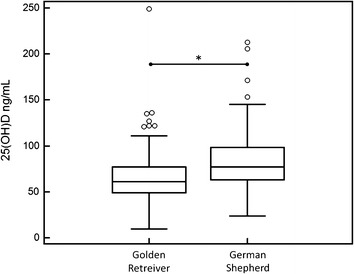
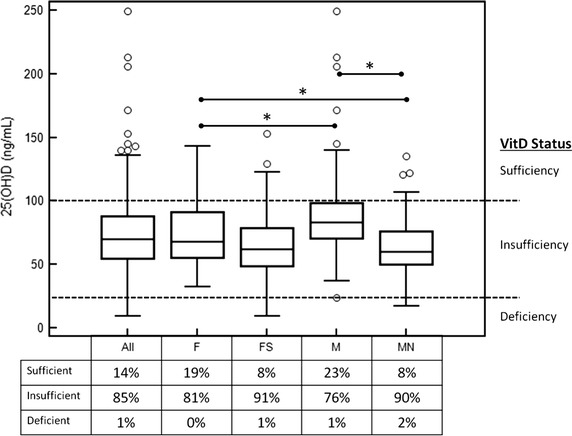
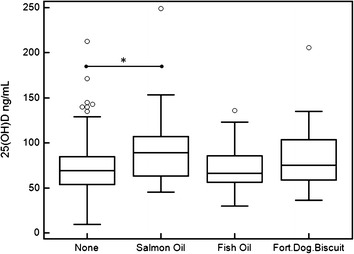
Dogs (n = 320) were tested for serum 25(OH)D concentrations (range 9.5-249.2 ng/mL). Dogs were fed commercial diets from forty different manufactures (n = 292); additionally some dogs were fed homemade diets (n = 18) or a combination of commercial and homemade diets (n = 10). Median serum 25(OH)D concentrations in dogs fed commercial foods ranged from 47.4 to 100.1 ng/mL with an overall median of 67.9 ng/ml (CV 29%). Analysis for differences among manufacturers was significant (P = 0.0006). Serum 25(OH)D concentrations amongst dogs fed homemade diets had the largest range (9.5-129 ng/mL) and the lowest value (9.5 ng/mL). Dogs receiving salmon oil as a supplement (n = 22) had significantly higher serum 25(OH)D (on average a 19.6 ng/mL increase) than those not receiving a supplement (P = 0.007).
Serum 25(OH)D concentrations in dogs vary widely which likely reflects varying dietary vitD content. Notable differences exist among manufacturers and brands and may reflect differences in proprietary formulations. Given the variability of measured serum 25(OH)D concentrations in dogs and the importance vitD appears to have on health status, dietary vitD content should be optimized.
维生素D(vitD)缺乏与包括佝偻病和癌症在内的多种疾病状态相关,并且已经探索了补充vitD以改善对癌症治疗的反应。补充剂可能最适合vitD浓度不理想的犬只。在犬类中,vitD的主要来源是饮食(主要通过商业狗粮)。我们的目标是确定食物来源和补充剂如何影响vitD的储存形式25(OH)D的浓度。从临床健康的犬只中采集血清,并就食物来源和补充剂对宠物主人进行调查。使用定量化学发光测定法(LIASON,DiaSorin,斯蒂尔沃特,明尼苏达州)测量血清25(OH)D浓度。
对320只犬只进行了血清25(OH)D浓度检测(范围为9.5 - 249.2 ng/mL)。犬只食用了来自40个不同制造商的商业饮食(n = 292);此外,一些犬只食用自制饮食(n = 18)或商业饮食与自制饮食的组合(n = 10)。食用商业食品的犬只血清25(OH)D浓度中位数范围为47.4至100.1 ng/mL,总体中位数为67.9 ng/ml(CV 29%)。制造商之间差异的分析具有显著性(P = 0.0006)。食用自制饮食的犬只血清25(OH)D浓度范围最大(9.5 - 129 ng/mL)且值最低(9.5 ng/mL)。接受鲑鱼油补充剂的犬只(n = 22)血清25(OH)D显著更高(平均增加19.6 ng/mL),高于未接受补充剂的犬只(P = 0.007)。
犬只血清25(OH)D浓度差异很大,这可能反映了饮食中vitD含量的不同。制造商和品牌之间存在显著差异,可能反映了专有配方的差异。鉴于犬只血清25(OH)D浓度测量的变异性以及vitD对健康状况的重要性,饮食中vitD的含量应予以优化。