Larsen Anne Konring, Holtermann Andreas, Mortensen Ole Steen, Punnett Laura, Rod Morten Hulvej, Jørgensen Marie Birk
National Research Centre for the Working Environment, Lersø Parkallé 105, 2100 Copenhagen Ø, Denmark ; National Institute of Public Health, University of Southern Denmark, Øster Farimagsgade 5A, 1353 Copenhagen K, Denmark.
National Research Centre for the Working Environment, Lersø Parkallé 105, 2100 Copenhagen Ø, Denmark.
BMC Nurs. 2015 Sep 17;14:46. doi: 10.1186/s12912-015-0096-4. eCollection 2015.
Despite numerous initiatives to improve the working environment for nursing aides, musculoskeletal disorders (pain) is still a considerable problem because of the prevalence, and pervasive consequences on the individual, the workplace and the society. Discrepancies between effort and effect of workplace health initiatives might be due to the fact that pain and the consequences of pain are affected by various individual, interpersonal and organizational factors in a complex interaction. Recent health literacy models pursue an integrated approach to understanding health behavior and have been suggested as a suitable framework for addressing individual, organizational and interpersonal factors concomitantly. Therefore, the aim of the trial is to examine the effectiveness of an intervention to improve health literacy (building knowledge, competences and structures for communication and action) at both the organizational and individual level and reduce pain among nursing aides.
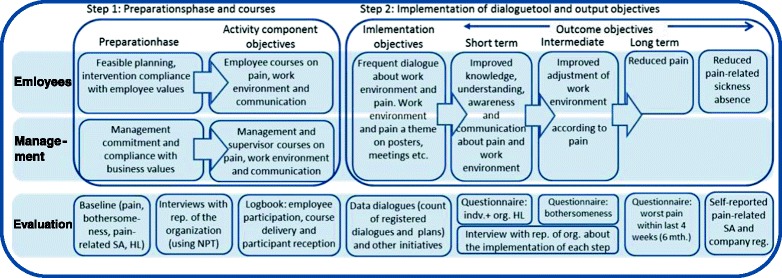
METHODS/DESIGN: The intervention consists of 2 steps: 1) Courses at the workplace for employees and management in order to organize a joint fundament of knowledge and understanding, and a platform for communication and action about pain prevention in the organization. 2) Organizing a fixed 3-weekly structured dialogue between each employee and her/his supervisor, with particular focus on developing specific plans to prevent and reduce pain and its consequences. This enables the workplace to generate knowledge about employee resources and health challenges and to act and convey this knowledge into initiatives at the workplace.
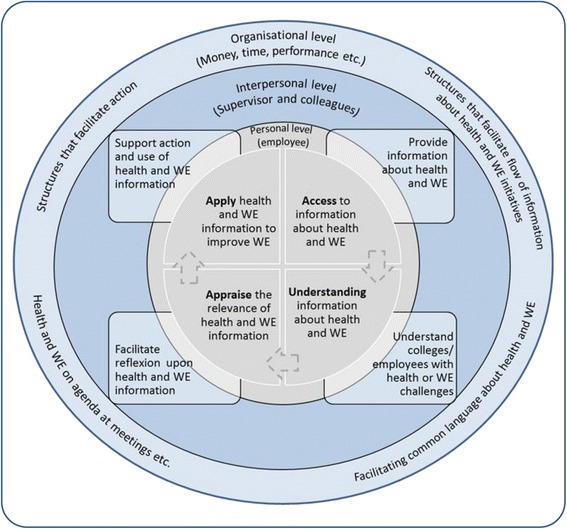
Previous studies to improve health literacy have primarily targeted patients or specific deprived groups in health care or community settings. Recently the idea of the workplace as an arena for improving health literacy has developed emphasizing the organizational responsibility in facilitating and supporting that employees obtain basic knowledge and information needed to understand and take action on individual and occupational health concerns. The literature about workplace health literacy is very limited but points at the importance of educating employees to be able to access, appraise and apply health information and of organizing the infrastructure and communication in the organization. This study suggests a concrete operationalization of health literacy in a workplace setting. Results are expected published in 2016.
尽管采取了许多举措来改善护理助理的工作环境,但肌肉骨骼疾病(疼痛)仍是一个相当严重的问题,因为其患病率高,且对个人、工作场所和社会都有广泛影响。工作场所健康倡议的努力与效果之间存在差异,可能是因为疼痛及其后果受到各种个人、人际和组织因素的复杂相互作用影响。最近的健康素养模型采用综合方法来理解健康行为,并被建议作为一个适合同时解决个人、组织和人际因素的框架。因此,该试验的目的是检验一项干预措施的有效性,该措施旨在在组织和个人层面提高健康素养(建立沟通和行动的知识、能力和结构),并减轻护理助理的疼痛。
方法/设计:干预包括两个步骤:1)为员工和管理层在工作场所举办课程,以便组织关于疼痛预防的知识和理解的共同基础,以及一个沟通和行动的平台。2)组织员工与其主管之间每三周一次的固定结构化对话,特别侧重于制定预防和减轻疼痛及其后果的具体计划。这使工作场所能够了解员工资源和健康挑战,并将这些知识转化为工作场所的倡议并加以实施。
以前提高健康素养的研究主要针对患者或医疗保健或社区环境中的特定贫困群体。最近,将工作场所作为提高健康素养的场所的理念得到了发展,强调组织有责任促进和支持员工获得理解和应对个人及职业健康问题所需的基本知识和信息。关于工作场所健康素养的文献非常有限,但指出了教育员工能够获取、评估和应用健康信息以及组织组织内的基础设施和沟通的重要性。本研究提出了在工作场所环境中健康素养的具体实施方法。预计结果将于2016年发表。