Daley A J, Jolly K, Jebb S A, Lewis A L, Clifford S, Roalfe A K, Kenyon S, Aveyard P
Primary Care Clinical Sciences, School of Health and Population Sciences, College of Medical and Dental Sciences, University of Birmingham, Birmingham, B15 2TT West Midlands.
Public Health, Epidemiology and Biostatistics, School of Health and Population Sciences, University of Birmingham, Birmingham, B15 2TT West Midlands.
BMC Obes. 2015 Sep 16;2:35. doi: 10.1186/s40608-015-0061-5. eCollection 2015.
Regular weighing in pregnant women is not currently recommended in many countries but has been suggested to prevent excessive gestational weight gain. This study aimed to establish the feasibility and acceptability of incorporating regular weighing, setting maximum weight gain targets and feedback by community midwives.
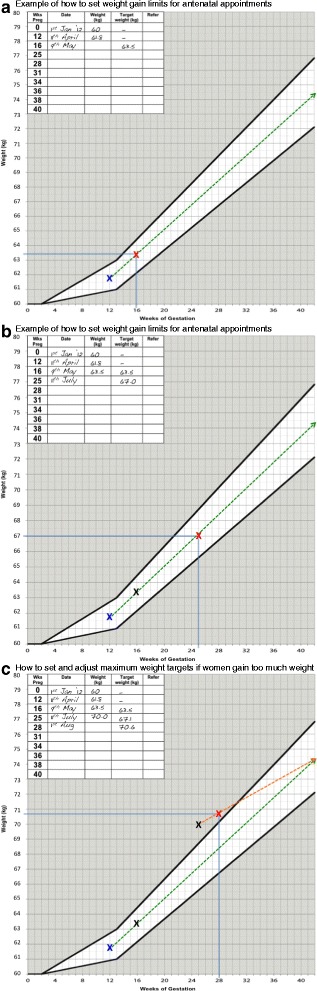
Low risk pregnant women cared for by eight community midwives were randomised to usual care or usual care plus the intervention at 10-14 weeks of pregnancy. The intervention involved community midwives weighing and plotting weight on a weight gain chart, setting weight gain limit targets, giving brief feedback at each antenatal appointment and encouraging women to weigh themselves weekly between antenatal appointments. Women and midwives were interviewed about their views of the intervention. The focus of the study was on process evaluation.
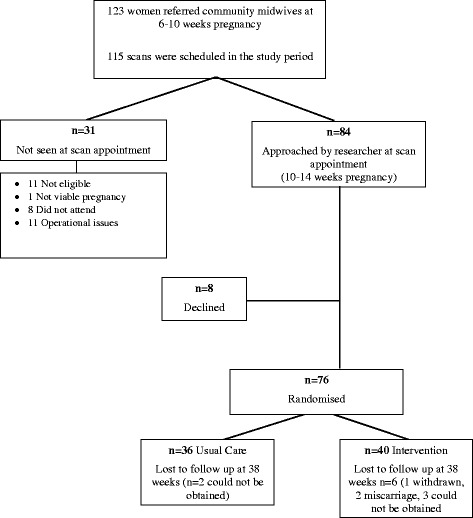
Community midwives referred 123 women and 115 were scheduled for their dating scan within the study period. Of these, 84/115 were approached at their dating scan and 76/84 (90.5 %) randomised. Data showed a modest difference favouring the intervention group in the percentage of women gaining excessive gestational weight (23.5 % versus 29.4 %). The intervention group consistently reported smaller increases in depression and anxiety scores throughout pregnancy compared with usual care. Most women commented the intervention was useful in encouraging them to think about their weight and believed it should be part of routine antenatal care. Community midwives felt the intervention could be implemented within routine care without adding substantially to consultation length, thus not perceived as adding substantially to their workload.
The intervention was feasible and acceptable to pregnant women and community midwives and was readily implemented in routine care.
ISRCTN81605162.
目前许多国家并不建议孕妇定期称重,但有人认为这有助于预防孕期体重过度增加。本研究旨在确定由社区助产士进行定期称重、设定最大体重增加目标并给予反馈的可行性和可接受性。
由八名社区助产士护理的低风险孕妇在怀孕10 - 14周时被随机分为常规护理组或常规护理加干预组。干预措施包括社区助产士在体重增加图表上称重并记录体重、设定体重增加限制目标、在每次产前检查时给予简短反馈,并鼓励妇女在两次产前检查之间每周自行称重。就妇女和助产士对干预措施的看法进行了访谈。该研究的重点是过程评估。
社区助产士转诊了123名妇女,其中115名计划在研究期间进行超声检查确定孕周。在这些妇女中,84/115在超声检查时被纳入研究,76/84(90.5%)被随机分组。数据显示,干预组孕妇孕期体重过度增加的百分比略低于常规护理组(23.5%对29.4%)。与常规护理相比,干预组在整个孕期的抑郁和焦虑评分增加幅度始终较小。大多数妇女表示,该干预措施有助于促使她们关注自己的体重,并认为这应该成为常规产前护理的一部分。社区助产士认为,该干预措施可以在常规护理中实施,而不会显著增加咨询时间,因此不会被视为大幅增加了他们的工作量。
该干预措施对孕妇和社区助产士来说是可行且可接受的,并且很容易在常规护理中实施。
ISRCTN81605162