Gu Weijie, Zhang Guiming, Sun Lijiang, Ma Qi, Cheng Yue, Zhang Hailiang, Shi Guohai, Zhu Yao, Ye Dingwei
Department of Urology, Shanghai Cancer Center, Fudan University Shanghai, China ; Department of Oncology, Shanghai Medical College, Fudan University Shanghai, 200032, China.
Department of Urology, The Affiliated Hospital of Qingdao University Qingdao, 266003, China.
J Cachexia Sarcopenia Muscle. 2015 Sep;6(3):222-30. doi: 10.1002/jcsm.12025. Epub 2015 Apr 20.
Although commonly observed, malnutrition is poorly characterized and frequently underdiagnosed in patients with metastatic renal cell carcinoma (RCC). The ability of nutritional screening tools to predict overall survival (OS) in patients with RCC has not been adequately validated. The objective of this study was to investigate the performance of nutritional screening tools and their additional prognostic value in patients with metastatic RCC treated with targeted therapies.
Patients were prospectively recruited from three tertiary hospitals between 2009 and 2013. Nutritional status was evaluated using the Geriatric Nutritional Risk Index (GNRI) and the Mini Nutritional Assessment-Short Form (MNA-SF). Their OS and early grade 3/4 adverse events were recorded as outcomes of interest, and their associations with nutritional status were assessed using Cox regression and logistic regression, respectively. The incremental value in prognostication was evaluated using concordance index and decision curve analyses.
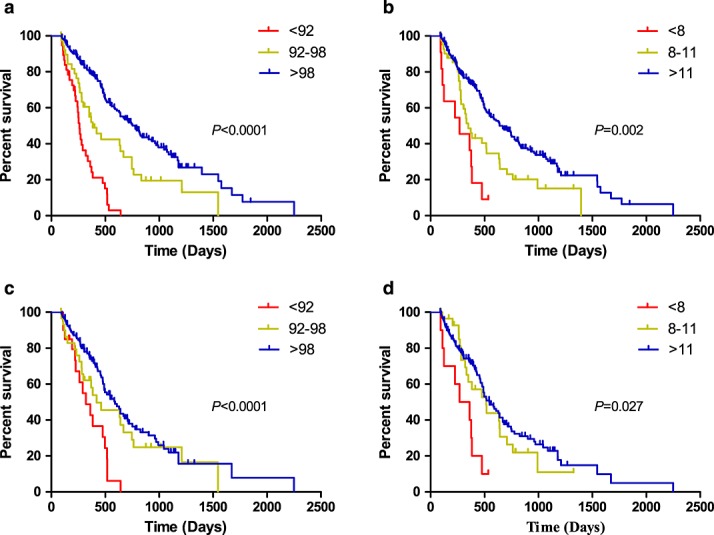
Of the 300 enrolled patients, 95 (31.7%) and 64 (21.3%) were classified as being at risk of malnutrition according to the GNRI and MNA-SF, respectively. Both GNRI and MNA-SF were independent predictors of OS in multivariate analyses and provided significant added benefit to Heng risk classification. Compared with the MNA-SF, the GNRI contributed a higher increment to the concordance index (0.041 vs. 0.016). Nutritional screening, however, was not associated with early grade 3/4 adverse events in multivariate analyses. Further investigations are needed using more comprehensive and accurate assessment tools.
This prospective study confirmed the importance of nutritional screening tools in survival prognostication in patients with metastatic RCC. The standardized and objective measurements would allow clinicians to identify metastatic RCC patients at risk of poor survival outcomes. Individualized nutritional assessment and intervention strategies may be included in the multidisciplinary treatment.
尽管营养不良在转移性肾细胞癌(RCC)患者中很常见,但对其特征描述不足,且经常被漏诊。营养筛查工具预测RCC患者总生存期(OS)的能力尚未得到充分验证。本研究的目的是调查营养筛查工具在接受靶向治疗的转移性RCC患者中的性能及其额外的预后价值。
2009年至2013年间,从三家三级医院前瞻性招募患者。使用老年营养风险指数(GNRI)和微型营养评定简表(MNA-SF)评估营养状况。将他们的OS和早期3/4级不良事件记录为感兴趣的结局,并分别使用Cox回归和逻辑回归评估它们与营养状况的关联。使用一致性指数和决策曲线分析评估预后的增量价值。
在300名入组患者中,分别根据GNRI和MNA-SF,有95名(31.7%)和64名(21.3%)被归类为有营养不良风险。在多变量分析中,GNRI和MNA-SF都是OS的独立预测因素,并为 Heng 风险分类提供了显著的额外益处。与MNA-SF相比,GNRI对一致性指数的增量更高(0.041对0.016)。然而,在多变量分析中,营养筛查与早期3/4级不良事件无关。需要使用更全面和准确的评估工具进行进一步研究。
这项前瞻性研究证实了营养筛查工具在转移性RCC患者生存预后中的重要性。标准化和客观的测量将使临床医生能够识别生存结局较差风险的转移性RCC患者。个体化营养评估和干预策略可能纳入多学科治疗中。