Calabrò Rocco Salvatore, Naro Antonino, Russo Margherita, Leo Antonino, Balletta Tina, Saccá Ileana, De Luca Rosaria, Bramanti Placido
Restor Neurol Neurosci. 2015;33(5):671-81. doi: 10.3233/RNN-140475.
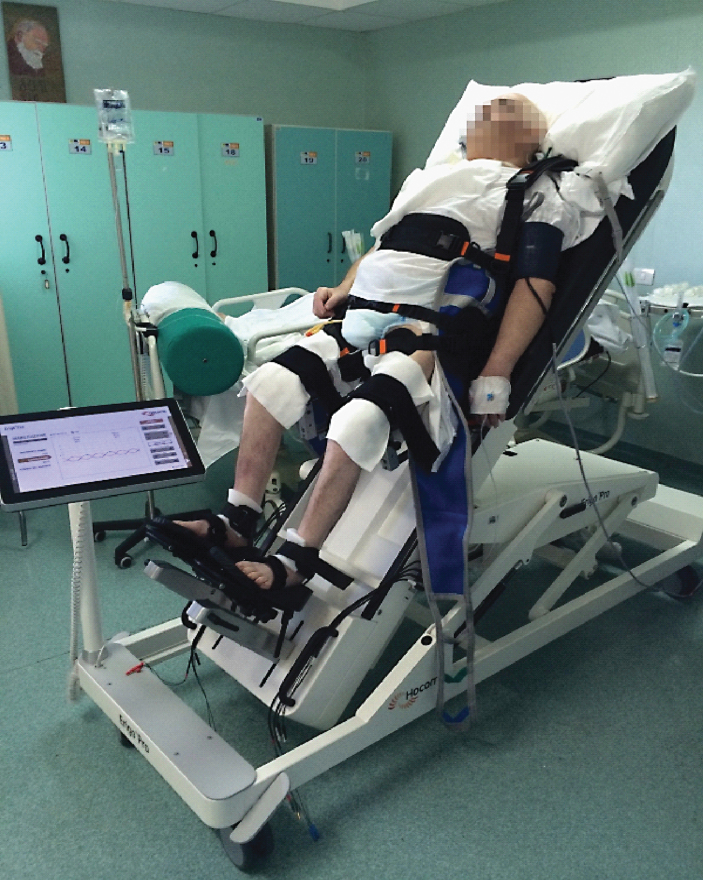
Tilt-table equipped with the dynamic foot-support (ERIGO) and the functional electric stimulation could be a safe and suitable device for stabilization of vital signs, increasing patient's motivation for further recovery, decreasing the duration of hospitalization, and accelerating the adaptation to vertical posture in bedridden patients with brain-injury. Moreover, it is conceivable that verticalization may improve cognitive functions, and induce plastic changes at sensory motor and vestibular system level that may in turn facilitate motor functional recovery.
To test the safety and effectiveness of ERIGO treatment on motor and cognitive functions, cortical plasticity within vestibular and sensory-motor systems in a bedridden post-stroke sample.
20 patients were randomly divided in two groups that performed ERIGO training (30 sessions) (G1) or physiotherapist-assisted verticalization training (same duration) (G2), beyond conventional neurorehabilitation treatment. Motor and cognitive functions as well as sensory-motor and vestibular system plasticity were investigated either before (T0) or after (T1) the rehabilitative protocols.
Both the verticalization treatments were well-tolerated. Notably, the G1 patients had a significant improvement in cognitive function (p = 0.03), global motor function (p = 0.006), sensory-motor (p < 0.001) and vestibular system plasticity (p = 0.02) as compared to G2.
ERIGO training could be a valuable tool for the adaptation to the vertical position with a better global function improvement, as also suggested by the sensory-motor and vestibular system plasticity induction.
配备动态足部支撑(ERIGO)和功能性电刺激的倾斜台可能是一种安全且合适的设备,可用于稳定生命体征、增强患者进一步康复的动力、缩短住院时间以及加速卧床脑损伤患者对垂直姿势的适应。此外,可以想象垂直化可能改善认知功能,并在感觉运动和前庭系统水平诱导可塑性变化,进而促进运动功能恢复。
测试ERIGO治疗对卧床中风患者样本的运动和认知功能、前庭和感觉运动系统内皮质可塑性的安全性和有效性。
20名患者被随机分为两组,除了接受常规神经康复治疗外,一组进行ERIGO训练(30次疗程)(G1组),另一组进行物理治疗师辅助的垂直化训练(相同疗程)(G2组)。在康复方案实施前(T0)和实施后(T1)对运动和认知功能以及感觉运动和前庭系统可塑性进行研究。
两种垂直化治疗的耐受性都很好。值得注意的是,与G2组相比,G1组患者在认知功能(p = 0.03)、整体运动功能(p = 0.006)、感觉运动(p < 0.001)和前庭系统可塑性(p = 0.02)方面有显著改善。
ERIGO训练可能是一种有价值的工具,有助于适应垂直姿势并改善整体功能,感觉运动和前庭系统可塑性的诱导也表明了这一点。