Liu Mi, Zhao Xiang, Hua Sha, Du Xiangjun, Peng Yousong, Li Xiyan, Lan Yu, Wang Dayan, Wu Aiping, Shu Yuelong, Jiang Taijiao
Center for Systems Medicine, Institute of Basic Medical Sciences, Chinese Academy of Medical Sciences &Peking Union Medical College, Beijing 100005; Suzhou Institute of Systems Medicine, Suzhou, Jiangsu 215123, China.
Key Laboratory of Protein and Peptide Pharmaceuticals, Institute of Biophysics, Chinese Academy of Sciences, Beijing 100101, China.
Sci Rep. 2015 Sep 28;5:14171. doi: 10.1038/srep14171.
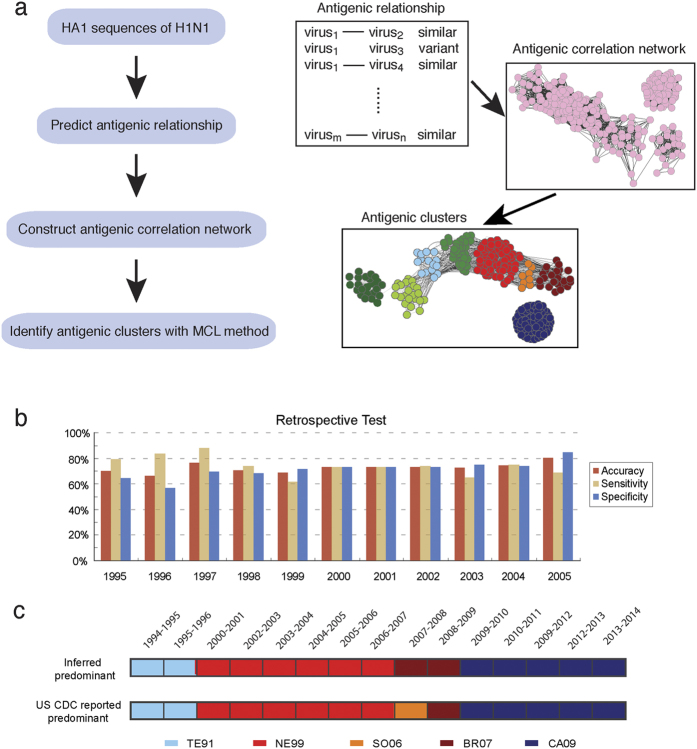
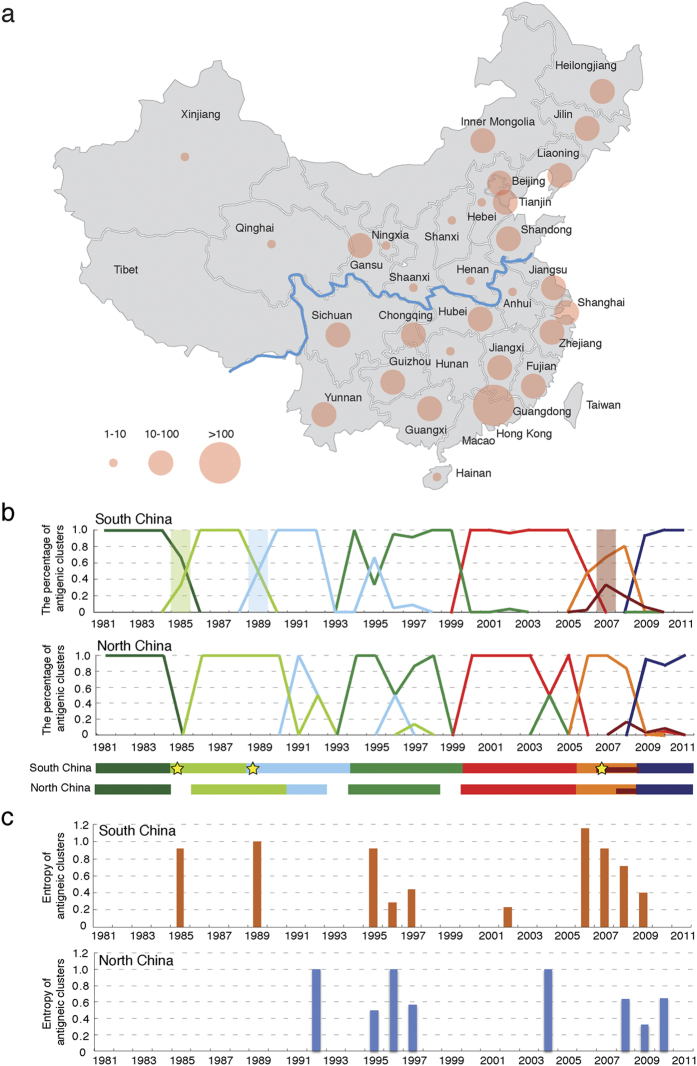
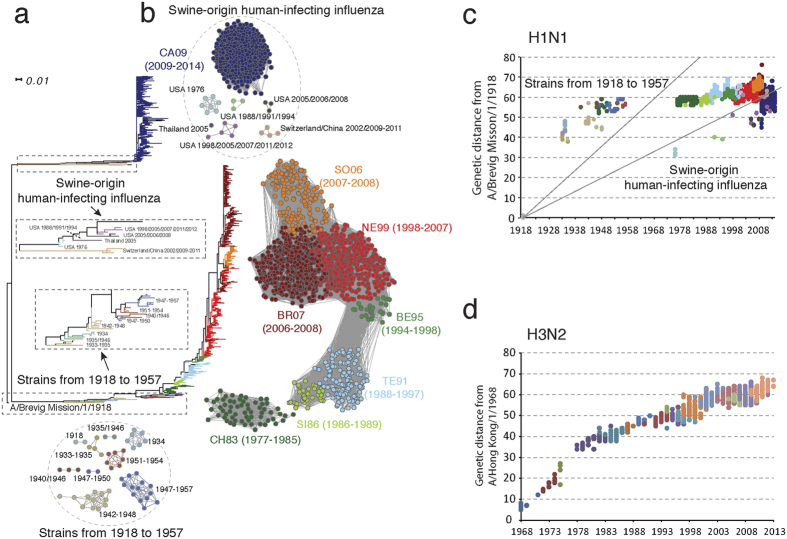
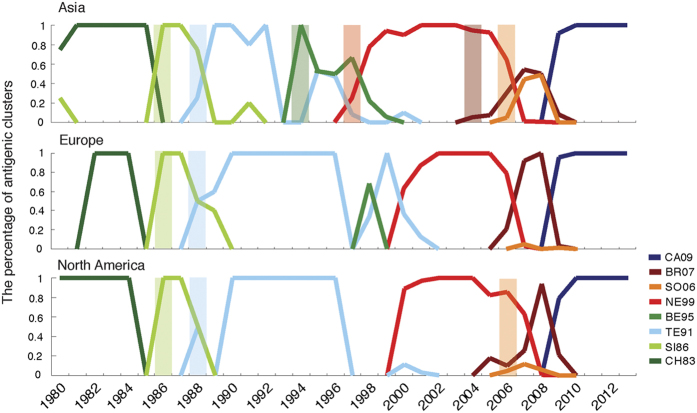
The influenza A (H1N1) virus causes seasonal epidemics that result in severe illnesses and deaths almost every year. A deep understanding of the antigenic patterns and evolution of human influenza A (H1N1) virus is extremely important for its effective surveillance and prevention. Through development of antigenicity inference method for human influenza A (H1N1), named PREDAC-H1, we systematically mapped the antigenic patterns and evolution of the human influenza A (H1N1) virus. Eight dominant antigenic clusters have been inferred for seasonal H1N1 viruses since 1977, which demonstrated sequential replacements over time with a similar pattern in Asia, Europe and North America. Among them, six clusters emerged first in Asia. As for China, three of the eight antigenic clusters were detected in South China earlier than in North China, indicating the leading role of South China in H1N1 transmission. The comprehensive view of the antigenic evolution of human influenza A (H1N1) virus can help formulate better strategy for its prevention and control.
甲型H1N1流感病毒引发的季节性流行几乎每年都会导致严重疾病和死亡。深入了解甲型H1N1流感病毒的抗原模式和进化对于其有效监测和预防极为重要。通过开发名为PREDAC-H1的甲型H1N1流感病毒抗原性推断方法,我们系统地描绘了甲型H1N1流感病毒的抗原模式和进化情况。自1977年以来,已推断出季节性H1N1病毒的八个主要抗原簇,这些抗原簇随时间推移呈现出依次更替的情况,在亚洲、欧洲和北美具有相似模式。其中,六个簇最早出现在亚洲。就中国而言,八个抗原簇中的三个在华南地区比华北地区更早被检测到,这表明华南地区在H1N1传播中起主导作用。对甲型H1N1流感病毒抗原进化的全面了解有助于制定更好的防控策略。