Murrells Trevor, Ball Jane, Maben Jill, Ashworth Mark, Griffiths Peter
National Nursing Research Unit, Florence Nightingale Faculty of Nursing and Midwifery, King's College London, London.
NIHR CLAHRC Wessex, University of Southampton, Southampton.
Br J Gen Pract. 2015 Oct;65(639):e642-8. doi: 10.3399/bjgp15X686881.
Diabetes affects around 3.6 million people in the UK. Previous research found that general practices employing more nurses delivered better diabetes care, but did not include data on individual patient characteristics or consultations received.
To examine whether the proportion of consultations with patients with diabetes provided by nurses in GP practices is associated with control of diabetes measured by levels of glycated haemoglobin (HbA1c).
A retrospective observational study using consultation records from 319 649 patients with diabetes from 471 UK general practices from 2002 to 2011.
Hierarchical multilevel models to examine associations between proportion of consultations undertaken by nurses and attaining HbA1c targets over time, controlling for case-mix and practice level factors.
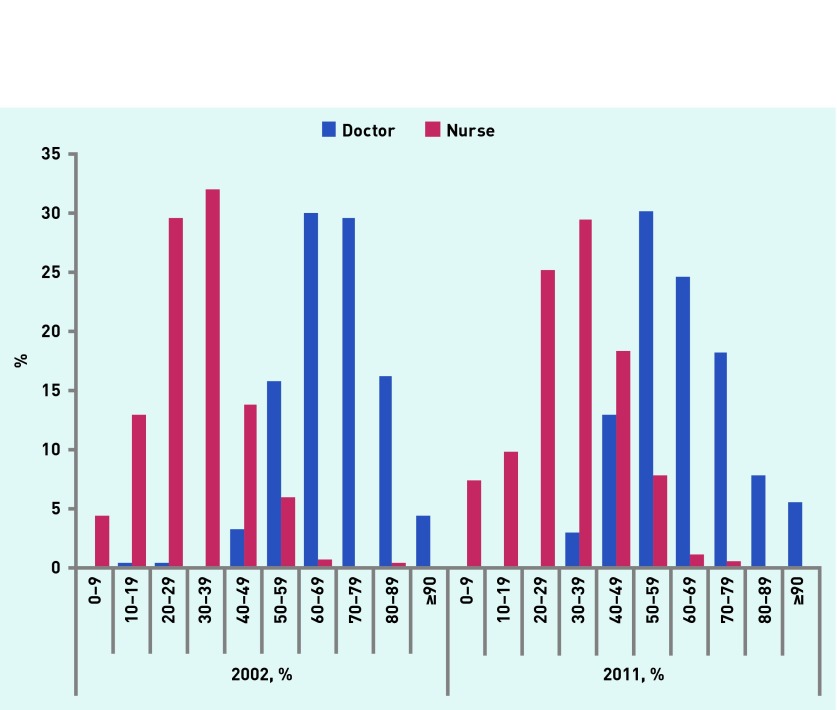
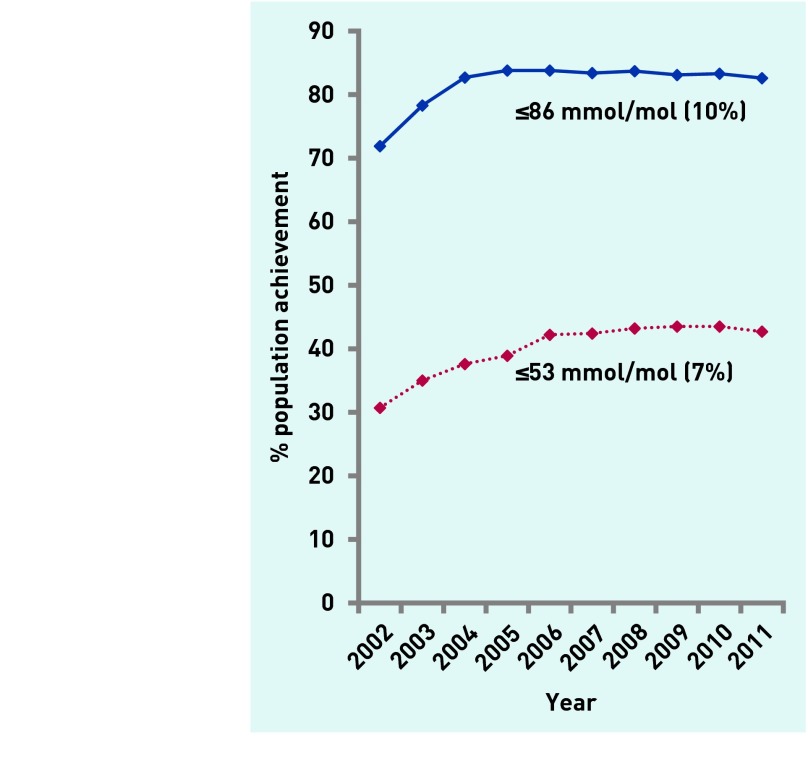
The proportion of consultations with nurses has increased by 20% since 2002 but patients with diabetes made fewer consultations per year in 2011 compared with 2002 (11.6 versus 16.0). Glycaemic control has improved and was more uniformly achieved in 2011 than 2002. Practices in which nurses provide a higher proportion of consultations perform no differently to those where nurse input is lower (lowest versus highest nurse contact tertile odds ratio [OR] [confidence interval {95% CI}]: HbA1c ≤53 mmol/mol (7%) 2002, 1.04 [95% CI = 0.87 to 1.25] and 2011, 0.95 [95% CI = 0.87 to 1.03]; HbA1c ≤86 mmol/mol (10%) 2002, 0.97 [95% CI = 0.73 to 1.29] and 2011, 0.95 [95% CI = 0.86 to 1.04]).
Practices that primarily use GPs to deliver diabetes care could release significant resources with no adverse effect by switching their services towards nurse-led care.
在英国,约有360万人受糖尿病影响。此前的研究发现,聘用更多护士的普通医疗诊所能提供更好的糖尿病护理,但未纳入患者个体特征或所接受诊疗的数据。
研究在全科医疗诊所中,护士为糖尿病患者提供诊疗的比例与糖化血红蛋白(HbA1c)水平所衡量的糖尿病控制情况之间是否存在关联。
一项回顾性观察研究,使用了2002年至2011年期间英国471家普通医疗诊所中319649名糖尿病患者的诊疗记录。
采用分层多级模型,研究护士进行诊疗的比例与随着时间推移达到HbA1c目标之间的关联,同时控制病例组合和诊所层面的因素。
自2002年以来,护士诊疗的比例增加了20%,但与2002年相比,2011年糖尿病患者每年的诊疗次数减少(分别为11.6次和16.0次)。血糖控制有所改善,且2011年比2002年实现得更为一致。护士提供诊疗比例较高的诊所与护士参与度较低的诊所表现并无差异(护士接触最少与最多三分位数的比值比[OR][置信区间{95%CI}]:2002年HbA1c≤53 mmol/mol(7%),1.04[95%CI = 0.87至1.25];2011年,0.95[95%CI = 0.87至1.03];2002年HbA1c≤86 mmol/mol(10%),0.97[95%CI = 0.73至1.29];2011年,0.95[95%CI = 0.86至1.04])。
主要依靠全科医生提供糖尿病护理的诊所,通过将服务转向由护士主导的护理方式,可以释放大量资源且不会产生不利影响。