Rabattu Pierre-Yves, Massé Benoit, Ulliana Federico, Rousset Marie-Christine, Rohmer Damien, Léon Jean-Claude, Palombi Olivier
Department of Anatomy, LADAF, Université Joseph Fourier, Grenoble, France.
LJK (CNRS-UJF-INPG-UPMF), INRIA, Université de Grenoble, Grenoble, France.
J Biomed Semantics. 2015 Sep 24;6:36. doi: 10.1186/s13326-015-0034-0. eCollection 2015.
Embryology is a complex morphologic discipline involving a set of entangled mechanisms, sometime difficult to understand and to visualize. Recent computer based techniques ranging from geometrical to physically based modeling are used to assist the visualization and the simulation of virtual humans for numerous domains such as surgical simulation and learning. On the other side, the ontology-based approach applied to knowledge representation is more and more successfully adopted in the life-science domains to formalize biological entities and phenomena, thanks to a declarative approach for expressing and reasoning over symbolic information. 3D models and ontologies are two complementary ways to describe biological entities that remain largely separated. Indeed, while many ontologies providing a unified formalization of anatomy and embryology exist, they remain only descriptive and make the access to anatomical content of complex 3D embryology models and simulations difficult.
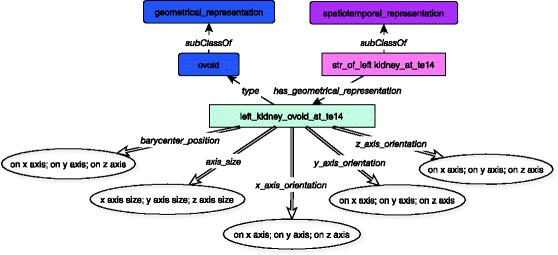
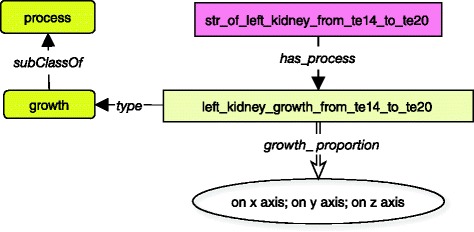
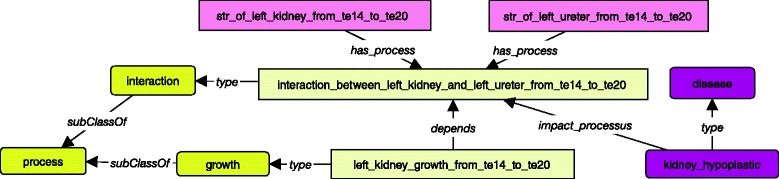
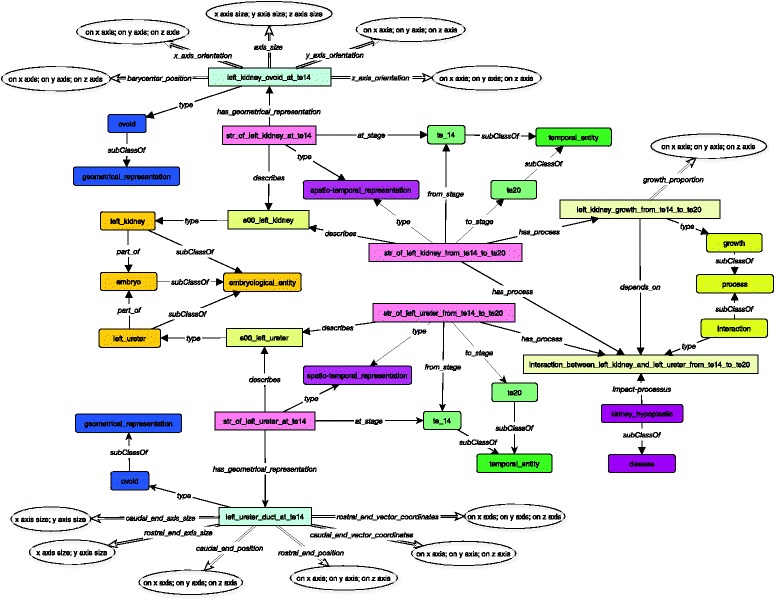
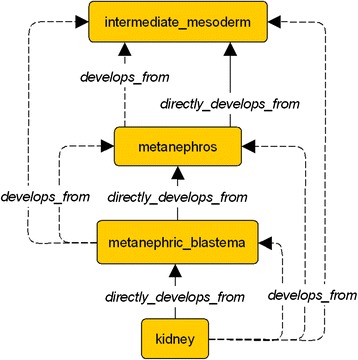
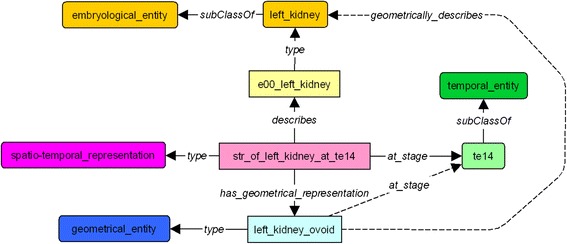
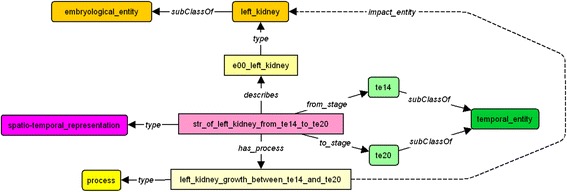
In this work, we present a novel ontology describing the development of the human embryology deforming 3D models. Beyond describing how organs and structures are composed, our ontology integrates a procedural description of their 3D representations, temporal deformation and relations with respect to their developments. We also created inferences rules to express complex connections between entities. It results in a unified description of both the knowledge of the organs deformation and their 3D representations enabling to visualize dynamically the embryo deformation during the Carnegie stages. Through a simplified ontology, containing representative entities which are linked to spatial position and temporal process information, we illustrate the added-value of such a declarative approach for interactive simulation and visualization of 3D embryos.
Combining ontologies and 3D models enables a declarative description of different embryological models that capture the complexity of human developmental anatomy. Visualizing embryos with 3D geometric models and their animated deformations perhaps paves the way towards some kind of hypothesis-driven application. These can also be used to assist the learning process of this complex knowledge.
胚胎学是一门复杂的形态学学科,涉及一系列相互交织的机制,有时难以理解和可视化。最近,从几何建模到基于物理的建模等基于计算机的技术被用于辅助虚拟人体的可视化和模拟,应用于手术模拟和学习等众多领域。另一方面,应用于知识表示的基于本体的方法在生命科学领域越来越成功地被采用,用于将生物实体和现象形式化,这得益于一种用于表达和推理符号信息的声明式方法。3D模型和本体是描述生物实体的两种互补方式,但它们在很大程度上仍然是分开的。事实上,虽然存在许多提供解剖学和胚胎学统一形式化的本体,但它们仍然只是描述性的,使得访问复杂的3D胚胎学模型和模拟的解剖学内容变得困难。
在这项工作中,我们提出了一种新颖的本体,用于描述人类胚胎发育过程中3D模型的变形。除了描述器官和结构是如何组成的,我们的本体还整合了它们3D表示的过程性描述、时间变形以及与它们发育相关的关系。我们还创建了推理规则来表达实体之间的复杂联系。这导致了对器官变形知识及其3D表示的统一描述,能够动态地可视化卡内基阶段胚胎的变形。通过一个简化的本体,包含与空间位置和时间过程信息相关联的代表性实体,我们展示了这种声明式方法在3D胚胎交互式模拟和可视化方面的附加值。
将本体和3D模型相结合能够对不同的胚胎学模型进行声明式描述,捕捉人类发育解剖学的复杂性。用3D几何模型及其动画变形来可视化胚胎可能为某种假设驱动的应用铺平道路。这些也可用于辅助这种复杂知识的学习过程。