Chen Guo-Chong, Szeto Ignatius M Y, Chen Li-Hua, Han Shu-Fen, Li Yan-Jie, van Hekezen Rina, Qin Li-Qiang
Department of Nutrition and Food Hygiene, School of Public Health, Soochow University, Suzhou, 215123, China.
Yili Innovation Center, Inner Mongolia Yili Industrial Group Co., Ltd., Hohhot, 010110, China.
Sci Rep. 2015 Sep 29;5:14606. doi: 10.1038/srep14606.
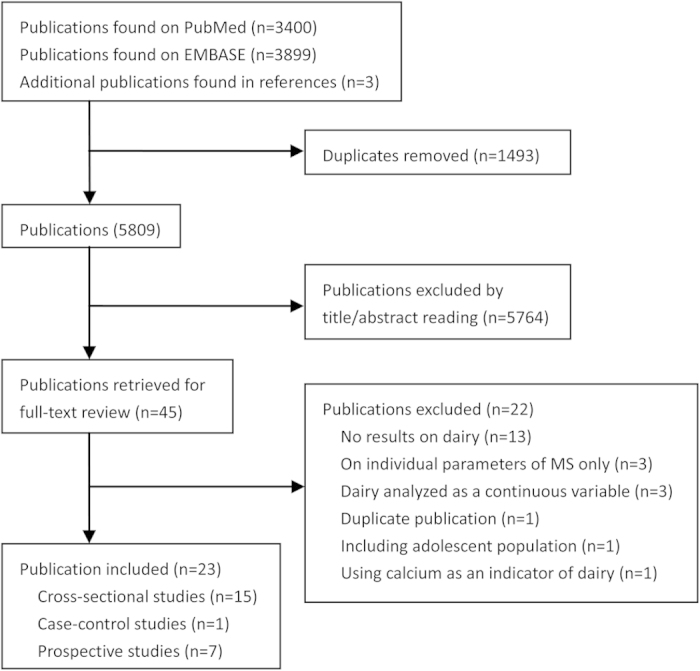
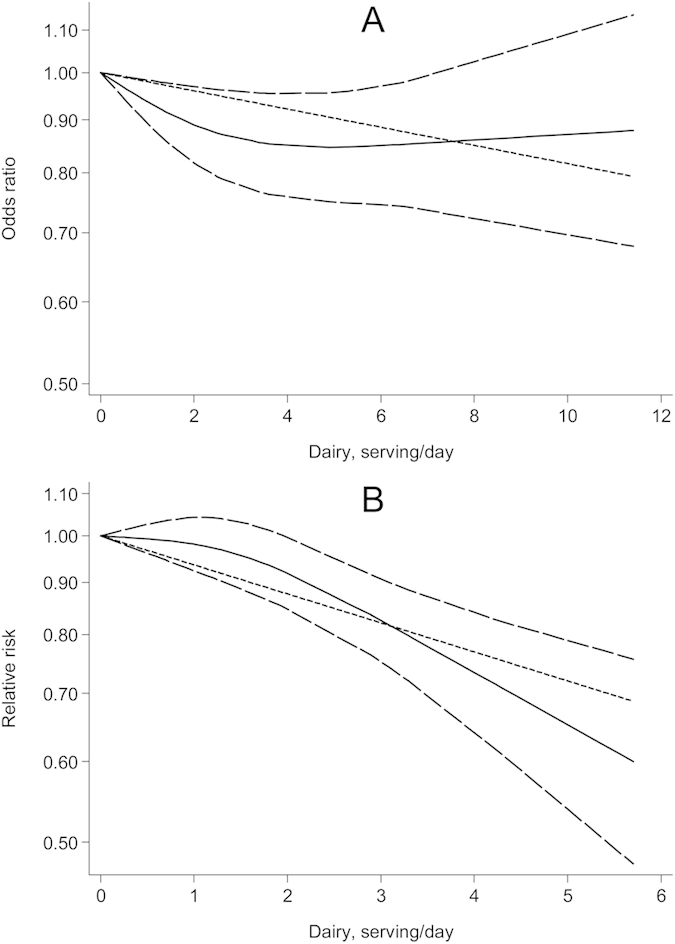
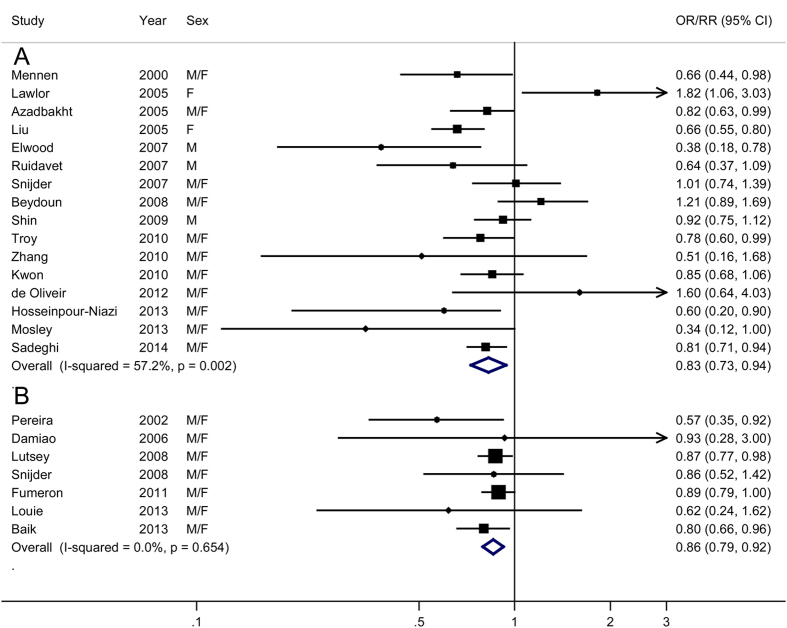
The association of dairy products consumption with risk of metabolic syndrome (MetS) has been inconsistently reported in observational studies. A systematic review and meta-analysis of published observational studies was conducted to quantitatively evaluate this association. Relevant studies were identified by searching PubMed and EMBASE databases and by carefully checking the bibliographies of retrieved full reports and related reviews. Eligible studies were observational studies that investigated the association between dairy products consumption and risk of MetS in adults, with risk estimates available. Random-effects model was assigned to calculate the summary risk estimates. The final analysis included 15 cross-sectional studies, one case-control study and seven prospective cohort studies. Higher dairy consumption significantly reduced MetS by 17% in the cross-sectional/case-control studies (odds ratio = 0.83, 95% confidence interval [CI], 0.73-0.94), and by 14% (relative risk [RR] = 0.86, 95% CI, 0.79-0.92) in cohort studies. The inverse dairy-MetS association was consistent in subgroup and sensitivity analyses. The dose-response analysis of the cohort studies conferred a significant 6% (RR = 0.94, 95% CI, 0.90-0.98) reduction in the risk of MetS for each increment in dairy consumption of one serving/d. No significant publication bias was observed. Our findings suggest an inverse dose-response relationship between dairy consumption and risk of MetS.
在观察性研究中,乳制品消费与代谢综合征(MetS)风险之间的关联报道并不一致。本研究进行了一项系统评价和对已发表观察性研究的荟萃分析,以定量评估这种关联。通过检索PubMed和EMBASE数据库,并仔细查阅检索到的完整报告和相关综述的参考文献来确定相关研究。符合条件的研究为观察性研究,调查了成人乳制品消费与MetS风险之间的关联,并提供了风险估计值。采用随机效应模型计算汇总风险估计值。最终分析纳入了15项横断面研究、1项病例对照研究和7项前瞻性队列研究。在横断面/病例对照研究中,较高的乳制品消费量使MetS风险显著降低了17%(优势比=0.83,95%置信区间[CI],0.73 - 0.94),在队列研究中降低了14%(相对风险[RR]=0.86,95%CI,0.79 - 0.92)。在亚组分析和敏感性分析中,乳制品与MetS之间的反向关联是一致的。队列研究的剂量反应分析显示,乳制品消费量每增加一份/天,MetS风险显著降低6%(RR=0.94,95%CI,0.90 - 0.98)。未观察到显著的发表偏倚。我们的研究结果表明,乳制品消费与MetS风险之间存在反向剂量反应关系。