Melville Craig A, Mitchell Fiona, Stalker Kirsten, Matthews Lynsay, McConnachie Alex, Murray Heather M, Melling Chris, Mutrie Nanette
University of Glasgow, Institute of Health and Wellbeing, Academic Centre, Gartnavel Royal Hospital, 1055 Great Western Road, Glasgow, G12 0XH, UK.
Social Work and Social Policy, Lord Hope Building, University of Strathclyde, Glasgow, G4 OLT, UK.
Int J Behav Nutr Phys Act. 2015 Sep 29;12:125. doi: 10.1186/s12966-015-0290-5.
Programs to change health behaviours have been identified as one way to reduce health inequalities experienced by disadvantaged groups. The objective of this study was to examine the effectiveness of a behaviour change programme to increase walking and reduce sedentary behaviour of adults with intellectual disabilities.
We used a cluster randomised controlled design and recruited participants over 18 years old and not regularly involved in physical activity from intellectual disabilities community-based organisations. Assessments were carried out blind to allocation. Clusters of participants were randomly allocated to the Walk Well program or a 12-week waiting list control. Walk Well consisted of three face-to-face physical activity consultations incorporating behaviour change techniques, written resources for participants and carers, and an individualised, structured walking programme. The primary outcome measured with accelerometers was change in mean step count per day between baseline and 12 weeks. Secondary outcomes included percentage time per day sedentary and in moderate-vigorous physical activity (MVPA), body mass index (BMI), and subjective well being.
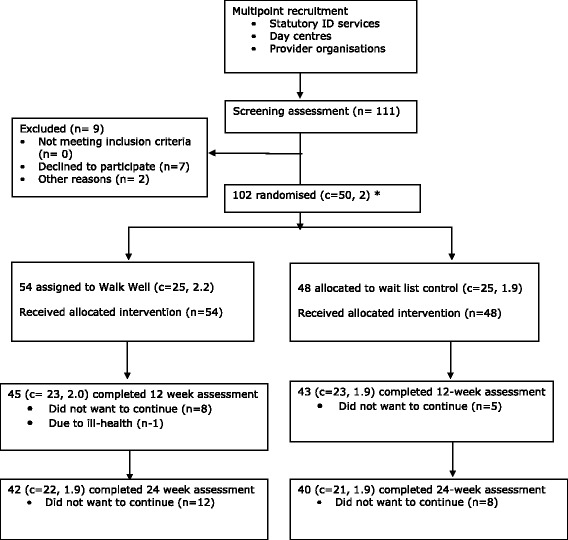
One hundred two participants in 50 clusters were randomised. 82 (80.4%) participants completed the primary outcome. 66.7% of participants lived in the most deprived quintile on the Scottish Index of Multiple Deprivation. At baseline, participants walked 4780 (standard deviation 2432) steps per day, spent 65.5% (standard deviation 10.9) of time sedentary and 59% percent had a body mass in the obesity range. After the walking programme, the difference between mean counts of the Walk Well and control group was 69.5 steps per day [95% confidence interval (CI) -1054 to 1193.3]. There were no significant between group differences in percentage time sedentary 1.6% (95% CI -2.984 to 6.102), percentage time in MVPA 0.3% (95% CI -0.7 to 1.3), BMI -0.2 kg/m(2) (95% CI -0.8 to 0.4) or subjective well-being 0.3 (95% CI -0.9 to 1.5).
This is the first published trial of a walking program for adults with intellectual disabilities. Positively changing physical activity and sedentary behaviours may require more intensive programmes or upstream approaches to address the multiple social disadvantages experienced by adults with intellectual disabilities. Since participants spent the majority of their time sedentary, home-based programmes to reduce sitting time may be a viable health improvement approach.
Current Controlled Trials ISRCTN50494254.
改变健康行为的项目已被视为减少弱势群体健康不平等现象的一种方式。本研究的目的是检验一项行为改变项目对增加成年智障人士步行量及减少久坐行为的有效性。
我们采用整群随机对照设计,从智障人士社区组织中招募18岁以上且未经常参与体育活动的参与者。评估在不了解分配情况的前提下进行。参与者群组被随机分配到“健康步行”项目组或为期12周的等待名单对照组。“健康步行”项目包括三次结合行为改变技巧的面对面体育活动咨询、为参与者及护理人员提供的书面资料,以及一个个性化的结构化步行计划。用加速度计测量的主要结果是基线至12周期间每日平均步数的变化。次要结果包括每日久坐时间的百分比、中度至剧烈身体活动(MVPA)时间的百分比、体重指数(BMI)以及主观幸福感。
50个群组中的102名参与者被随机分组。82名(80.4%)参与者完成了主要结果评估。66.7%的参与者生活在苏格兰多重贫困指数中最贫困的五分之一区域。基线时,参与者每日步行4780步(标准差2432),65.5%(标准差10.9)的时间处于久坐状态,59%的人体重处于肥胖范围。步行项目结束后,“健康步行”组与对照组平均步数的差值为每日69.5步[95%置信区间(CI)-1054至1193.3]。两组在久坐时间百分比1.6%(95%CI -2.984至6.102)、MVPA时间百分比0.3%(95%CI -0.7至1.3)、BMI -0.2kg/m²(95%CI -0.8至0.4)或主观幸福感0.3(95%CI -0.9至1.5)方面无显著组间差异。
这是首次发表的针对成年智障人士步行项目的试验。积极改变体育活动和久坐行为可能需要更强化的项目或上游方法来解决成年智障人士所经历的多重社会劣势。鉴于参与者大部分时间处于久坐状态,基于家庭的减少久坐时间项目可能是一种可行的改善健康的方法。
当前对照试验ISRCTN50494254