de Simone Giovanni, Roman Mary J, De Marco Marina, Bella Jonathan N, Izzo Raffaele, Lee Elisa T, Devereux Richard B
Hypertension Research Center, Federico II University, Naples, Italy (G.S., M.D.M., R.I.) Department of Translational Medical Sciences, Federico II University, Naples, Italy (G.S., M.D.M., R.I.) Department of Medicine, Weill-Cornell Medical College, New York, NY (G.S., M.J.R., R.B.D.).
Department of Medicine, Weill-Cornell Medical College, New York, NY (G.S., M.J.R., R.B.D.).
J Am Heart Assoc. 2015 Sep 28;4(10):e002309. doi: 10.1161/JAHA.115.002309.
We evaluated the relationship of aortic root dimension (ARD) with flow output and both peripheral and central blood pressure, using multivariable equations predicting ideal sex-specific ARD at a given age and body height.
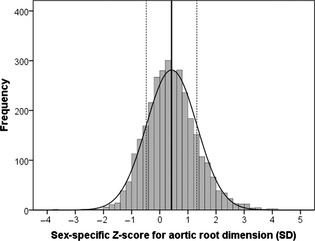
We measured echocardiographic diastolic ARD at the sinuses of Valsalva in 3160 adults (aged 42±16 years, 61% women) from the fourth examination of the Strong Heart Study who were free of prevalent coronary heart disease, and we compared measured data with the theoretical predicted value to calculate a z score. Central blood pressure was estimated by applanation tonometry of the radial artery in 2319 participants. ARD z scores were divided into tertiles representing small, normal, and large ARD. Participants with large ARD exhibited greater prevalence of central obesity and higher levels of inflammatory markers and lipids (0.05<P<0.0001). Stroke volume, heart rate, and both cuff and central diastolic blood pressure were progressively greater from small to large ARD (all P<0.0001). Pulse pressure was higher in small ARD (P<0.0001). In multivariable analysis, ARD z score was related positively to stroke volume, either cuff or central diastolic blood pressure, and negatively to pulse pressure. Large ARD was also independently correlated to higher waist circumference and percentages of neutrophils and plasminogen activator inhibitor-1 (all P<0.01).
Aortic root dilatation is associated with high diastolic blood pressure, high stroke volume, central fat distribution, and inflammatory status. In contrast, at a given diastolic blood pressure and stroke volume, aortic root dilatation is associated with lower pulse pressure and systolic blood pressure.
我们使用预测特定年龄和身高下理想性别特异性主动脉根部尺寸(ARD)的多变量方程,评估了主动脉根部尺寸与心输出量以及外周和中心血压之间的关系。
我们在强心脏研究第四次检查中,对3160名无冠心病病史的成年人(年龄42±16岁,61%为女性)进行超声心动图测量,获取其在主动脉瓣窦处的舒张期ARD,并将测量数据与理论预测值进行比较以计算z分数。在2319名参与者中,通过桡动脉压平式眼压测量法估算中心血压。ARD z分数被分为代表小、正常和大ARD的三分位数。大ARD参与者的中心性肥胖患病率更高,炎症标志物和血脂水平也更高(0.05<P<0.0001)。从小ARD到中ARD再到大ARD,每搏输出量、心率以及袖带舒张压和中心舒张压均逐渐升高(均P<0.0001)。小ARD的脉压更高(P<0.0001)。在多变量分析中,ARD z分数与每搏输出量、袖带或中心舒张压呈正相关,与脉压呈负相关。大ARD还与更高的腰围、中性粒细胞百分比和纤溶酶原激活物抑制剂-1独立相关(均P<0.01)。
主动脉根部扩张与高舒张压、高每搏输出量、中心脂肪分布和炎症状态相关。相反,在给定的舒张压和每搏输出量下,主动脉根部扩张与较低的脉压和收缩压相关。