Stakisaitis Donatas, Uleckiene Saule, Didziapetriene Janina, Valanciute Angelija, Mozuraite Raminta, Matusevicius Paulius
Laboratory of Carcinogenesis and Tumor Pathophysiology, Institute of Oncology, Vilnius University, Vilnius, Lithuania ; Mykolas Romeris University, Vilnius, Lithuania.
Laboratory of Carcinogenesis and Tumor Pathophysiology, Institute of Oncology, Vilnius University, Vilnius, Lithuania.
EXCLI J. 2014 Jun 5;13:667-87. eCollection 2014.
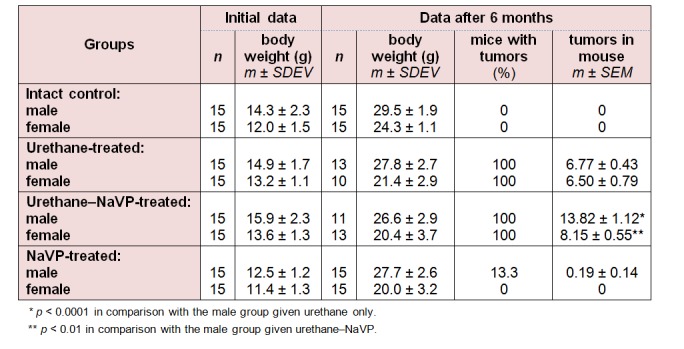
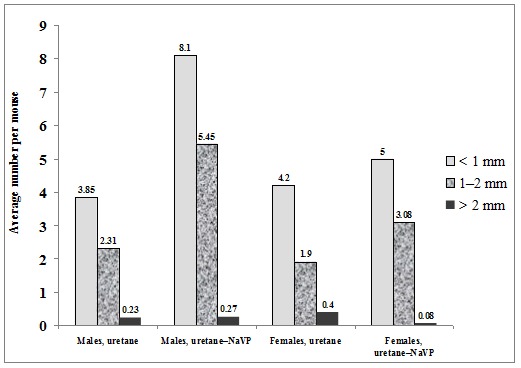
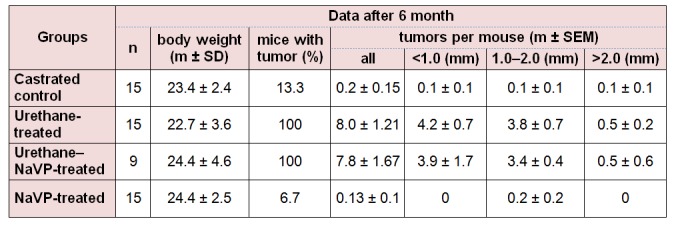
In the study, the possible effect of sodium valproate (NaVP) on urethane-induced lung tumors in mice has been evaluated. BALB/c mice (n = 120; 4-6 weeks old, both sexes) were used in the following groups: 1) urethane-treated, 2) urethane-NaVP-treated, 3) only NaVP-treated, 4) control. In the same groups, castrated male mice (n = 48) were investigated. Urethane was given by intraperitoneal injections 10 mg/mouse, twice a week, the total dose 50 mg/mouse. In NaVP-treated mice, the 0.4 % NaVP aqueous solution was offered to mice ad libitum. The duration of the experiment was 6 months. The number of tumors per mouse in urethane-NaVP-treated males was significantly higher than in those treated with urethane only (13.82 ± 1.12 vs 6.77 ± 0.43, p < 0.0001). No significant difference in the number of tumors per mouse was revealed while comparing the female urethane- and urethane-NaVP-treated groups (6.50 ± 0.79 vs 8.15 ± 0.55, p = 0.105). No difference in the number of tumors per mouse was found in urethane-NaVP-treated castrated males as compared with urethane-treated castrated males. However, in the urethane-NaVP-treated castrated males the number of tumors per mouse was significantly lower than in analogous non-castrated males (7.8 ± 1.67 vs 13.82 ± 1.12, p < 0.01). NaVP combined with urethane potentiates urethane tumorigenicity in BALB/c non-castrated but not in female and castrated male mice. These data indicate an important role of testosterone in the urethane-NaVP induced lung tumorigenesis.
在该研究中,已评估了丙戊酸钠(NaVP)对氨基甲酸乙酯诱导的小鼠肺部肿瘤的可能影响。BALB/c小鼠(n = 120;4 - 6周龄,雌雄均有)被分为以下几组:1)氨基甲酸乙酯处理组,2)氨基甲酸乙酯 - NaVP处理组,3)仅NaVP处理组,4)对照组。在相同分组中,对去势雄性小鼠(n = 48)进行了研究。氨基甲酸乙酯通过腹腔注射给予,剂量为10 mg/小鼠,每周两次,总剂量为50 mg/小鼠。在NaVP处理组小鼠中,给予0.4%的NaVP水溶液,任其自由饮用。实验持续时间为6个月。氨基甲酸乙酯 - NaVP处理的雄性小鼠每只小鼠的肿瘤数量显著高于仅用氨基甲酸乙酯处理的小鼠(13.82 ± 1.12对6.77 ± 0.43,p < 0.0001)。在比较雌性氨基甲酸乙酯处理组和氨基甲酸乙酯 - NaVP处理组时,未发现每只小鼠肿瘤数量有显著差异(6.50 ± 0.79对8.15 ± 0.55,p = 0.105)。与氨基甲酸乙酯处理的去势雄性小鼠相比,氨基甲酸乙酯 - NaVP处理的去势雄性小鼠每只小鼠的肿瘤数量未发现差异。然而,在氨基甲酸乙酯 - NaVP处理的去势雄性小鼠中,每只小鼠的肿瘤数量显著低于类似的未去势雄性小鼠(7.8 ± 1.67对13.82 ± 1.12,p < 0.01)。NaVP与氨基甲酸乙酯联合使用可增强氨基甲酸乙酯在BALB/c未去势小鼠中的致瘤性,但在雌性和去势雄性小鼠中则不然。这些数据表明睾酮在氨基甲酸乙酯 - NaVP诱导的肺部肿瘤发生中起重要作用。