Lushchak Volodymyr I
Department of Biochemistry and Biotechnology, Vassyl Stefanyk Precarpathian National University,Ukraine.
EXCLI J. 2014 Aug 26;13:922-37. eCollection 2014.
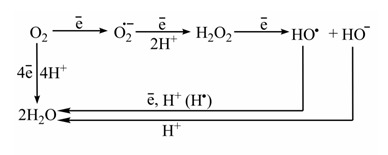
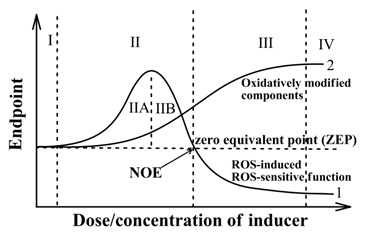
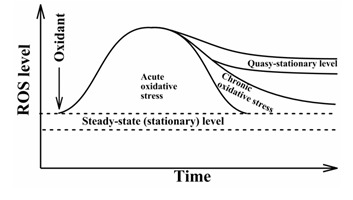
In living organisms production of reactive oxygen species (ROS) is counterbalanced by their elimination and/or prevention of formation which in concert can typically maintain a steady-state (stationary) ROS level. However, this balance may be disturbed and lead to elevated ROS levels called oxidative stress. To our best knowledge, there is no broadly acceptable system of classification of oxidative stress based on its intensity due to which proposed here system may be helpful for interpretation of experimental data. Oxidative stress field is the hot topic in biology and, to date, many details related to ROS-induced damage to cellular components, ROS-based signaling, cellular responses and adaptation have been disclosed. However, it is common situation when researchers experience substantial difficulties in the correct interpretation of oxidative stress development especially when there is a need to characterize its intensity. Careful selection of specific biomarkers (ROS-modified targets) and some system may be helpful here. A classification of oxidative stress based on its intensity is proposed here. According to this classification there are four zones of function in the relationship between "Dose/concentration of inducer" and the measured "Endpoint": I - basal oxidative stress (BOS); II - low intensity oxidative stress (LOS); III - intermediate intensity oxidative stress (IOS); IV - high intensity oxidative stress (HOS). The proposed classification will be helpful to describe experimental data where oxidative stress is induced and systematize it based on its intensity, but further studies will be in need to clear discriminate between stress of different intensity.
在生物体内,活性氧(ROS)的产生与它们的清除和/或形成的预防相互平衡,这通常能共同维持稳态(静止)的ROS水平。然而,这种平衡可能会被打破,导致ROS水平升高,即所谓的氧化应激。据我们所知,目前还没有基于强度的被广泛接受的氧化应激分类系统,因此本文提出的系统可能有助于解释实验数据。氧化应激领域是生物学中的热门话题,迄今为止,许多与ROS诱导的细胞成分损伤、基于ROS的信号传导、细胞反应和适应相关的细节已经被揭示。然而,研究人员在正确解释氧化应激的发展时经常遇到很大困难,尤其是在需要表征其强度的时候。在这里,仔细选择特定的生物标志物(ROS修饰的靶点)和一些系统可能会有所帮助。本文提出了一种基于强度的氧化应激分类方法。根据这种分类,在“诱导剂的剂量/浓度”与测量的“终点”之间的关系中有四个功能区:I - 基础氧化应激(BOS);II - 低强度氧化应激(LOS);III - 中等强度氧化应激(IOS);IV - 高强度氧化应激(HOS)。所提出的分类将有助于描述诱导氧化应激的实验数据,并根据其强度进行系统化,但还需要进一步的研究来明确区分不同强度的应激。