Saleh Farzana, Ara Ferdous, Mumu Shirin Jahan, Hafez Md Abdul
Department of Community Nutrition, Bangladesh University of Health Sciences (BUHS), 125/1 Darussalam Mirpur 1, Dhaka, 1216, Bangladesh.
BRAC Institute of Global Health, BRAC University, icddr,b campus, 68 Shaheed Tajuddin Ahmed Sharani, Mohakhali, Dhaka, 1212, Bangladesh.
BMC Res Notes. 2015 Sep 29;8:497. doi: 10.1186/s13104-015-1453-9.
The management of diabetes requires a fundamental change in the lifestyle of patients, and one of the important outcome criteria is the quality of life. We assessed the health-related quality of life (HR-QoL) and examined the factors associated with it in type 2 diabetes.
An analytical cross-sectional study was conducted among 500 type 2 diabetes patients (age >25 years and duration of diabetes >1 year). They were selected conveniently from the Out-Patient department of the Bangladesh Institute of Health Sciences Hospital. The HR-QoL was assessed using an adapted and validated Bangla version of the EQ-5D (© 1990 EuroQol Group. EQ-5D™) questionnaire. It has five domains: mobility, self-care, usual activities, pain/discomfort, and anxiety/depression and two levels (problem and no problem) on each dimension. The responses to the EQ-5D were further translated into a single summary EQ-5D index using the UK TTO value set.
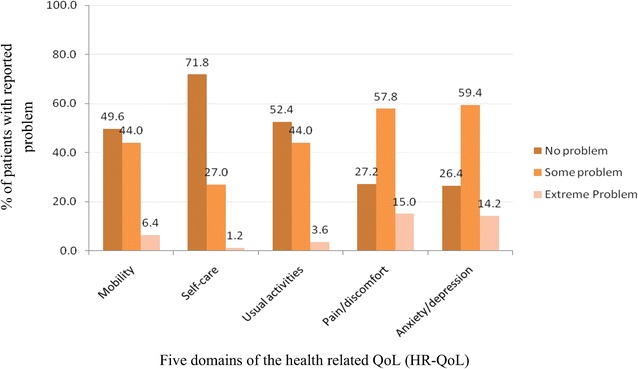
Of the patients, 50.2% were female, and 49.4% were aged >55 years. Only 28.4% had completed higher secondary education, and 50.8% were from lower-middle-income families. Around 78.8% either had overweight or were obese. About 50.4% had problems in mobility, 28.2% in self-care, 47.6% in usual activities, 72.8% in pain/discomfort, and 73.6% in anxiety/depression. Results of binary logistic regression analysis showed that age, gender, lower-middle income, and HbA1C were significantly (p < 0.05) associated with mobility. Self-care was significantly (p < 0.05) related to age, family history and duration of diabetes mellitus (DM). Gender, family history of DM, and lower-middle income had a significant (p < 0.05) association with usual activities. Pain was significantly (p < 0.05) associated with age, lower-middle income, and upper-middle income. Rural area, higher education, and HbA1C were significantly (p < 0.05) related to anxiety. Results of multiple linear regression analysis showed that age (p = 0.0001), female gender (p = 0.0001), and prescribed treatment (p = 0.048) were associated with the EQ-5D index.
The large majority (73%) of the patients had problems in pain/discomfort and anxiety/depression; 50% had problems in mobility and usual activities; and three in ten in self-care. Age, female gender, income, education, family history and duration of DM, and prescribed treatment are important factors that are associated with the HR-QoL in type 2 diabetes.
糖尿病的管理需要患者生活方式发生根本性改变,其中一个重要的结果标准是生活质量。我们评估了2型糖尿病患者的健康相关生活质量(HR-QoL),并研究了与之相关的因素。
对500例2型糖尿病患者(年龄>25岁,糖尿病病程>1年)进行了一项分析性横断面研究。他们是从孟加拉国健康科学研究所医院门诊部方便选取的。使用经过改编和验证的孟加拉语版EQ-5D(©1990欧洲生活质量研究组。EQ-5D™)问卷评估HR-QoL。它有五个领域:行动能力、自我护理、日常活动、疼痛/不适和焦虑/抑郁,每个维度有两个水平(有问题和无问题)。使用英国TTO值集将对EQ-5D的回答进一步转换为单个汇总的EQ-5D指数。
患者中,50.2%为女性,49.4%年龄>55岁。只有28.4%的人完成了高中教育,50.8%来自中低收入家庭。约78.8%的人体重超重或肥胖。约50.4%的人有行动能力问题,28.2%有自我护理问题,47.6%有日常活动问题,72.8%有疼痛/不适问题,73.6%有焦虑/抑郁问题。二元逻辑回归分析结果显示,年龄、性别、中低收入和糖化血红蛋白(HbA1C)与行动能力显著相关(p<0.05)。自我护理与年龄、家族史和糖尿病病程显著相关(p<0.05)。性别、糖尿病家族史和中低收入与日常活动有显著关联(p<0.05)。疼痛与年龄、中低收入和中上收入显著相关(p<0.05)。农村地区、高等教育和HbA1C与焦虑显著相关(p<0.05)。多元线性回归分析结果显示,年龄(p=0.0001)、女性性别(p=0.0001)和规定治疗(p=0.048)与EQ-5D指数相关。
绝大多数(73%)患者有疼痛/不适和焦虑/抑郁问题;50%有行动能力和日常活动问题;十分之三有自我护理问题。年龄、女性性别、收入、教育、糖尿病家族史和病程以及规定治疗是与2型糖尿病患者HR-QoL相关的重要因素。