Taki Sarah, Campbell Karen J, Russell Catherine G, Elliott Rosalind, Laws Rachel, Denney-Wilson Elizabeth
Faculty of Health, University of Technology Sydney, Sydney, Australia.
Interact J Med Res. 2015 Sep 29;4(3):e18. doi: 10.2196/ijmr.4323.
Internet websites and smartphone apps have become a popular resource to guide parents in their children's feeding and nutrition. Given the diverse range of websites and apps on infant feeding, the quality of information in these resources should be assessed to identify whether consumers have access to credible and reliable information.
This systematic analysis provides perspectives on the information available about infant feeding on websites and smartphone apps.
A systematic analysis was conducted to assess the quality, comprehensibility, suitability, and readability of websites and apps on infant feeding using a developed tool. Google and Bing were used to search for websites from Australia, while the App Store for iOS and Google Play for Android were used to search for apps. Specified key words including baby feeding, breast feeding, formula feeding and introducing solids were used to assess websites and apps addressing feeding advice. Criteria for assessing the accuracy of the content were developed using the Australian Infant Feeding Guidelines.
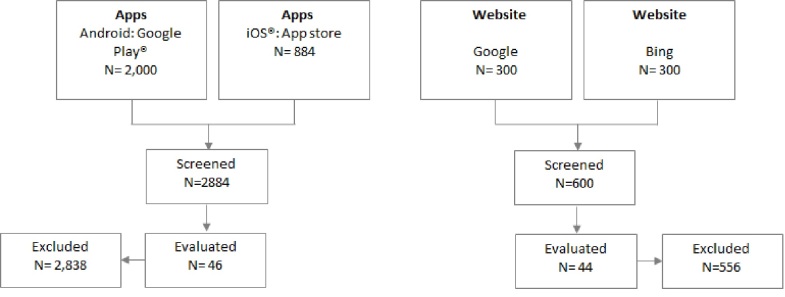
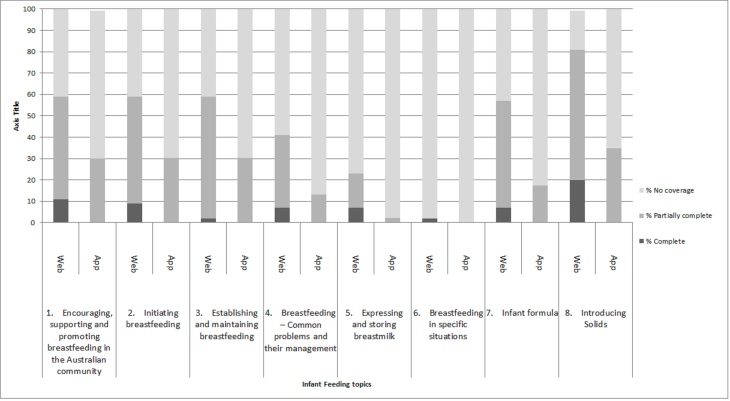
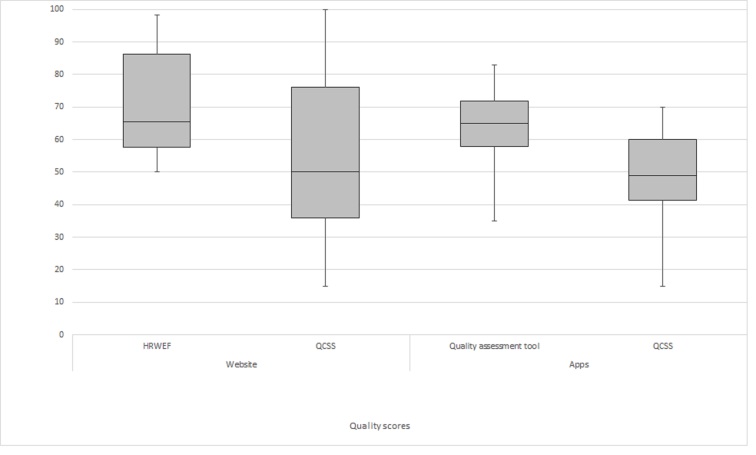
A total of 600 websites and 2884 apps were screened, and 44 websites and 46 apps met the selection criteria and were analyzed. Most of the websites (26/44) and apps (43/46) were noncommercial, some websites (10/44) and 1 app were commercial and there were 8 government websites; 2 apps had university endorsement. The majority of the websites and apps were rated poor quality. There were two websites that had 100% coverage of information compared to those rated as fair or poor that had low coverage. Two-thirds of the websites (65%) and almost half of the apps (47%) had a readability level above the 8th grade level.
The findings of this unique analysis highlight the potential for website and app developers to merge user requirements with evidence-based content to ensure that information on infant feeding is of high quality. There are currently no apps available to consumers that address a variety of infant feeding topics. To keep up with the rapid turnover of the evolving technology, health professionals need to consider developing an app that will provide consumers with a credible and reliable source of information about infant feeding, using quality assessment tools and evidence-based content.
互联网网站和智能手机应用程序已成为指导家长进行儿童喂养和营养的热门资源。鉴于婴儿喂养方面的网站和应用程序种类繁多,应评估这些资源中的信息质量,以确定消费者是否能够获取可信且可靠的信息。
本系统分析提供了关于网站和智能手机应用程序上婴儿喂养可用信息的观点。
使用一种开发的工具对婴儿喂养方面的网站和应用程序进行系统分析,以评估其质量、可理解性、适用性和可读性。利用谷歌和必应搜索澳大利亚的网站,同时使用适用于iOS的应用商店和适用于安卓的谷歌应用商店搜索应用程序。使用包括婴儿喂养、母乳喂养、配方奶喂养和引入固体食物等特定关键词来评估提供喂养建议的网站和应用程序。依据澳大利亚婴儿喂养指南制定了评估内容准确性的标准。
共筛选了600个网站和2884个应用程序,44个网站和46个应用程序符合选择标准并进行了分析。大多数网站(26/44)和应用程序(43/46)是非商业性的,一些网站(10/44)和1个应用程序是商业性的,还有8个政府网站;2个应用程序得到了大学认可。大多数网站和应用程序的质量评级较差。有两个网站的信息覆盖率为100%,相比之下,那些评级为中等或较差的网站覆盖率较低。三分之二的网站(65%)和近一半的应用程序(47%)的可读性水平高于八年级水平。
这一独特分析的结果凸显了网站和应用程序开发者将用户需求与基于证据的内容相结合的潜力,以确保婴儿喂养信息的高质量。目前消费者无法获取涉及多种婴儿喂养主题的应用程序。为了跟上不断发展的技术的快速更新,卫生专业人员需要考虑开发一款应用程序,该应用程序将使用质量评估工具和基于证据的内容,为消费者提供关于婴儿喂养的可信且可靠的信息来源。