Slama Imane Ben, Allali Fadoua, Lakhdar Touria, El Kabbaj Sarra, Medrare Lamyae, Ngeuleu Ange, Rkain Hanan, Hajjaj-Hassouni Najia
Department of Rheumatology, El Ayachi Sale University-Hospital, Sale, 11000, Morocco.
Laboratory of Information and Research on Bone Diseases (LIRPOS-URAC 30), Mohamed V University, Souissi Rabat, Rabat, 10000, Morocco.
BMC Musculoskelet Disord. 2015 Sep 29;16:268. doi: 10.1186/s12891-015-0718-8.
Clinical disease activity index (CDAI) and simplified disease activity index (SDAI) are useful tools for the evaluation of disease activity in patients with rheumatoid arthritis (RA), but have not been comparatively validated in Moroccan population. Therefore, this study was designed to assess validity and reliability of CDAI and SDAI in comparison to disease activity score-28 joints (DAS-28) in Moroccan patients with RA.
Patients with RA were included in a cross-sectional study. Patient characteristics and RA were collected. The disease activity was assessed by DAS-28, CDAI and SDAI. Patients were splitted into groups of remission, low, moderate and high activity on the basis of predefined cut-offs for DAS-28, CDAI, and SDAI. A Spearman correlation between composite indexes and inter-group comparison of the indexes were performed. Using DAS-28 as a gold standard, the Receiver operator characteristic (ROC) curve was used to assess the performance of a screening test at different levels.
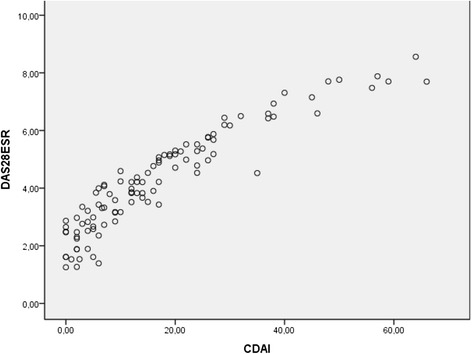
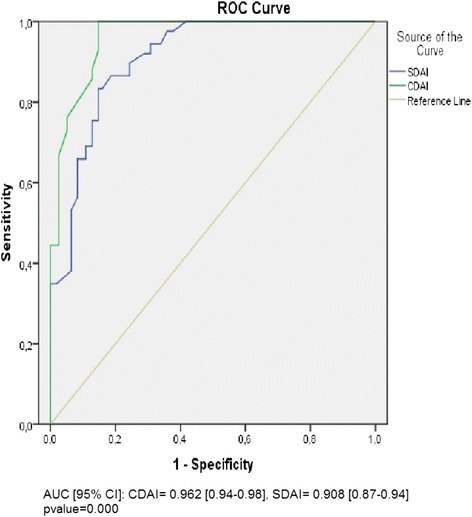
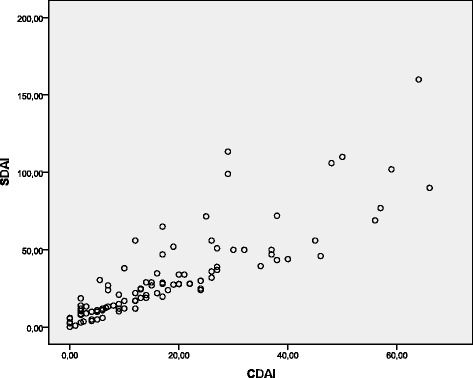
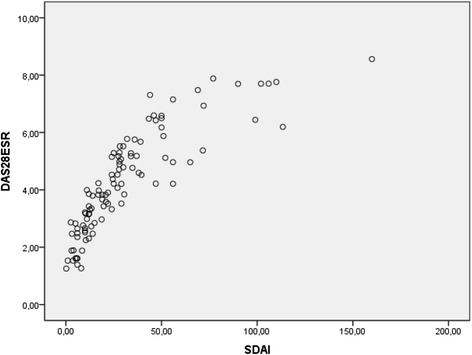
The study was conducted with 103 patients of female predominance (87.4%). Mean age was 49.7 ± 11.4 years. Median disease duration was in the order of 8 years [3-14]. There was an excellent correlation between DAS-28 and CDAI (r = 0.95, p <0.001), CDAI and SDAI (r = 0.90, p <0.001), and DAS-28 and SDAI (r = 0.92, p <0.001). There was a good inter-rater alignment between the DAS-28 and CDAI (Weighted kappa =0.743) and there was a moderate inter-rater alignment between the DAS-28 and SDAI (Weighted kappa =0.60), and also between the SDAI and CDAI (Weighted kappa = 0.589). There was no statistically significant difference between AUROC of CDAI and SDAI as both were performed equally well.
This study is the first Moroccan case study to compare the performance of both CDAI and SDAI in evaluation of disease activity in patients with RA. Our study showed that there was a direct and excellent correlation between DAS-28 and CDAI, and SDAI and DAS-28.
Our study shows a strong positive correlation between DAS-28, CDAI and SDAI. The cut-off values for CDAI and SDAI used in western literature can be used with minor modifications in Moroccan scenario.
临床疾病活动指数(CDAI)和简化疾病活动指数(SDAI)是评估类风湿关节炎(RA)患者疾病活动度的有用工具,但尚未在摩洛哥人群中进行比较验证。因此,本研究旨在评估CDAI和SDAI在摩洛哥RA患者中相对于28关节疾病活动评分(DAS-28)的有效性和可靠性。
将RA患者纳入一项横断面研究。收集患者特征和RA相关信息。通过DAS-28、CDAI和SDAI评估疾病活动度。根据DAS-28、CDAI和SDAI的预定义临界值,将患者分为缓解、低、中、高活动度组。对综合指标之间进行Spearman相关性分析,并对指标进行组间比较。以DAS-28作为金标准,使用受试者操作特征(ROC)曲线评估不同水平筛查试验的性能。
该研究共纳入103例患者,以女性为主(87.4%)。平均年龄为49.7±11.4岁。疾病持续时间中位数约为8年[3-14]。DAS-28与CDAI之间存在极好的相关性(r = 0.95,p <0.001),CDAI与SDAI之间(r = 0.90,p <0.001),以及DAS-28与SDAI之间(r = 0.92,p <0.001)。DAS-28与CDAI之间存在良好的评分者间一致性(加权kappa = 0.743),DAS-28与SDAI之间存在中等评分者间一致性(加权kappa = 0.60),SDAI与CDAI之间也是如此(加权kappa = 0.589)。CDAI和SDAI的曲线下面积(AUROC)之间无统计学显著差异,因为两者表现相当。
本研究是第一项比较CDAI和SDAI在评估摩洛哥RA患者疾病活动度方面性能的摩洛哥病例研究。我们的研究表明,DAS-28与CDAI之间以及SDAI与DAS-28之间存在直接且极好的相关性。
我们的研究表明DAS-28、CDAI和SDAI之间存在强正相关。西方文献中使用的CDAI和SDAI临界值在摩洛哥情况下稍作修改即可使用。