Gillman Anna, Muradrasoli Shaman, Mårdnäs Andreas, Söderström Hanna, Fedorova Ganna, Löwenthal Max, Wille Michelle, Daggfeldt Annika, Järhult Josef D
Section for Infectious Diseases, Department of Medical Sciences, Uppsala University, Uppsala, Sweden; Zoonosis Science Centre, Department of Medical Biochemistry and Microbiology, Uppsala University, Uppsala, Sweden.
Department of Biomedical Sciences and Veterinary Public Health, Swedish University of Agricultural Sciences, Uppsala, Sweden.
PLoS One. 2015 Sep 30;10(9):e0139415. doi: 10.1371/journal.pone.0139415. eCollection 2015.
Wild waterfowl is the natural reservoir of influenza A virus (IAV); hosted viruses are very variable and provide a source for genetic segments which can reassort with poultry or mammalian adapted IAVs to generate novel species crossing viruses. Additionally, wild waterfowl act as a reservoir for highly pathogenic IAVs. Exposure of wild birds to the antiviral drug oseltamivir may occur in the environment as its active metabolite can be released from sewage treatment plants to river water. Resistance to oseltamivir, or to other neuraminidase inhibitors (NAIs), in IAVs of wild waterfowl has not been extensively studied.
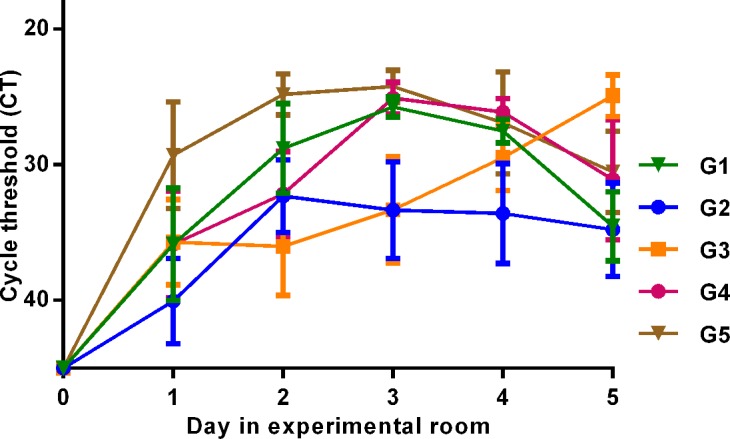
In a previous in vivo Mallard experiment, an influenza A(H6N2) virus developed oseltamivir resistance by the R292K substitution in the neuraminidase (NA), when the birds were exposed to oseltamivir. In this study we tested if the resistance could be maintained in Mallards without drug exposure. Three variants of resistant H6N2/R292K virus were each propagated during 17 days in five successive pairs of naïve Mallards, while oseltamivir exposure was decreased and removed. Daily fecal samples were analyzed for viral presence, genotype and phenotype.
Within three days without drug exposure no resistant viruses could be detected by NA sequencing, which was confirmed by functional NAI sensitivity testing. We conclude that this resistant N2 virus could not compete in fitness with wild type subpopulations without oseltamivir drug pressure, and thus has no potential to circulate among wild birds. The results of this study contrast to previous observations of drug induced resistance in an avian H1N1 virus, which was maintained also without drug exposure in Mallards. Experimental observations on persistence of NAI resistance in avian IAVs resemble NAI resistance seen in human IAVs, in which resistant N2 subtypes do not circulate, while N1 subtypes with permissive mutations can circulate without drug pressure. We speculate that the phylogenetic group N1 NAs may easier compensate for NAI resistance than group N2 NAs, though further studies are needed to confirm such conclusions.
野生水禽是甲型流感病毒(IAV)的天然宿主;其所携带的病毒具有高度变异性,为基因片段提供了来源,这些基因片段可与家禽或适应哺乳动物的IAV进行重配,从而产生新的跨物种病毒。此外,野生水禽还是高致病性IAV的宿主。野生鸟类可能会在环境中接触到抗病毒药物奥司他韦,因为其活性代谢产物可从污水处理厂排放到河水中。野生水禽IAV对奥司他韦或其他神经氨酸酶抑制剂(NAIs)的耐药性尚未得到广泛研究。
在之前一项针对野鸭的体内实验中,当野鸭接触奥司他韦时,一种甲型(H6N2)流感病毒通过神经氨酸酶(NA)中的R292K替换产生了奥司他韦耐药性。在本研究中,我们测试了在不接触药物的情况下,这种耐药性是否能在野鸭中维持。三种耐药H6N2/R292K病毒变体分别在五对连续的未接触过病毒的野鸭中连续传代17天,同时减少并去除奥司他韦暴露。每天对粪便样本进行病毒检测、基因分型和表型分析。
在不接触药物的三天内,通过NA测序未检测到耐药病毒,功能NAI敏感性测试也证实了这一点。我们得出结论,在没有奥司他韦药物压力的情况下,这种耐药N2病毒在适应性方面无法与野生型亚群竞争,因此没有在野生鸟类中传播的潜力。本研究结果与之前关于禽类H1N1病毒药物诱导耐药性的观察结果形成对比,后者在野鸭不接触药物的情况下也能维持。关于禽类IAV中NAI耐药性持久性的实验观察结果与人类IAV中所见的NAI耐药性相似,其中耐药N2亚型不会传播,而具有允许性突变的N1亚型在没有药物压力的情况下可以传播。我们推测,系统发育组N1的NA可能比组N2的NA更容易补偿NAI耐药性,不过还需要进一步研究来证实这一结论。