Pigeault Romain, Nicot Antoine, Gandon Sylvain, Rivero Ana
MIVEGEC, UMR CNRS, 5290, Montpellier, France.
CEFE, UMR CNRS, 5175, Montpellier, France.
Malar J. 2015 Sep 30;14:383. doi: 10.1186/s12936-015-0912-z.
The immune system of many insects wanes dramatically with age, leading to the general prediction that older insects should be more susceptible to infection than their younger counterparts. This prediction is however challenged by numerous studies showing that older insects are more resistant to a range of pathogens. The effect of age on susceptibility to infections is particularly relevant for mosquitoes given their role as vectors of malaria and other diseases. Despite this, the effect of mosquito age on Plasmodium susceptibility has been rarely explored, either experimentally or theoretically.
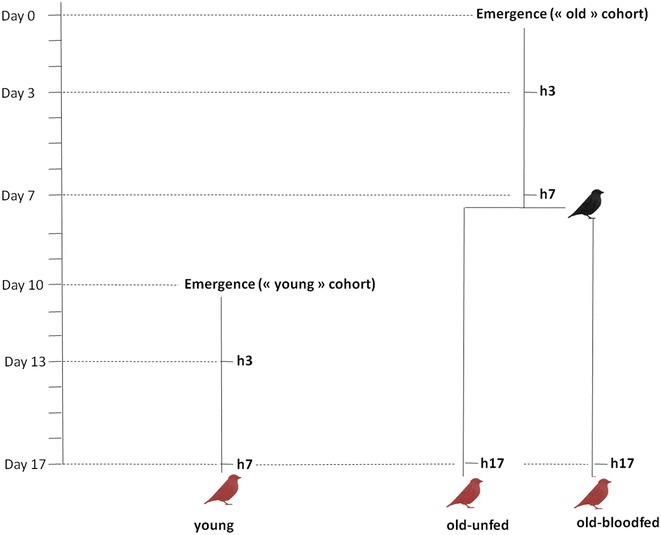
Experiments were carried out using the avian malaria parasite Plasmodium relictum and its natural vector in the field, the mosquito Culex pipiens. Both innate immune responses (number and type of circulating haemocytes) and Plasmodium susceptibility (prevalence and burden) were quantified in seven- and 17-day old females. Whether immunity or Plasmodium susceptibility are modulated by the previous blood feeding history of the mosquito was also investigated. To ensure repeatability, two different experimental blocks were carried out several weeks apart.
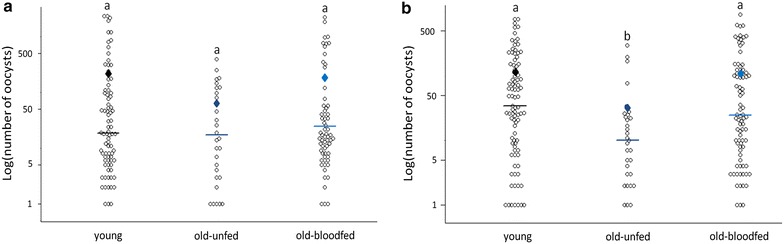
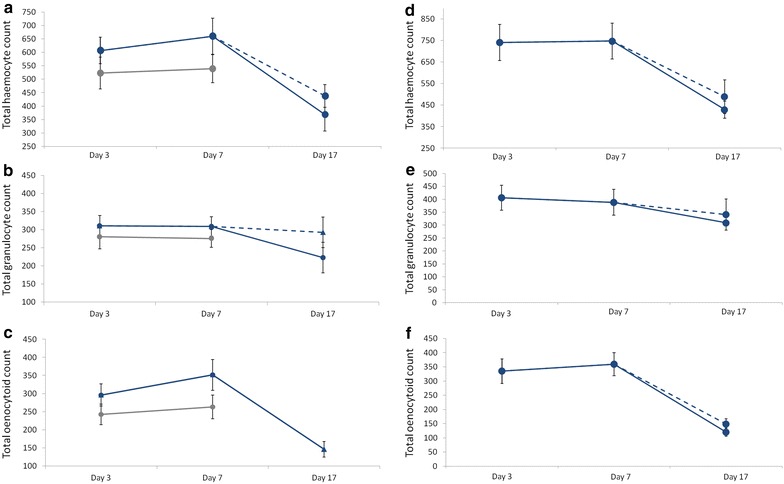
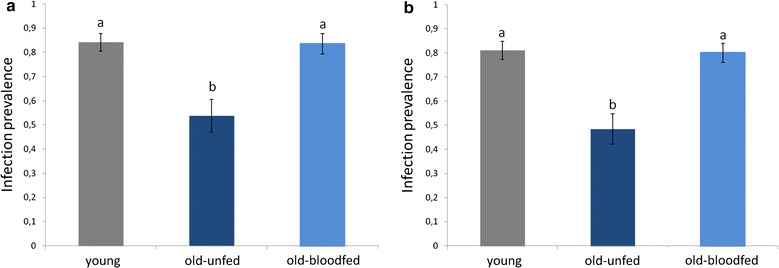
Haemocyte numbers decrease drastically as the mosquitoes age. Despite this, older mosquitoes are significantly more resistant to a Plasmodium infection than their younger counterparts. Crucially, however, the age effect is entirely reversed when old mosquitoes have taken one previous non-infected blood meal.
The results agree with previous studies showing that older insects are often more resistant to infections than younger ones. These results suggest that structural and functional alterations in mosquito physiology with age may be more important than immunity in determining the probability of a Plasmodium infection in old mosquitoes. Possible explanations for why the effect is reversed in blood-fed mosquitoes are discussed. The reversal of the age effect in blood fed mosquitoes implies that age is unlikely to have a significant impact on mosquito susceptibility in the field.
许多昆虫的免疫系统会随着年龄的增长而急剧衰退,这使得人们普遍预测,老龄昆虫应该比年轻昆虫更容易受到感染。然而,大量研究对这一预测提出了挑战,这些研究表明老龄昆虫对一系列病原体具有更强的抵抗力。鉴于蚊子作为疟疾和其他疾病的传播媒介,年龄对其感染易感性的影响尤为重要。尽管如此,无论是在实验上还是理论上,很少有人探究蚊子年龄对疟原虫易感性的影响。
使用禽疟原虫残疟原虫及其在野外的天然传播媒介库蚊进行实验。对7日龄和17日龄的雌性库蚊,同时测定其先天免疫反应(循环血细胞的数量和类型)和疟原虫易感性(感染率和感染负荷)。还研究了蚊子先前的吸血历史是否会调节免疫力或疟原虫易感性。为确保可重复性,相隔数周进行了两个不同的实验区。
随着蚊子年龄的增长,血细胞数量急剧下降。尽管如此,老龄蚊子对疟原虫感染的抵抗力明显高于年轻蚊子。然而,至关重要的是,当老龄蚊子之前吸食过一次未感染的血餐时,年龄效应会完全逆转。
这些结果与之前的研究一致,表明老龄昆虫通常比年轻昆虫对感染更具抵抗力。这些结果表明,蚊子生理结构和功能随年龄的变化在决定老龄蚊子感染疟原虫的可能性方面可能比免疫力更重要。文中讨论了为何在吸食过血的蚊子中这种效应会逆转的可能解释。吸食过血的蚊子中年龄效应的逆转意味着年龄在野外不太可能对蚊子的易感性产生显著影响。